


Helena’s Jason Gregory on Maximizing Yields: Data-Driven Fertilizer Strategies and Micronutrients for 2026.
As producers look toward the 2025 and 2026 growing seasons, they face a familiar and frustrating squeeze: fertilizer prices remain high while crop profits are harder to pencil out. In a recent conversation with Oklahoma Farm Report’s Maci Carter, Jason Gregory of Helena Agri-Enterprises emphasized that while the economic pressure is real, knee-jerk cost-cutting could do more harm than good.
Precision Over Panic: Navigating High Inputs with Data-Driven Fertility
** The Danger of the “Flat Cut”**
Gregory acknowledges the tight margins, noting that Helena’s local representatives are deeply embedded in their communities—going to church and school with the farmers they serve—and understand the financial stress firsthand. However, he warns against the common impulse to simply slash all inputs by a flat percentage, such as cutting everything by 30% to save money.
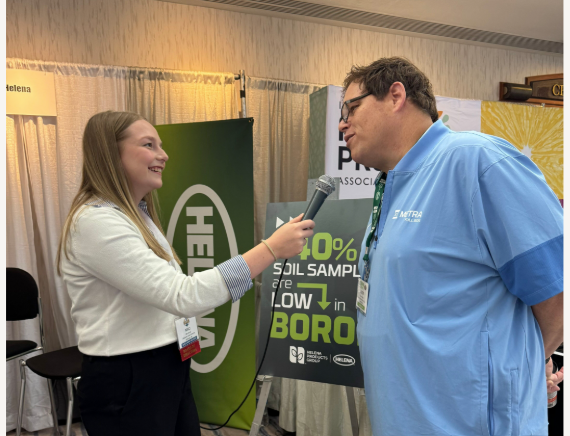
Instead, Gregory advocates for data-driven decisions anchored in soil sampling. “Maybe you don’t cut everything 30%,” Gregory explained. “Maybe you cut something 40%—this one nutrient, I’m going to cut it 40% because I can—but I better not cut this other nutrient at all, because that’s what’s really going to limit my yield on my farm”. Helena processes about 650,000 soil samples annually to help growers identify exactly which nutrients are expendable and which are critical.
Micronutrients: Essential, Not Optional
A major shift Gregory has observed is the rising importance of micronutrients. While growers have become proficient at managing macronutrients like potassium, soil tests in 2024 revealed that the top four deficiencies were sulfur, manganese, boron, and zinc.
Gregory, self-described as an “old fired football coach,” believes in pushing a crop to its maximum potential rather than settling. He argues that when crop prices are low, maximizing yield is the only way to recover revenue. Viewing micronutrients as merely “nice to have” is a mistake because a crop is only as good as its most limiting factor.
Timing is Everything: The “Spoon-Feeding” Approach
To get the most out of these investments, Gregory recommends “spoon-feeding” the crop—delivering nutrients exactly when the plant needs them most, rather than dumping them all upfront.
He uses boron as a prime example. While boron is important throughout the year, it is most critical during the reproductive stage. “If you had to really hone in… I’m going to make one application of boron,” Gregory said. “We think it’s more important to put it out over the top right before that plant goes into reproductive stage”.
New Technology on the Horizon
Helena is also launching new technologies to support this spoon-feeding strategy. Gregory highlighted a new product for the upcoming year called Metro Fullbor. This product utilizes controlled-release technology to deliver a small amount of boron to the plant each day over a period of weeks.
This steady supply stimulates pollen tube development, ensuring the plant is physiologically ready for efficient reproduction. Gregory compares this to feeding an athlete: just as a marathon runner can’t run a race on a single big breakfast, a high-yielding crop performs better with sustained nutrition over time.
The Playbook for 2026
Gregory’s final advice for growers preparing for the next season is simple: Make a plan and stick to it.
“Don’t just do things because that’s how you’ve always done it,” he advised. By utilizing analytics to determine the precise timing and mixture of applications—such as spiking in boron or zinc with starter fertilizers—growers can ensure every dollar spent contributes directly to yield.