AFIA Warns of Feed Ingredient Supply Chain Risks
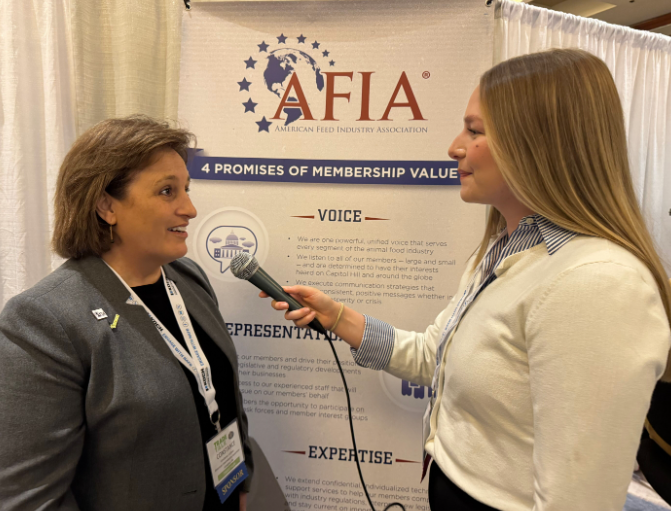
Feed manufacturers are navigating growing supply chain, regulatory, and sustainability pressures at a time when global trade dynamics and geopolitical risks are shifting rapidly, according to Constance Cullman, president and CEO of the American Feed Industry Association. Speaking about a new IFEEDER report, Cullman said the study revealed significant vulnerabilities in sourcing critical feed ingredients. “Over 73% of our vitamins come from China,” she explained, adding that such concentration makes it “very difficult to have any sort of resiliency in your supply chain when you have so much dependence on one source for such a critical ingredient.” The report also highlighted similar risks for amino acids, where China’s expanding production capacity is putting pressure on global producers.
Cullman said the findings prompted the industry to take a deeper look at how limited its flexibility really is. “It demonstrated for us that it’s very difficult to adjust rations to be able to compensate for the lack of availability of these synthetic vitamins and amino acids,” she said. While some adjustments are possible, she noted they are “not enough to be able to maintain our current production.” As a result, AFIA has elevated the issue to federal leaders, engaging the White House, the National Security Council, and Congress. Cullman said officials have shown interest in “designat[ing] these ingredients as critical infrastructure and as a national security concern,” while exploring policies to encourage onshoring, nearshoring, and friendshoring.
In her role as chair of the International Feed Industry Federation, Cullman said global sustainability debates are placing added pressure on the feed sector. She noted that calls to reduce consumption of animal-source foods “puts it right on the feed industry.” To address those concerns, the federation is working with international partners, including the UN Food and Agriculture Organization, on a dynamic systems mapping project. “We’re really looking to be able to sit down with those UN agencies, with detractors from animal ag, and find real solutions, rather than removing those important nutrients from people’s diet,” she said.
Cullman expressed optimism about innovation, particularly in ration development and animal health technologies. “I’m most excited about what we can do with ration development, as well as the innovations that companies are bringing forward to be able to help animals fight off diseases, decrease mortality, increase animal health and increase animal efficiency,” she said. She pointed to FAO research showing that improving mortality and feed efficiency offers meaningful sustainability gains, noting it was “surprising” that removing meat from diets ranked among “the least effective ways to achieve sustainability gains.”
On the regulatory front, Cullman said outdated approval pathways and slow innovation approvals are major concerns. “We’re currently far behind the rest of the world in bringing innovations to the market because of our antiquated regulatory system,” she said, emphasizing support for the Innovative Feed Act. She also underscored the importance of the Securing American Agriculture Act, saying that understanding supply chain risks “is the first step to being able to strengthen that supply chain.” Ultimately, Cullman said policymakers and the public must recognize that “the feed industry is a complex system” and “an integral part of our food chain,” extending far beyond just corn and soybeans.