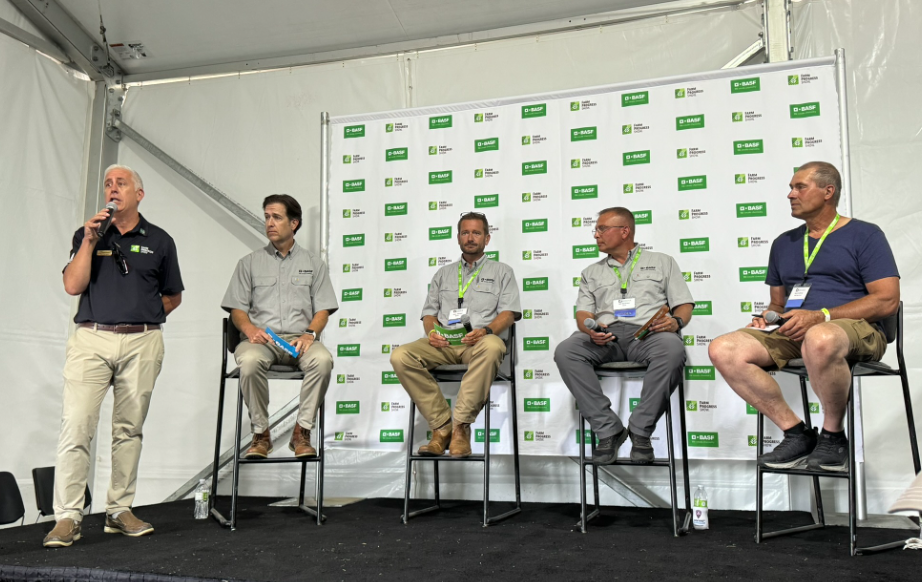
While viewing the latest in agricultural technology at the Farm Progress Show in Boone, Iowa, Oklahoma Farm Report’s Maci Carter talked with Albre Brown, BASF Technical Marketing Manager, about how BASF is helping producers grow healthier and more viable crops.
“At BASF, we really want to be the whole acre recommendation for your agronomic needs, from seed-to-seed treatment, we want to talk to you about fungicide and insecticide offerings,” Brown said.
BASF is a chemical company looking to do more with its formulations than generic modes of action. Brown said to treat pests on cotton, in particular, she recommends Sefina insecticides due to their unique mode of action that helps control both lygus and aphids. She said that cotton stressed by early-season drought becomes more susceptible to pest damage than plants with adequate water.
Revylok fungicide, just launched this year, is a FRAC group 3 and FRAC group 7 mode of action product, and research has shown that it increases root growth in treated plants which aids the plant in hot, dry conditions. Composed of Revysol and Xemium, It also helps with areolate mildew in cotton, but for target spot, Brown recommends Revytek fungicide, which is a group 3 mode of action that helps with all-acreage broad-spectrum disease control.
“We take pride in our local agronomic recommendations,” Brown said. “We want to spend time with you as a technical team, looking at your farm, who you are on your acreage, and your geography, so we can recommend products that are tailored to your specific needs.
“A big part of agriculture is agronomics which is local soil fertility, local environments, weather conditions, etc. At BASF, we are going to offer a recommendation for a specific acre, not just a broad recommendation that isn’t based on technical acumen.”
Brown is currently working on a heat-stress research trial to help producers reach their sustainability goals. The research team is using infrared monitors to look at heat stress response with crops that were treated with BASF fungicides and those that were not.
“You can see the difference in the drought-stress and heat-stress mitigation with the fungicide application,” she said. “It does this by helping with water retention and improving root growth, which is water uptake. They also reduce stress caused by diseases.”
The research has allowed the benefits of the fungicides to be monitored very acutely. They will ultimately increase yield, which lowers the carbon footprint of the producer to increase the sustainability of their on-fam practices.
BASF has a team devoted to sustainable practices. Published research can be found on the BASF sustainability website. Additional information can also be found at growsmartlive.com where local agronomists and BASF representatives can post what they are seeing.