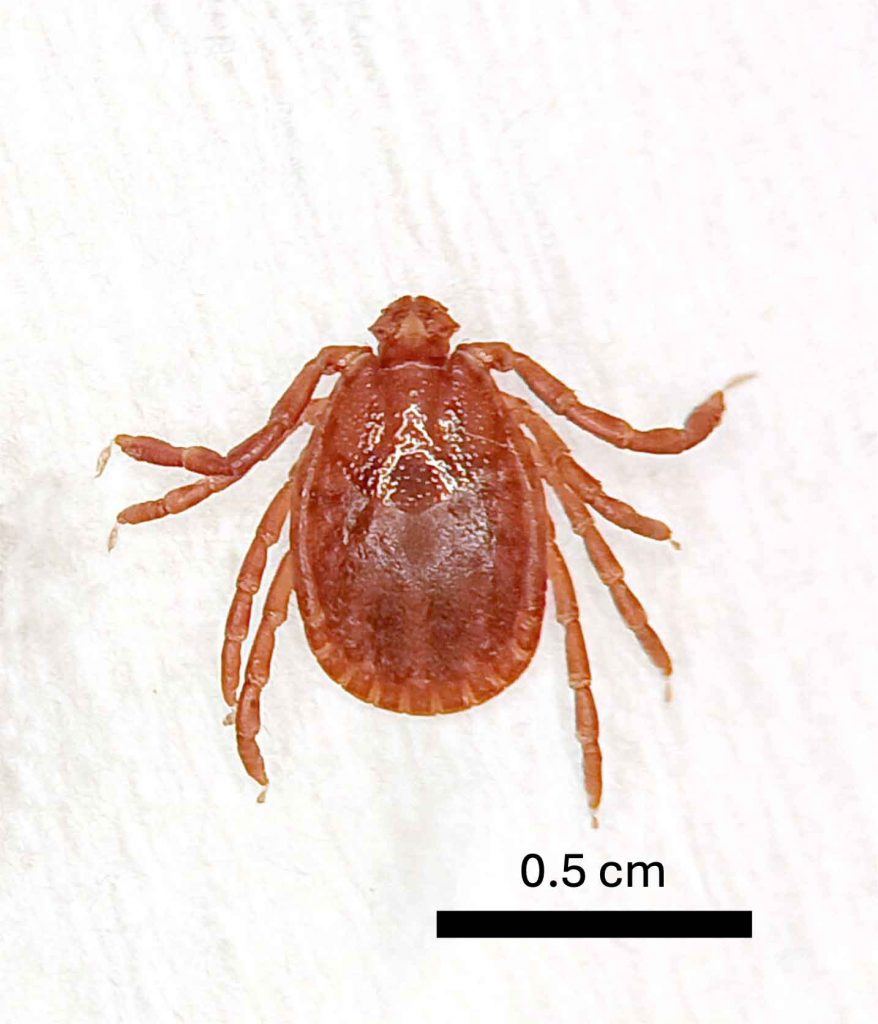
Originally from eastern Asia, the Asian longhorned tick, Haemaphysalis longicornis, has successfully established itself in countries around the world and now the United States. In the summer of 2024, the tick was identified on cattle in northeast Oklahoma counties.
The Asian longhorned tick parasitizes multiple species including humans, pets, livestock and wildlife, including birds. Relatively small in size when compared to native ticks, it is a three-host tick. It spends 90 percent of its life off the animal. Larva, commonly called seed ticks, feed on smaller animals. The nymph and adult stages then feed on larger animals including humans and cattle. The four most common animals this tick has been found on within the United States are dogs, white-tailed deer, raccoons and cattle.
The female tick can reproduce without mating and may produce 1,000 to 2,000 eggs at a time. A single female tick has the potential to create an established population in a newly introduced location in two to three weeks.
Severe infestations of the Asian longhorned tick in cattle can lead to death from the stress of excessive blood loss. Production losses including decreased milk production and growth are substantial. The Asian longhorned tick has also been recognized as a vector for multiple diseases of both humans and animals including viral, bacterial, and protozoan agents.
In other countries, the tick is the primary vector of Theileria orientalis Ikeda genotype in cattle. The protozoal agent causes clinical signs similar to anaplasmosis-anemia, fever, lethargy, jaundice and death. The mortality rate for cattle infected with T. orientalis Ikeda genotype varies from three to 90 percent. T. orientalis Ikeda genotype has been identified in the United States, but as of this time not in Oklahoma.
Beginning in late 2024, Oklahoma State University College of Veterinary Medicine researchers will launch a project to evaluate the status of the pathogenic T. orientalis genotype Ikeda and the Asian longhorned tickin cattle herds from Oklahoma and eastern border states. 30 to 50 farms have the opportunity to participate by submitting blood, ticks, or both.
Each participating herd will provide five to twenty blood samples. Herds that test positive to T. orientalis will be followed up with once or twice during the study. Ticks will also be collected from the animals. Tick trapping may also be performed. A maximum of 15 ticks will be analyzed from each sample collection site. All samples will be tested at the Oklahoma Animal Disease Diagnostic Laboratory.
Sampling supplies, shipping labels, and testing will be provided at no cost. Samples may be collected by veterinarians or producers with a consulting herd veterinarian. Blood submissions will process twice weekly with results emailed to the address on the submittal form and the consulting herd veterinarian. Anaplasma marginale testing will also be provided free of charge (up to 20 samples per herd) if anaplasmosis is suspected in the herd.
For more information or to participate in the study please contact a member of the research team:
Dr. Ruth Scimeca ruth.scimeca@okstate.edu, Dr. Rosslyn Biggs rosslyn.biggs@okstate.edu, or Dr. John Gilliam john.gilliam@okstate.edu.
By Rosslyn Biggs, DVM