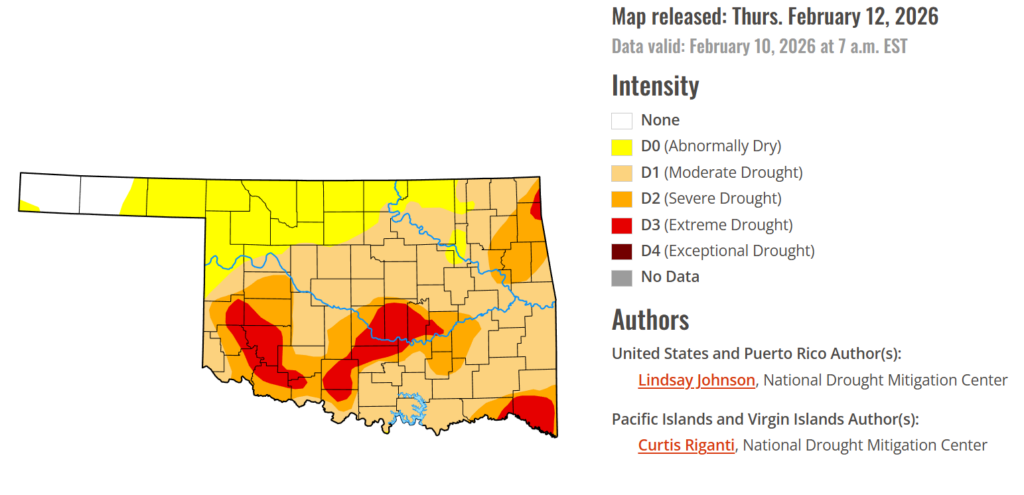
To view the latest Oklahoma drought map, CLICK HERE.
Oklahoma is heading deeper into late winter with drought still shaping the conversation, as dry soils and limited recharge continue to set the tone across much of the state. While exceptional drought isn’t on the map, nearly three-quarters of Oklahoma remains under some level of drought, with the most intense conditions expanding in the southwest and stressing rangeland, soil moisture, and streamflows. Looking ahead, near-normal precipitation is expected for much of the state in the short term, but continued dryness in parts of western and southwestern Oklahoma suggests drought concerns aren’t going away anytime soon.
According to the latest Oklahoma Drought Monitor report, exceptional drought remains at 0 percent, unchanged from the start of the calendar year.
Moderate drought to extreme drought conditions in the current period indicate that 74.11% of the state is affected by drought. Compared with last week’s 73.57%, drought conditions have this week.
Extreme Drought has also grown this week, now covering 10.23% of the state in southwestern Oklahoma, affecting mainly Pottawatomie, Seminole, McClain, Garvin, Stephens, Kiowa, Washita, Delaware, Ottawa, and parts of surrounding counties.
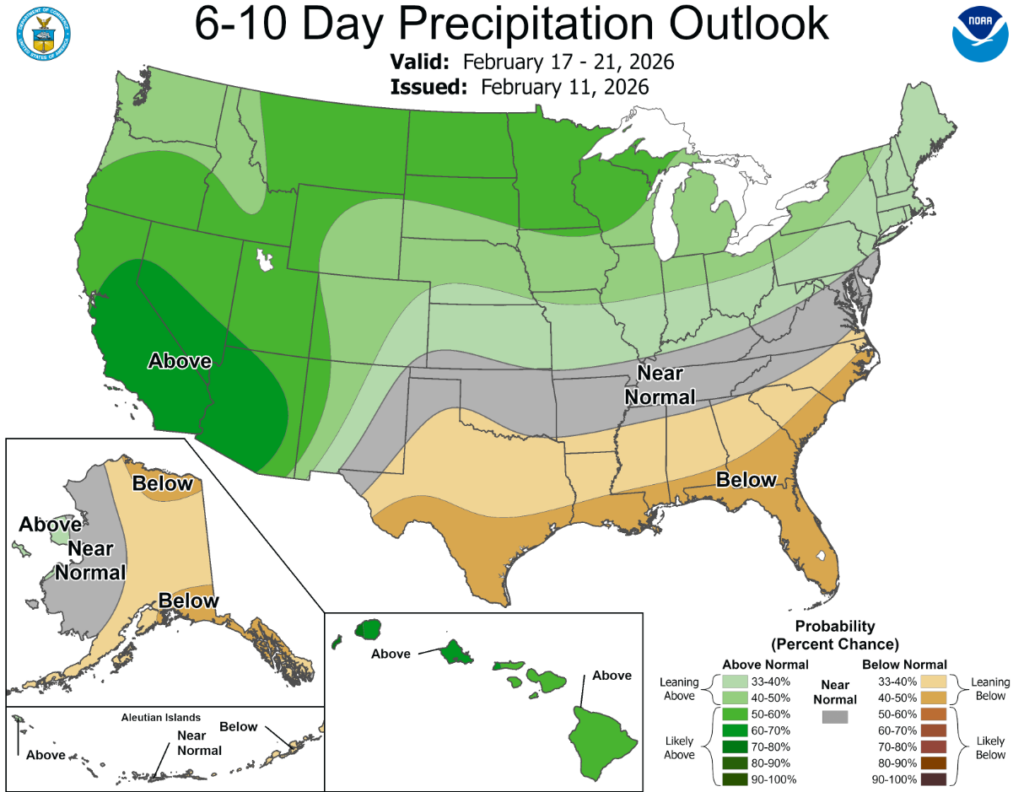
According to the 6-to-10-day precipitation outlook map, a large majority of Oklahoma is expecting near normal conditions, while far southwest Oklahoma is leaning below 33-40% chance of rain through February 21.
The Lower 48 states and Alaska only saw degradations this week. There was a strong east-to-west temperature gradient again this week, with below-normal temperatures across much of the East and above-normal temperatures across the West. Another week of localized precipitation that missed large portions of the country led to expanding precipitation deficits. Degradations were also scattered across the West, from the Pacific Northwest into the northern and central Rockies, including portions of Oregon, Idaho, Montana, Wyoming and western Colorado. Although some mountain snow fell, critically low snowpack with snow-water equivalent levels below the 15th percentile continues to dominate much of the region and support ongoing drought expansion. Across the High Plains and into the western Midwest, one-class degradations followed another mostly dry week. In the Northeast, despite colder-than-normal temperatures, a continued lack of meaningful precipitation contributed to worsening conditions in parts of Pennsylvania and southern New England. In the South, from the eastern southern Plains of Oklahoma and Texas eastward into the Lower Mississippi Valley and the western Carolinas. Despite scattered precipitation in some locations, short- to mid-term precipitation deficits continue to grow, with drying soils and low streamflows supporting intensification. In southern Georgia and Florida, fire danger continues to rise, with parts of Florida reporting Keetch-Byram Drought Index values between 500 and 700.
In Hawaii, strong trade winds brought heavy precipitation and wind to the windward slopes of Molokai, Maui and the Big Island, where 4 to 10 inches of rain fell at lower elevations and snow at higher elevations, supporting one-class improvements in those areas.
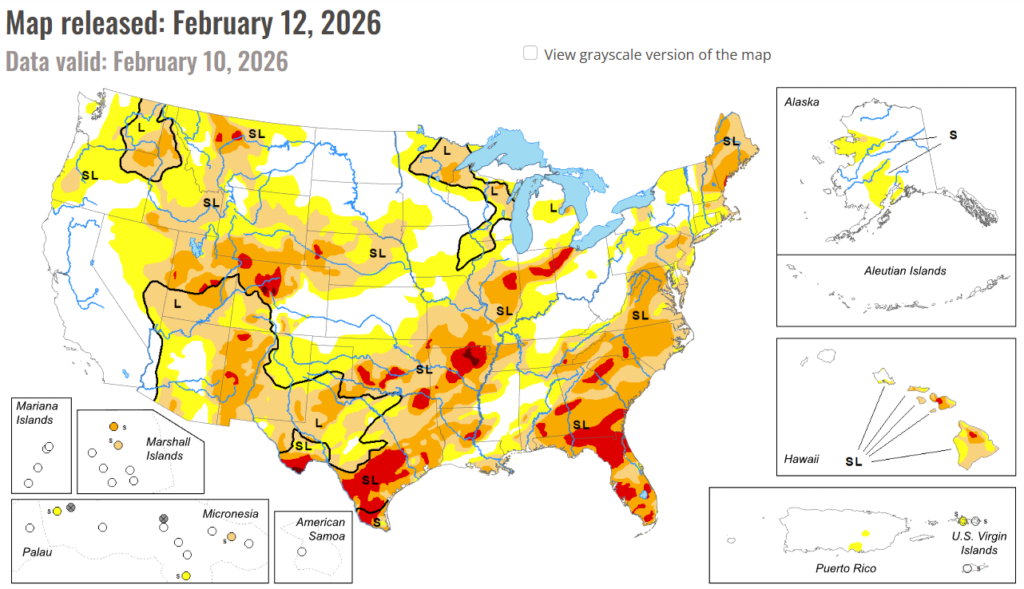
In the Southern Plains: Drought conditions across the South continued to deteriorate this week, as much of the region received little to no meaningful precipitation. Most areas recorded below 50 percent of normal rainfall, with many locations under 25 percent of normal. Portions of middle and northeastern Tennessee received 0.5 to 1 inch of precipitation, but amounts were insufficient to offset ongoing 30- to 90-day precipitation deficits. Degradations occurred across the southern Plains into the Lower Mississippi Valley as short- to mid-term precipitation deficits continue to grow across Louisiana, Arkansas and portions of Texas and Oklahoma, with many areas 2 to 6 inches below normal over the past few months. Soil moisture percentiles remain below normal across much of the region and are particularly low in central Louisiana, southern Arkansas and parts of western Oklahoma and South Texas. Streamflows in several basins continue to run below seasonal averages, with some gauges in low percentiles following weeks of limited recharge. In Deep South Texas, long-term dryness continues to intensify. From August 14, 2025, through February 10, 2026, Rio Grande City ranks as the fifth warmest and third driest on record dating back to 1928, while McCook ranks as the second warmest and sixth driest since 1942 according to NWS and NOAA. A nearby Texas Mesonet site near Hebbronville recorded just 3.81 inches over the past 180 days, and another Mesonet site along the Starr and Jim Hogg County line recorded 11.5 inches, with only 0.33 inches falling during December and January combined. Persistent six-month precipitation deficits and continued warmth reinforced long-term hydrologic stress across the lower Rio Grande Valley.
In the High Plains: The High Plains saw little to no meaningful precipitation this week, with most of the region receiving less than 25 percent of normal and many locations at or below 5 percent of normal precipitation. Any snowfall was light and offered minimal liquid-equivalent benefit. In eastern Wyoming and eastern Colorado, precipitation deficits continue to deepen with soil moisture percentiles declining, and recent above-normal temperatures led to drying where snow cover is limited. This led to expansion of moderate (D1) and severe drought (D2) across parts of eastern Wyoming and Colorado into the southwest South Dakota, the Nebraska Panhandle and the western Nebraska Sandhills. Similarly, growing short- to medium-term precipitation deficits, below-normal soil moisture percentiles and elevated evaporative demand led to the introduction of extreme drought (D3) to Nebraska’s Panhandle. Eastern Nebraska also saw the expansion of abnormal dryness (D0) as the lack of precipitation has led to drying conditions. Across Kansas, degradations occurred primarily in the northwest, south and along the Missouri border in eastern Kansas following another dry week which, like the rest of the region, added to the growing precipitation deficits and drying soil moisture.
In the West: Precipitation across the West this week was light and uneven. Most low-elevation areas in California, Nevada, Arizona, Utah and western Colorado received little to no measurable liquid precipitation, with seven-day totals generally below 0.25 to 0.50 inches. Mountain snow did fall in portions of the northern Rockies and Pacific Northwest, but accumulations were locally light and patchy. Snowpack and Snow Water Equivalent (SWE) percentiles remain well below normal at many SNOTEL sites: much of Oregon, Washington, Idaho, Montana, Wyoming and western Colorado show SWE values in the lowest 15th percentile, with numerous locations in the single digits for this time of year. Temperatures were above normal across broad areas of the interior West, especially in the Great Basin, central and eastern Wyoming, and northern Colorado, where daytime highs ran 5 to 15 degrees above average at times. These warmer temperatures limited snow accumulation in some basins and contributed to surface drying where snow cover was sparse or absent.
To view the 6-10 Day Precipitation Outlook Map, click here.
To view the 6-10 Day Temperature Outlook Map, click here.
To view the Monthly Drought Outlook Map, click here.