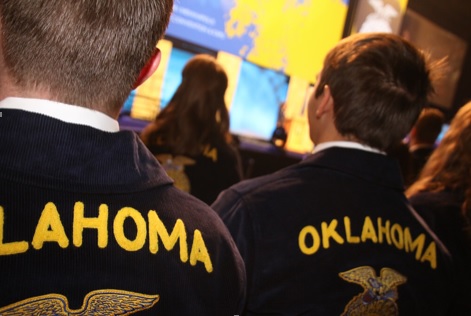
By: Dianna Butler – the current and former wearers of that blue corduroy jacket. National FFA Week is upon us, which brings to mind the FFA programs across the state. However, most of us do not realize that the National FFA is under fire from political activists, and possibly others, demanding transparency in policies and business transactions. As with any organization that achieves national recognition, the National FFA now has drawn criticism from the group calling itself, “Save Oklahoma Farms and Ranches,” who does have its own Facebook page. According to another group, “Hands Off My Land,” which can be followed on State Representative District 61 Casey Murdock’s Facebook page or on its own Facebook page, the “Save Oklahoma Farms and Ranches” group calls FFA a “complete joke” and accuses the FFA of “enslaving our future.” Yet another group, the “Save Oklahoma Farms and Ranches: The Herd,” which deems itself as “the gathering place for the HERD of Political Animals,” also calls the National FFA organization a “complete joke” and hurls accusations at the organization of “not even being aware of what they are putting in the ground.” According to AGDAILY, House Republicans are demanding records from the National FFA Organization about its partnership with Syngenta Group, arguing the agribusiness’ Chinese state ownership and the youth groups’ diversity initiatives could jeopardize FFA’s mission – and, potentially, its tax-exempt status. Exactly what is the FFA’s mission? The national organization puts forth as its mission: “Growing the next generation of leaders who will change the world. FFA makes a positive difference in the lives of students by developing their potential for premier leadership, personal growth and career success through agricultural education.” This, at first, seems to be a great amount of educational rhetoric, but these accusations force an introspection of the National FFA.
FFA, no doubt, is the largest youth organization in the nation. To date, there are 1,042, 245 FFA members in 9,407 chapters in all 50 states, Puerto Rico, and the U.S. Virgin Islands, and indeed, the ag ed curriculum is as diverse and varied as the organization itself revolving around but not limited to a three-tier model of instruction: 1) Classroom/Laboratory Instruction (contextual learning) 2) Supervised Agricultural Experience Programs (work-based learning) and 3) Student leadership organizations (National FFA Organization, National Young Farmer Educational Association, and National Post-secondary Agricultural Student Organization.)
Meanwhile, an old adage, “back at the ranch” comes to mind. Taking the large leap from the National FFA Organization to the local public schools across the state, does bring about the question– “What is actually being taught in the Ag Ed Classroom? That seems like a question that could be easily answered but is not so! As with anything, the instruction actually lies, “Where the rubber meets the road.” Local Ag Ed instructors are apparently some kind of genies as they are required to adhere to the National and State Ag Ed curriculum/requirements all the while meeting the expectations of local school boards and their communities. They must jump through the hoops of agri-science to ag business to animal science and onward to ag communication, to leadership development, to plant science, to farm shop skills, and thus and so attempting to meet the standards of this diversified curriculum.
The FFA is not just about welding and show animals. The FFA changed its name from “Future Farmers of America” to the “National FFA Organization” in 1988 to reflect the massive expansion and
diversity of the agriculture industry beyond traditional farming, recognizing careers in science, technology, business, and more, while still adhering to its agricultural roots. While the National FFA grapples with activists and politics, local Ag Ed Instructors discover that they must be good mechanics, above-average welders, be able to change a trailer tire with Olympic speed and accuracy, be able to perform in extreme heat as well as snow and ice—there’s diversity for you,—and back that stock trailer with the precision of a brain surgeon while under the scrutiny of an audience of bystanders, and yet, rival Bill Gates in computer skills?
As with any company, it is only as good as its end product. With that in mind, I contacted several “end product” individuals to decipher if, indeed, their time in FFA had yielded them any productive skills that carried them into work and/or their careers. According to Josh Haven, Vice President of Security State Bank in Cheyenne, “FFA taught me the importance of networking. I learned the valuable lessons of building relationships not only with community members but beyond. I developed and honed my ag business skills and learned how to communicate not only as a presenter but also one-on-one with individuals. I use those skills every day.”
Phil Thomas, the Director of Radiology at Roger Mills County Hospital, says that FFA taught him “pressure is a privilege.” He expounds on that with, “My time at Woodward Regional Hospital—I was told I was hired because they believed in my ability to perform my job at the highest possible level.” He states in his ag class he learned three important lessons that he still uses today: 1) Practice makes perfect 2) Communication skills are key to success and 3) Show up and show out! Be confident in yourself and in the skills you have acquired.”
Congressman Frank Lucas credits FFA with his development and honing of his leadership skills and his public speaking skills. He states, “Without the FFA, I could have never successively run for office. I learned valuable research skills and presentation skills, but most importantly, I honed the ability to address those public speaking judges effectively while presenting my positon on my speech topic, much like I do in Congress today.” In addition, Lucas says that “FFA exposed me to the world.” He recalls that he would have never even been on the OSU campus without FFA opening up that avenue of experience for him.
Chrystal Allen Marshall, independent cattle producer and co-owner of JL Allen Cattle Company, believes that FFA embedded into her the ag business skills she uses every day. “FFA taught me how to network with other ag people who can give me valuable up-to-date ag information about current events. I developed great communication skills through my FFA Public Speaking Class as well as learning animal science and marketing skills. I think that ag class taught me more life skills than any other class, and those skills help me with my daily ranching responsibilities.”
Lia Hillman, classroom teacher, explains it very well: “Showing animals taught me responsibility, work ethic, and pride. I developed my photography and writing skills in FFA –skills I still use every day. FFA helped me find my voice and instilled confidence into me, and I try to pass that on to my students each day.” She also says that FFA helped her to understand diversity in that every person has different strengths and passions.
According to Bray Haven, Executive Vice President of Cattlemen’s Congress and Principal of BLH Consulting Government Affairs, “There is no other organization or program that better prepares you for
life than the FFA. I learned valuable management skills that I use every day in my adult life. Also, the contacts I made not only throughout the state but also nationally have proven to be invaluable.”
FFA, yes, a National and State Organization—but it is the local chapter in the public school ag classroom where leadership, communication, financial literacy, work ethic, record keeping, entrepreneurship, community respect, and community responsibility is not just taught but modeled. It gives hands-on experience and teaches students how to win humbly and how to lose graciously. FFA is a pipeline that provides a steady stream to the workforce. Look around you, those former blue jacket wearers are your doctors, lawyers, legislators, ag producers—they are your medical staff, your school teachers, your pharmacists, your police officers. They walk among us, but they all discovered a secret—that blue jacket and those magical FFA shoes can take you anywhere.