
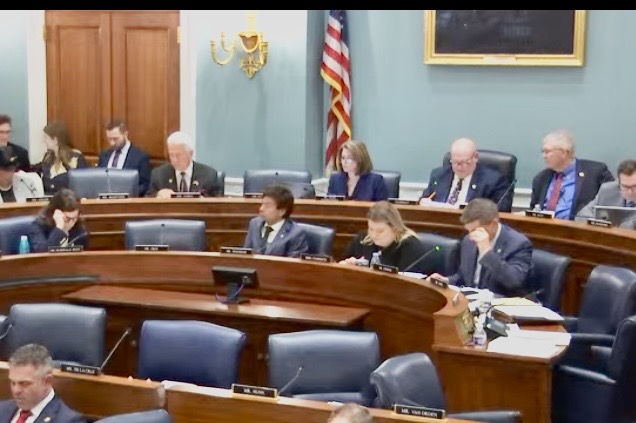
On Tuesday evening the House Ag Committee, under the leadership of Chairman GT Thompson of Pennsylvania, began the work of marking up the “Farm, Food, and National Security Act of 2026” which has also been dubbed as Farm Bill 2.0. Many key provisions of farm policy in the US were addressed last summer- including reference prices that were updated for the federal farm safety net found in Title One- as well as work in Conservation, Crop Insurance and Nutrition. The first two hours plus of the business meeting of the Committee allowed each member of the Committee to speak for up to five minutes to offer their view of the bill.
Among those opening comments- Oklahoma Congressman Frank Lucas, the elder statesman of the Committee, spoke of the importance of this reauthorization of farm policy, “We have an opportunity today to vote for a bill that goes much further than just disaster recovery. The bill before us is eight hundred and two pages of policy that is aimed at making life better back home. To name just a few provisions among many, this bill reauthorizes a suite of critical research, rural development, and credit programs that will invest into our communities and create rural resiliency for decades to come.
“This bill also focuses on expanding and investing into market access programs abroad, and it ensures that voluntary conservation programs continue to reflect the needs of producers. The bottom line is – all of these programs under review today make a difference. I want everyone in this room, and those who are listening online, to be reminded just how much this bill will impact you, your neighbors, and our friends across the country.“
The bill, introduced Feb. 13, is 802 pages long, and deals with most titles in the farm bill, which was last passed in 2018. The One Big Beautiful Bill Act addressed some of the major provisions of the commodity title and nutrition programs, along with some adjustments to crop insurance. You can review the main provisions of the skinny farm bill by clicking here.
Among many other provisions, the bill:
-Reauthorizes the Conservation Reserve Program and keeps the cap on acres at 27 million.
-In the credit title, the bill would increase loan limits for guaranteed operating loans to $3 million and guaranteed ownership loans to $3.5 million. Direct ownership loans would be increased to $850,000 while direct operating loans would be increased to $750,000. The bill also includes provisions meant to speed up approval times, especially for certified and preferred guaranteed lenders.
-Transfers the Food for Peace international food aid program from the U.S. Agency for International Development to USDA and reserves 50% of the resources in the program for the purchase and shipping of U.S. food.
-Increases access to the Real Energy for America Program.
-Increases requirements for reporting farmland ownership by foreigners.
-Increases funding for farm export promotion programs.
-Ties the Supplemental Nutrition Assistance Program (SNAP) to the administration’s Make America Healthy Again agenda.
-Integrates the ReConnect program that furnishes loans and grants for rural broadband internet construction into the farm bill broadband program.
-Allocates research funding for specialty crops, innovation and crop insurance.
-Addresses state laws requiring standard living conditions for animals providing meat and eggs, such as California’s Proposition 12, by stating that states and localities cannot require living conditions outside their jurisdiction.
-Allows auction owners to invest in packing facilities.
-Adds the Agriculture secretary to the Committee on Foreign Investment in the United States.
-Addresses Tetrahydrocannabinol (THC) concentration in hemp
-Requires uniform pesticide labeling by stating EPA has the sole authority for making safety finding for pesticides, blocking states from implementing tougher standards such as California.
Most of the votes on amendments to the Chairman’s mark followed party lines. Several votes had a recorded vote requested and Thompson will hold those votes all at once at the end of the markup. One exception to the party line trend was a proposed amendment from Democratic Congresswoman Sherice Davids of Kansas, who offered an amendment specifically aimed at winter wheat as a cover crop– she presented her amendment and then was ready to withdraw it when Chairman Thompson interrupted her by saying that “you can do that if you want- but I am prepared to support it.” As laughter rippled through the room- the Kansas lawmaker quickly decided she would leave the amendment on the floor- it was voted on and approved without any nays.
Another amendment offered by a Democratic member- Gabe Vasquez of New Mexico would require a study on the impact on US Beef Cattle producers of purchases of imported beef from Argentina. That measure was passed on a voice vote- and it ended consideration of multiple amendments for Title Three- the Trade title.
Chairman Thompson ended the night there- adjourning the Committee just ahead of midnight eastern time and promising a call to order on Wednesday morning at 8 AM.