
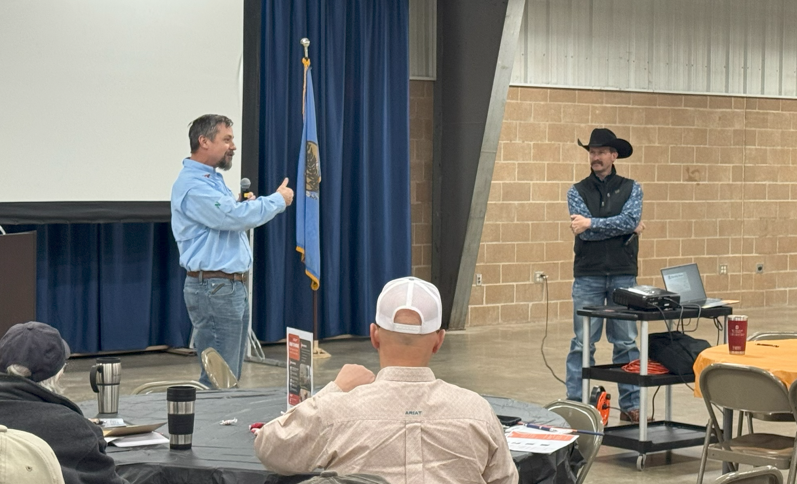
Maci Carter visited with Dr. Brian Arnall and Brian Pugh, both extension specialists with Oklahoma State University, following the Oklahoma Central Cattle Conference, where the two led a jointly delivered session built as a conversation rather than a formal presentation. Arnall explained that the idea came from wanting to mirror the kind of back-and-forth dialogue producers often appreciate, noting that he and Pugh “will go back and forth” naturally and that the format allowed them to cover a wide range of forage health and fertility topics in a practical way.
Arnall said the discussion stretched well beyond traditional fertility, drawing heavily on Pugh’s experience with pasture, range, and weed management. He explained that their session addressed “everything from hay management, pasture management, weeds, common weeds,” and how producers across central Oklahoma manage those challenges through “herbicide, fire, grazing and fertility.” The interactive crowd helped drive the conversation, allowing them to adapt recommendations to real-world scenarios producers are facing.
When asked how they balance sustainability with economic realities, Arnall emphasized that economics guide every recommendation he makes. “Any recommendation I make to a producer, I try to make sure that it has sound economic backing,” Arnall said, adding that advising strategies that cost more than they return is “a disservice to producers.” He stressed that forage systems in Oklahoma typically operate on tight margins, making efficient input use critical even when cattle markets are strong.
Arnall also pointed to long-term data showing why efficiency matters, explaining that in normal markets “it’s only the top third of producers that are actually in the black.” He said this reality makes it essential to “pinch a few pennies here or there,” because today’s strong cattle prices will not last forever. Pugh agreed, noting that producers often maintain stocking rates learned decades ago, even as input costs rise and environmental stress increases.
Addressing the mindset of “grass doesn’t matter when cattle are worth this much,” Arnall said the issue often comes back to stocking pressure rather than fertility alone. He warned that over time, running cattle harder than the land can handle weakens forage stands and limits recovery. Pugh echoed that concern, explaining that declining inputs combined with drought and heavy grazing have led to reduced stand health, making recovery more difficult when conditions eventually turn.
Soil testing emerged as a central theme, with Arnall recommending testing each pasture at least every four to five years. “Knowing what’s in the soil” can save money by avoiding unnecessary fertilizer while identifying hidden deficiencies, he said. Arnall emphasized that phosphorus and potassium are just as important as nitrogen, explaining that low P and K affect “stand viability” and long-term productivity, not just yield.
The conversation wrapped up with a focus on drought preparedness and practical takeaways. Pugh outlined a three-point strategy of nutrients, competition control, and rest, stressing that even short rest periods can dramatically improve forage resilience. Arnall’s closing advice was simple and direct: “Take a soil sample, visit with your county office and go to the fields often.” Pugh added that understanding how fertility, weed control, and grazing management work together is “the first step to having a healthy forage stand,” which ultimately supports a healthy livestock herd.