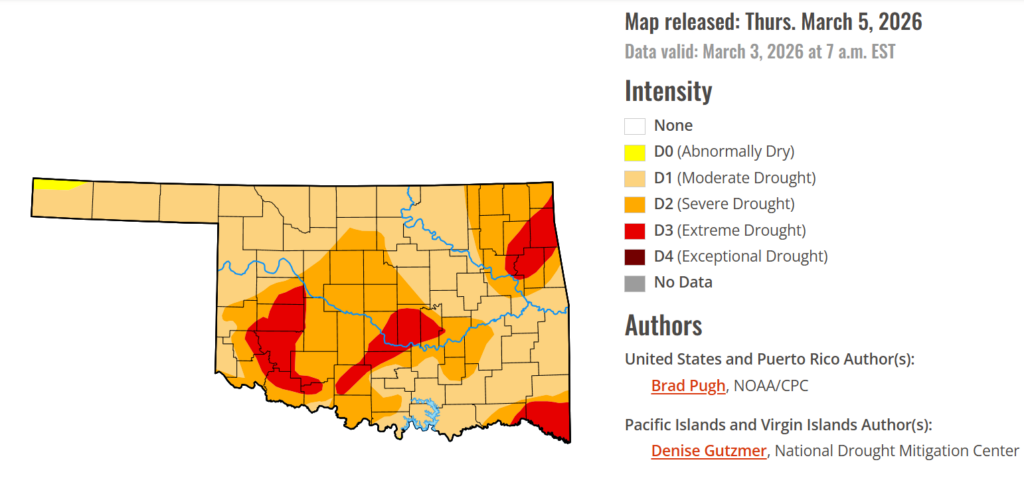
To view the latest Oklahoma drought map, CLICK HERE.
Drought conditions continue to tighten their grip across Oklahoma as dry weather lingers across much of the state. A combination of below-normal winter precipitation, warmer-than-average temperatures, and persistent winds has allowed drought conditions to intensify in recent weeks.
According to the latest Oklahoma Drought Monitor report, exceptional drought remains at 0 percent, unchanged from the start of the calendar year.
Moderate drought to extreme drought conditions in the current period indicate that 99.43% of the state is affected by drought. Compared with last week’s 91.22%, drought conditions have grown substantially.
Extreme Drought conditions have also spread this week, now covering 12.97% of the state, up from 12.08% last week, affecting mainly Pottawatomie, Seminole, McClain, Garvin, Stephens, Kiowa, Washita, Delaware, Ottawa, Mayes, Cherokee, and parts of surrounding counties.
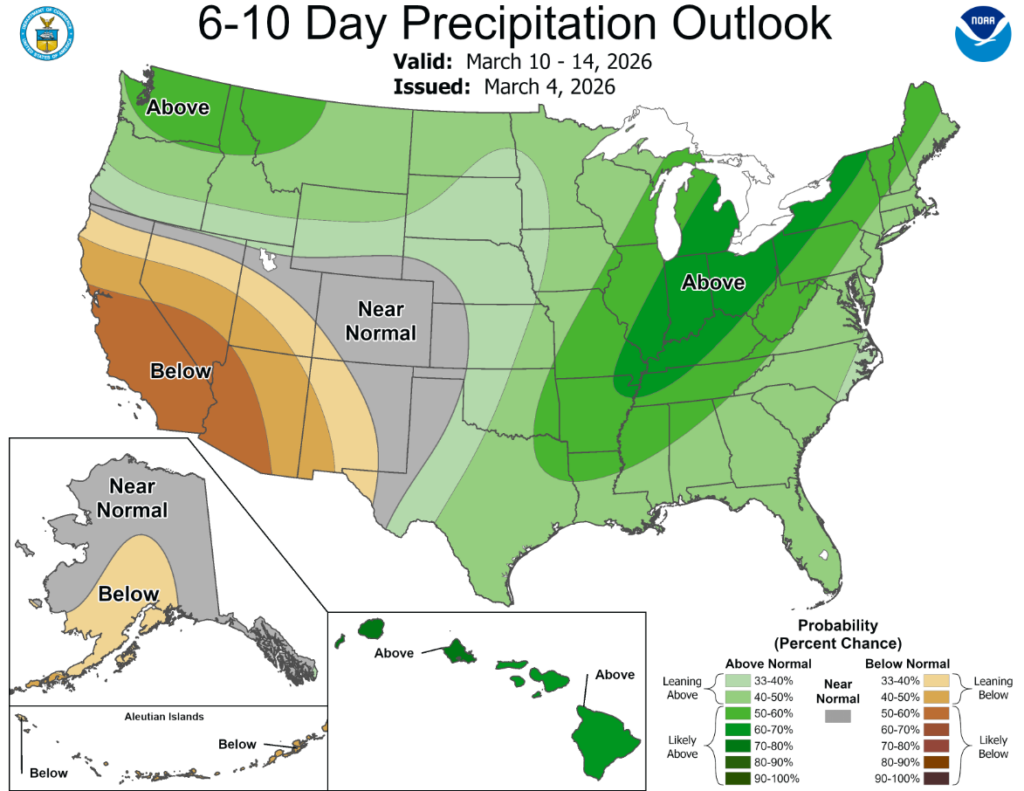
According to the 6-to-10-day precipitation outlook map, the panhandle is expecting near-normal conditions, while central Oklahoma is leaning above 33-50% trough march 14th.
Since the beginning of December 2025, drought expanded and intensified across the Lower Mississippi Valley and Southern Great Plains which is typical during a La Nina winter. Much needed precipitation at the end of February led to small improvements across parts of the Southeast and also at least briefly stabilized the drought status for this region. Widespread severe to extreme drought is designated for much of the Carolinas, Georgia, southeastern Alabama, and Florida. A longer-term drought continues to affect the Mid-Atlantic and portions of the Northeast. The unusually dry winter persisted across the Midwest through the end of February with additional degradations made this past week. These worsening drought conditions extend west to the Central Great Plains along with the Central to Northern Rockies. Below-normal snowpack remains a major concern for the West heading into the spring. Drought coverage decreased in Hawaii during the past few weeks, while Alaska and Puerto Rico remained drought-free.
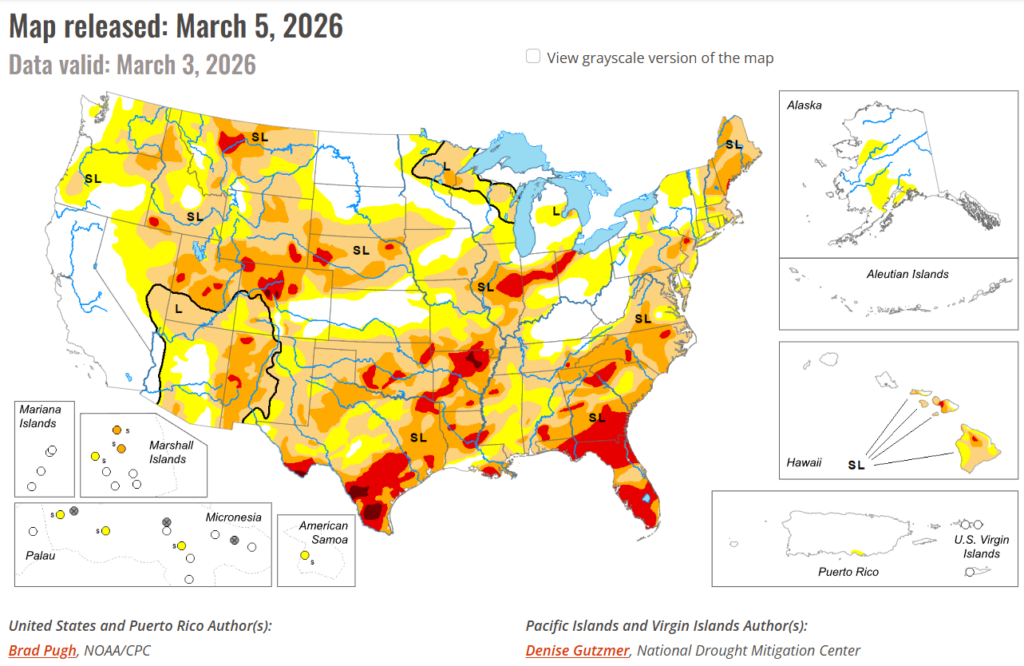
In The South: Heavy rainfall (1 to 3 inches, locally more) resulted in a small 1-category improvement to parts of northeastern Tennessee. For the Lower Mississippi Valley and Southern Great Plains, drought continued to expand and intensify through the end of February and beginning of March. The major change this past week was a widespread 1-category degradation to Mississippi and also north-central Oklahoma. Since the beginning of December, precipitation has averaged less than 50 percent of normal across much of the Lower Mississippi Valley and Southern Great Plains. Impact reports from north-central Oklahoma include poor wheat conditions and surface water supply shortages. An expansion of moderate drought (D1) was also warranted for northeastern New Mexico. In addition to the drier-than-normal winter, 90-day temperatures have averaged 2 to 6 degrees F above normal. The lack of winter precipitation combined with periods of unseasonably warm temperatures and enhanced winds led to an increasing coverage of severe (D2) to extreme (D3) drought from the Mississippi River west through Oklahoma and Texas.
In the High Plains: Although late winter is a relatively dry time of year across the Central Great Plains, periods of unseasonably warm temperatures and enhanced winds this past month led to intensifying drought across northeastern Colorado and Nebraska. 30-day temperatures averaged 6 to 10 degrees F above normal throughout the Great Plains. A 1-category degradation was made this past week to parts of Kansas and South Dakota. Widespread drought of varying intensity remains designated for much of Colorado and Wyoming. As of March 3, snow water equivalent is less than 70 percent of normal across the Central Rockies.
In the West: Water-year-to-date precipitation (October 1, 2025 to March 2, 2026) averaged below-normal for the Great Basin which led to a slight increase in moderate (D1) coverage across northeastern Nevada this past week. Following a drier- and warmer-than-normal February, a 1-category degradation was also made to parts of Montana. A 1-category degradation was also warranted for parts of Idaho, reflecting the below-normal precipitation and low snowpack this past winter. Even for areas of the West that have received above-normal precipitation since the beginning of October 1 such as the Northern Intermountain West and Northern Cascades of Washington, snow water equivalent (SWE) is running below normal. The low snowpack throughout much of the West is a major concern heading into the spring. As of March 3, SWE is less than 50 percent of normal from the Cascades of the Pacific Northwest southward through the Great Basin and Four Corners region. Although California remains drought-free, SWE is 59 percent of normal statewide according to the California Department of Water Resources.
To view the 6-10 Day Precipitation Outlook Map, click here.
To view the 6-10 Day Temperature Outlook Map, click here.
To view the Monthly Drought Outlook Map, click here.