

Global beef consumption in 2026 is projected at 59.5 million metric tons (mmt), down 1.4 percent year over year, largely due to decreased beef consumption in China. Global beef consumption has increased an average of 0.8 percent annually in the last 46 years, from the 1980 level of 42.4 mmt. The U.S. is the largest beef consuming nation, accounting for 22.4 percent of total global beef consumption in 2026. The U.S. has averaged 23.3 percent of global beef consumption since 1980.
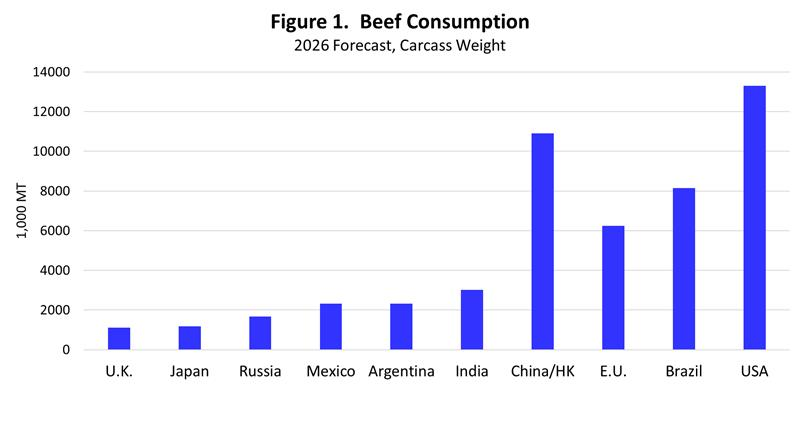
China/HK is the second largest beef consuming country, with total consumption more than doubling in the past 25 years. Brazil is the number three beef consuming country, followed by the E.U. at number four. Typically, large beef producing countries are also large beef consuming countries.
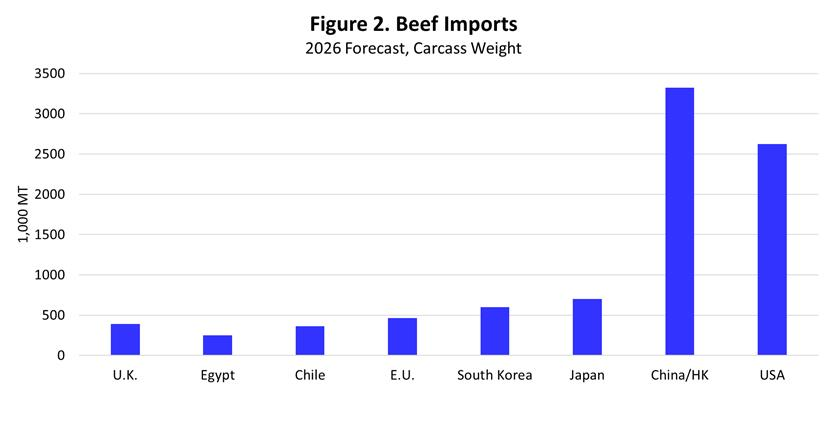
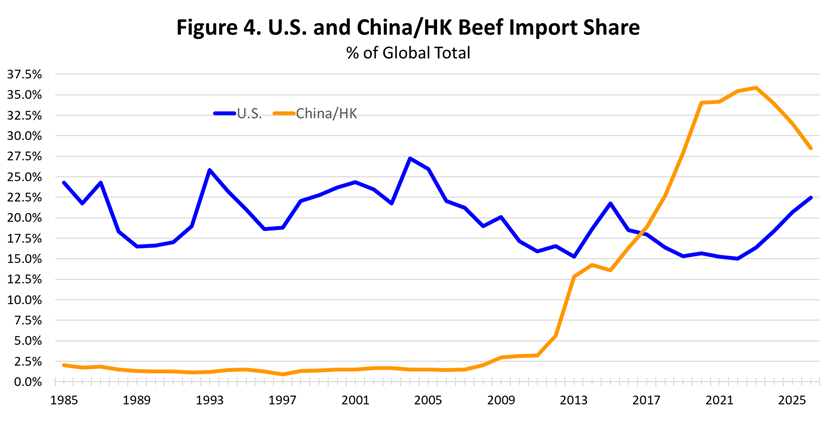
Chin/HK is the largest beef importing country, having moved ahead of the U.S. in in 2017 (Figure 2). Beef imports in China/HK have increased sharply since 2013, and especially after 2018, with beef imports supplementing domestic beef production to rapidly increase beef consumption in China/HK (Figure 3). The next three beef importing countries: Japan, South Korea and the E.U. combined are less than the U.S. (Figure 2).
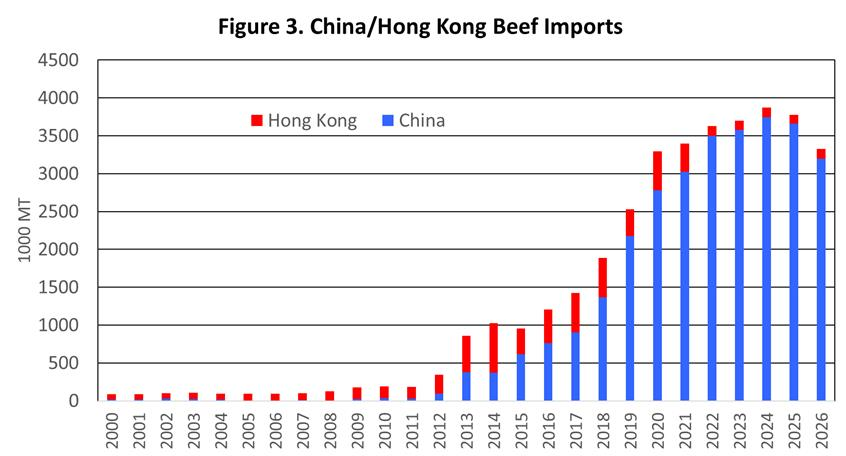
Figure 4 shows the rapid increase China/HK beef imports as a share of global total imports, pushing China/HK ahead of the U.S. since 2017. The U.S. share of global beef imports has remained relatively steady for many years.
China/HK is certainly the major driver of global beef trade. Recent tariff rate quotas (TRQ) announced by China will have ripple effects on all global beef markets.