

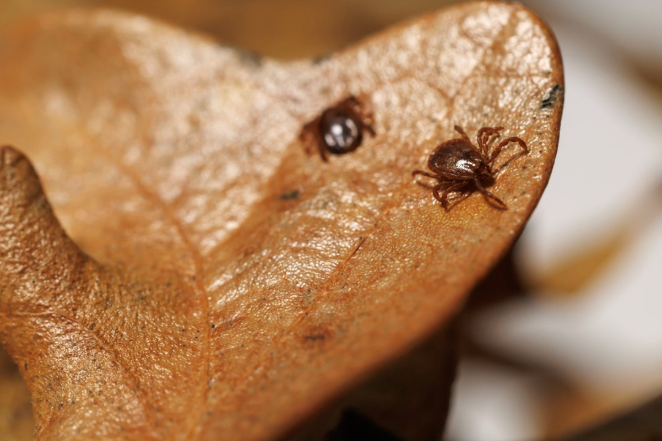
As Oklahoma enters the spring months, Dr. Jonathan Cammack, Oklahoma State University State Extension Specialist for livestock entomology and parasitology, offers tips for handling ticks and flies around cattle.
Asian longhorned ticks
Asian longhorned ticks were first documented in the state in 2024, with confirmed cases in Craig and Mayes Counties. With ticks present in bordering states like Arkansas and Missouri, producers in the northeast corner of Oklahoma should remain vigilant.
“Sequoyah County up to Ottawa County, that range of six to eight counties in that corner of the state is where producers should be looking,” Cammack said.
But what’s so concerning about these ticks? There are several reasons, Cammack said. Asian longhorned ticks are a non-native species, meaning Oklahoma doesn’t necessarily have natural control options present in its environment.
This species also reproduces asexually through parthenogenesis, meaning females can lay eggs without the added challenge of finding a mate. This allows tick populations to explode quickly, and in states with established populations, thousands of Asian longhorned ticks can be present on a single animal.
“For this time of year, this is when we expect to see that nymphal stage that’s been hiding in the leaf litter,” Cammack said. “They start to come out, be active and look for a host animal to feed on.”
There are plenty of treatment options available. Products labeled for tick control are effective against this species. Based on published research, Cammack recommends treating animals in the spring as the most effective time. As producers prepare cattle for pasture, using a synthetic pyrethroid and spraying it onto the animal where ticks are visible is effective.
“As long as you’ve got a pyrethroid or some other product labeled for managing ticks in general, what we’ve seen from laboratory studies is that they are effective for Asian longhorned ticks,” Cammack said.
Horn flies
As the weather continues to warm up into the summer months, horn flies will also become a problem for cattle across the state. As Cammack explains, the southeast portion of Oklahoma is the first to begin dealing with the flies, which slowly start moving north throughout the summer.
Horn fly season usually peaks in July and August. One of the best things producers can do right now is provide animals with a feed-through insect growth regulator, which is readily available at any local feed store.
“Get a mineral block or mineral tub that’s got some sort of insect growth regulator in it,” Cammack said. “That way, the cattle are going to consume that mineral and that pesticide product is going to pass through the digestive tract and end up in the manure.”
When horn flies do arrive and lay eggs in the manure, the pesticide present in it will kill the larvae, Cammack explained.
Insecticide ear tags are another effective way to deal with horn flies. The trick is applying them at the proper time of year, Cammack explained.
“Everyone wants to do it during spring break when they’ve got the extra help that might be home from school,” he said. “That’s typically a little too early. Most ear tags are going to give about 3-4 months of control, depending on how hot it is.”
Ideally, producers should wait until the end of May or the beginning of June to maximize the benefits of the ear tags and align with the peak season.
For more area-specific recommendations for livestock pest management, Cammack said to reach out to your local county OSU Extension office.
“The Ag educator in each county is going to have great recommendations for what works in that local environment,” he said.







