

As the 2026 cotton planting season gets underway, growers are facing a complex landscape defined by high input costs and fluctuating crop prices. To provide practical guidance, Cotton Incorporated’s Ed Barnes and Gaylon Morgan shared a comprehensive toolkit of resources—ranging from artificial intelligence to soil science—designed to help producers protect their bottom line during the latest “Cotton and Coffee” seminar.
Thinking Outside the Box with AI and Economic Tools
Ed Barnes, Senior Director of Agricultural and Environmental Research, kicked off the discussion by urging growers to embrace “strategic thinking” through non-traditional means. He specifically highlighted the potential of Artificial Intelligence (AI) to serve as a sounding board for farm management.
- Strategic AI Use: Barnes recommended using tools like ChatGPT, Claude, or Gemini in “deep thinking” modes to brainstorm economic risk mitigation. While not a replacement for agronomists regarding herbicide rates, AI can help evaluate complex scenarios, such as managing high-acreage farms under tight margins.
- New Profitability Tool: A new “beta” economic tool developed in collaboration with the University of Arkansas allows growers to input state and county-level data to visualize their break-even points. This tool factors in lint percentage and cottonseed value, helping farmers identify which fields are most likely to be profitable at specific price points.
Weather Outlook and Irrigation Precision
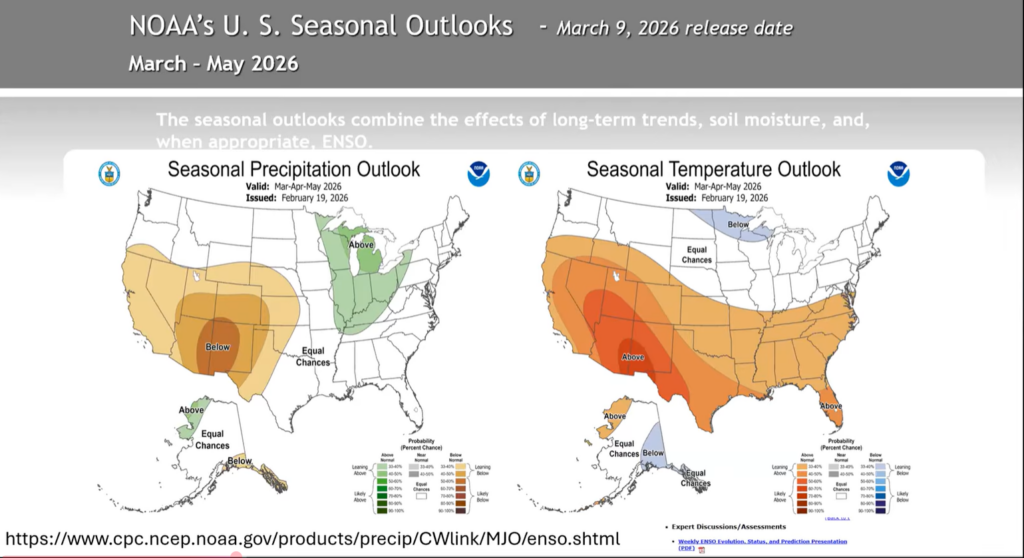
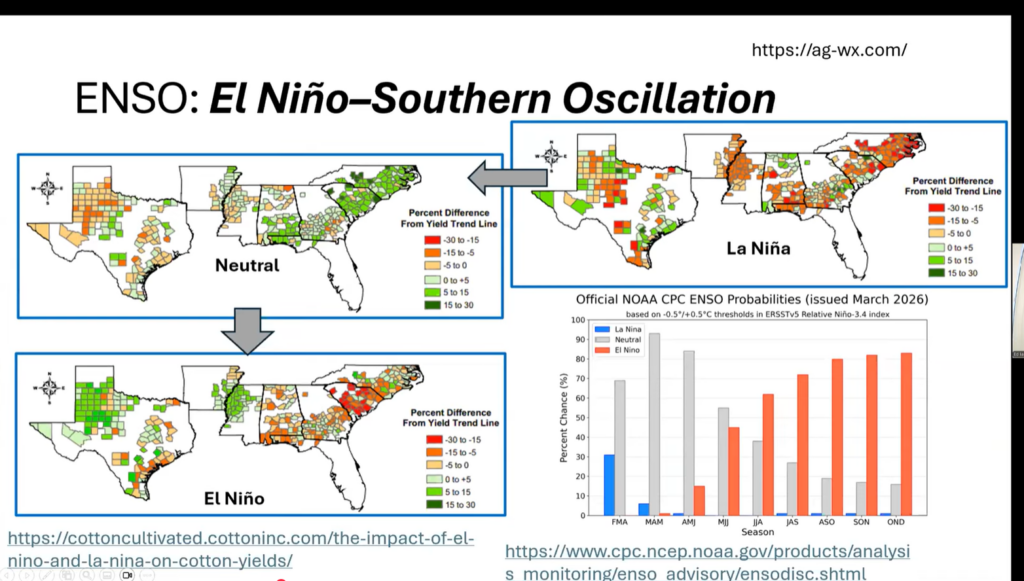
The climate outlook for the early season appears relatively stable. Barnes noted that the transition from La Niña to a neutral phase, followed by a rapid move toward El Niño, generally bodes well for much of the Cotton Belt.
- ENSO Phases: Historically, neutral phases are favorable for the Southeast and manageable for Texas. The expected El Niño is projected to arrive after the critical planting window, potentially avoiding the cool, wet conditions that can delay starts in the East.
- Irrigation Management: With water being a primary yield driver, growers are encouraged to use apps like CropFit (best suited for areas east of the Mississippi) to refine irrigation timing, ensuring every drop contributes to the final yield.
Planter Precision and Plant Population
Optimizing equipment and seed counts can lead to significant savings. Barnes highlighted that high-speed planting technologies not only increase field capacity but often provide more uniform stands and consistent seed depth.
Regarding population, research suggests cotton is remarkably resilient.
“You could go as low as 15,000 evenly spaced cotton plants per acre and not really hurt your yield,” Barnes noted. However, he warned that yields “fall off a cliff” below that number, making uniform spacing critical if seeding rates are reduced.
Seed Quality and Variety Selection
Dr. Gaylon Morgan, Director of Agricultural Research, emphasized that variety selection is perhaps the most impactful decision a grower makes.
- The Yield Gap: Data from 2024 trials across the belt showed a 192-pound-per-acre difference between top-performing varieties and “middle-of-the-pack” options. At 75 cents per pound, that equates to nearly $192 per acre in lost potential revenue.
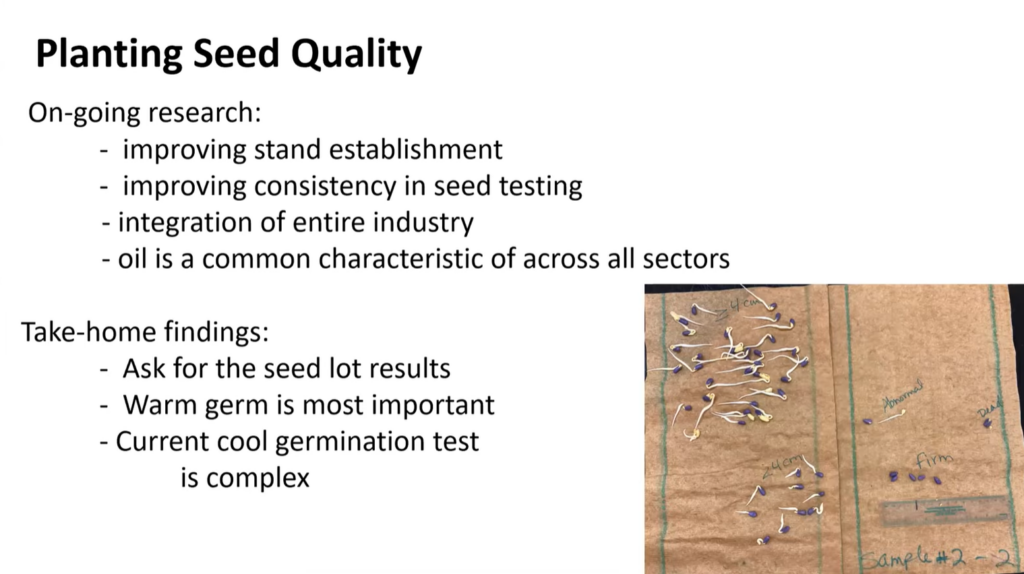
- Seed Vigor: Morgan advised growers to look beyond the standard “warm germ” results. While cool germination tests are undergoing research to improve their consistency as predictors of stand establishment, asking seed companies for additional vigor data can help determine which varieties are best suited for early-season planting.
Nutrient Efficiency: Crediting the “Soil Bank Account”
With nitrogen prices spiking, Morgan suggested that many growers might be sitting on a “bank account” of nitrogen already in their soil.
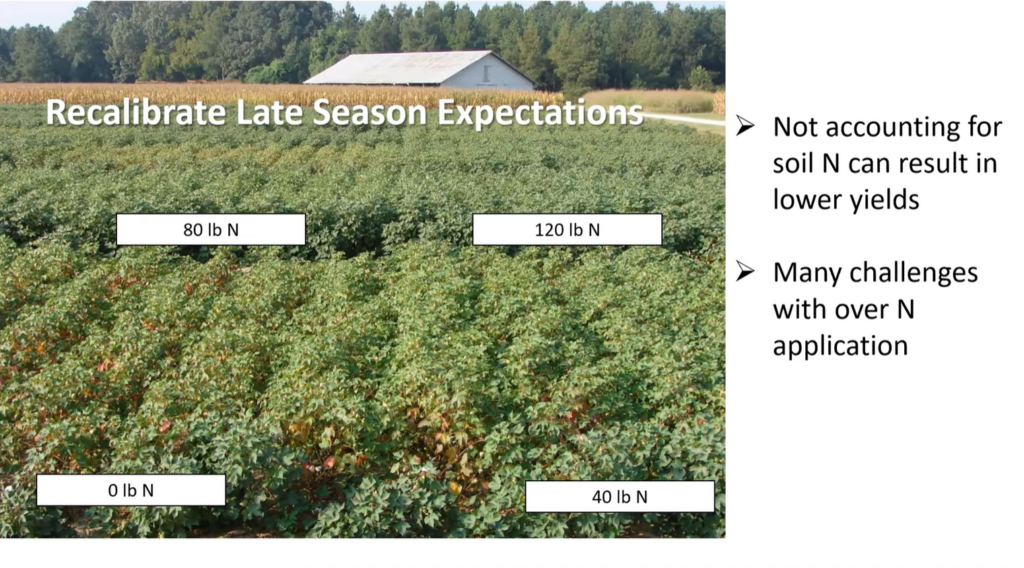
- The 50% Rule: In trials conducted from 2020 to 2024 across 142 sites, 50% of the locations were non-responsive to added nitrogen, meaning the soil already contained enough nitrates and ammonium to maximize yield.
- Soil Testing: Growers are encouraged to perform deep soil nitrate tests. Crediting existing nitrogen from crop rotations (like peanuts or soybeans) and organic matter mineralization can significantly reduce fertilizer bills without sacrificing the 40 pounds of nitrogen needed for the first bale.
Weed Management and Emerging Technology
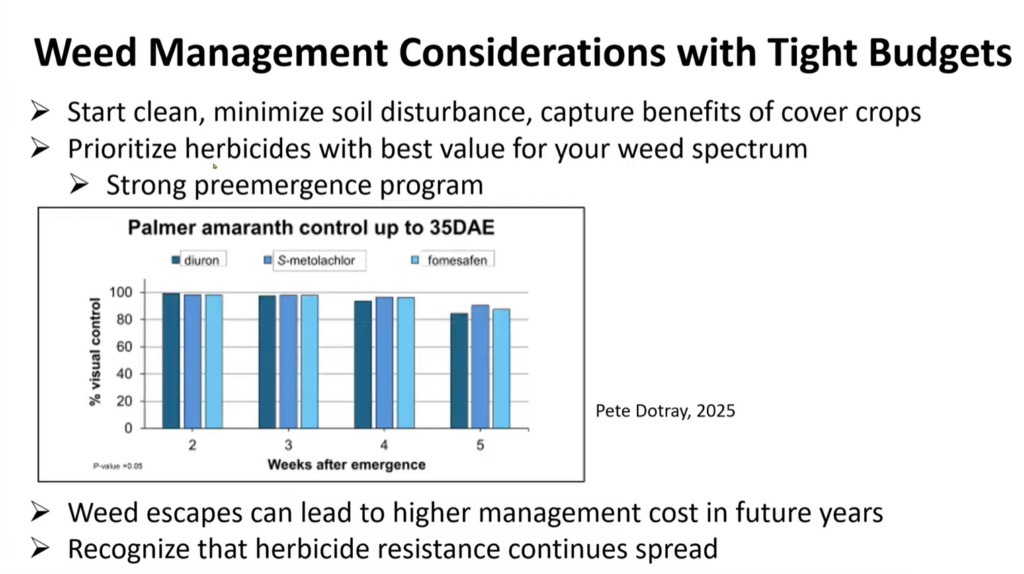
Starting clean remains the golden rule of weed management. Morgan highlighted that pre-emergence herbicides are a “really good investment” because they are relatively inexpensive and face very little resistance compared to post-emergence options.
- See-and-Spray Economics: While “See-and-Spray” technology is gaining traction, Morgan provided a reality check on the economics. For single-tank systems, herbicide costs generally need to exceed $10 per acre—and require coverage of 13,000 to 20,000 acres—to see a positive return on investment.
- Cover Crops: Utilizing cover crop biomass for weed suppression can reduce the number of herbicide passes required, provided the biomass is managed effectively.
Conclusion
As the season progresses, growers can find more detailed resources, including the “Cotton Specialist Corner” podcast and the “Focus on Cotton” webcasts, via the Cotton Cultivated website. By combining traditional agronomic wisdom with new digital tools, producers can navigate the economic challenges of 2026.
Click here to see the complete presentation:







