

During the month of April, the Radio Oklahoma Ag Network and Oklahoma Farm Report are spotlighting the 17 Area Stars of Oklahoma FFA, who are among the highest achievers in the organization.
The stars come from the four areas in four categories – Star in Ag Placement, Star in Agriscience, Star in Agribusiness, and Star in Agricultural Production.
This week, we spotlight the three area stars in Agricultural Placement in 2026.
One Star Finalist featured in the coming days from each of the categories will be named the State Star Award Winner during the 100th Oklahoma State FFA Convention, which will take place on May 5th and 6th in Tulsa, Oklahoma.
We continue our coverage of the 2026 Oklahoma FFA Star Award Finalists today with Jacob Boswell of the Boswell FFA representing the Southeast area.
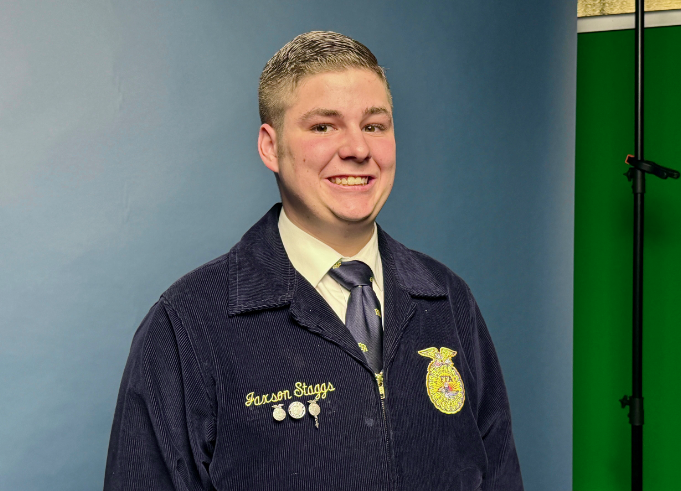
For some FFA members, a project starts small and grows into something much bigger over time. That has certainly been the case for Jacey Jaxton Staggs of the Purcell FFA Chapter, whose supervised agricultural experience has developed into a diversified registered seedstock cattle operation with long-term goals already in sight.
Staggs said his project now includes 37 registered cows made up of Charolais, Red Angus, and Black Angus genetics. “This project is a registered seed stock operation where I have 37 registered cows that are split between breeds of Charolais, Red Angus, and Black Angus.”
He said the operation first began with Charolais cattle during his sixth-grade year. “My main choice for the Charolais was I like the white cows. So that was where I started, and then from there, it’s just grown to so much more learning opportunities.”
Building a More Diversified Herd
As his experience grew, Staggs said he recognized the value of adding multiple breeds to strengthen the program. “I realized I wanted to have more of a diversified operation as well, and that was what really caused me to grow.”
He explained that Red Angus cattle were added in part because of their adaptability in Oklahoma’s climate. “They’re more efficient in terms of the heat because they’re not black hided. They stay a little cooler.”
Black Angus also remained part of the herd because of his history showing them. “I started out showing Black Angus, and I never got rid of them.” The result has been a herd designed around both practicality and opportunity, blending maternal strength, marketability, and adaptability.
Learning Management, Safety, and Family Teamwork
Beyond genetics, Staggs said one of the biggest lessons from the project has been livestock handling and safety. He prefers working cattle horseback whenever possible. “I utilize my horse as much as possible. It helps me when I’m moving cattle, working with them and sorting them. It helped me create a slower, calmer, safer environment.”
He added that both cattle and horse respond better in that setting than when machinery is used. The project has also become a family effort, with support from multiple generations. “It was mainly my father and grandfather when we first started out. Now it’s a family operation, where I have everybody within my family coming to help at all times.”
Staggs said working styles may differ, but the family has learned how to combine ideas efficiently. “We’ve really been able to compromise and figure out where our differences align and how we can make them all work together.”
Big Goals Beyond High School
Staggs already has clear plans for the future. He hopes to expand his registered herd to 150 to 200 head, then add a commercial cow-calf operation alongside it. “My goal is to be able to grow my registered herd to around 150 to 200 registered animals. And then after that, I want to focus on growing a commercial cow calf operation on the side.”
He also plans to attend Murray State College, major in general agriculture, and pursue a career as an ag insurance agent. Looking back on his FFA experience, Staggs said he hopes younger students understand the organization offers opportunities for everyone.
“FFA is not just for farmers, that anybody can get involved and anybody can do it.” “There’s something we can find for anybody within this organization.”
This year’s 17 Area Stars will each be recognized on stage in the fifth general session of the 100th Oklahoma FFA Convention May 6th in Tulsa and each will receive a plaque and $500 cash award co-sponsored by the Blue and Gold Sausage Co., Sirloin Club of Oklahoma, Masonic Charity Foundation, McDonald’s of Oklahoma, Davis Farms, The Chickasaw Nation, Oklahoma Farm Bureau and the Noble Research Institute.
The Star in each category will each receive $29,484 in scholarships or capital grant funds through a $3.2 million gift from the Carl C. Anderson Trust. The late Carl C. Anderson, after whom the State Star awards are now named, was born in Naples, Oklahoma, in 1911. One of 10 children, he dropped out of high school to earn money and support his family. From those modest beginnings, the Anderson Corp. grew across the country as well as in Canada and South America.
Our coverage of the 2026 Oklahoma FFA Association State Convention is sponsored by Oklahoma Farm Bureau, proud to support the young men and ladies of the Oklahoma FFA as they strive for excellence in all they do. Oklahoma Farm Bureau- We Are Rural Oklahoma.
Learn more about the 100th Annual Convention of the Oklahoma FFA by clicking here for the convention highlights.







