

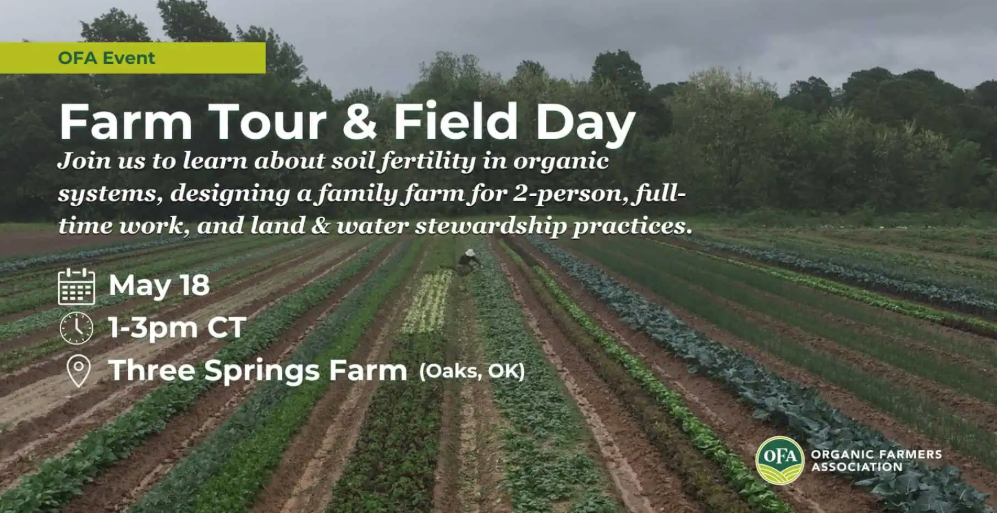
In a recent interview with Farm Director KC Sheperd, Mike Appel, a member of the Organic Farmers Association policy committee, discussed the upcoming Farm Tour and Field Day and the sustainable practices that have led to over 20 years of success in organic vegetable farming. Operating in the “green country” of Cherokee County, Appel emphasized that the secret to thriving in Oklahoma’s unpredictable climate lies in a commitment to soil health and crop variety.
The Foundation: Building Soil Health through Biomass
For Appel, the journey began with a focus on transformation. When he started his operation two decades ago, the land was exhausted, requiring a long-term strategy to restore its productivity without relying on outside chemicals.
“When we started farming our soil was very, very poor. It’s old weathered soil… so over time what we’ve really focused on is building that soil. And so what we do is a lot and lot of cover cropping.”
By rotating winter crops like rye and vetch with summer cover crops like Sudan grass and sunn hemp, the farm has become a closed-loop system of fertility.
“All of that stuff is returned to the soil. So we’re constantly adding biomass back to the soil… we’ve seen a tremendous improvement in our soil where we do not have to input, import any new fertility. We’re not buying fertilizers; we don’t have to bring in compost. Everything is really kind of done on the farm.”
Managing the Elements: Diversity as Insurance
Oklahoma’s weather is notoriously fickle, often swinging between extreme drought and heavy rainfall. Appel explained that a diverse planting strategy is the only way to ensure a full-time livelihood in such an environment.
“It really goes back down to that diversity of crops… we’re going to have some things fail every year. We just know that. And that’s when other things kind of pick up the slack.”
The farm maintains a robust variety of produce to mitigate these risks, ensuring that something is always ready for the market.
“We grow over three dozen different varieties… we have our spring crops, which are like cool weather crops like the brassicas, broccoli, cauliflower, cabbage… we also have our summer crops as well in the ground… tomatoes and peppers and eggplant and squash and cucumbers.”
Advocacy and Community: The Organic Farmers Association
Beyond the field, Appel serves on the policy committee for the Organic Farmers Association. He noted that the organization serves as a critical bridge between the local producer and national policy.
“It’s a great organization that it’s all made up of organic farmers. And so we set our own policy… we advocate on behalf of the organic farmers. We do lobby days in D.C… I’m in contact with our local representatives about policy surrounding organic agriculture.”
Event Details: Farm Tour and Field Day in Oaks
The upcoming Farm Tour and Field Day offers a rare opportunity for the public and other producers to see these organic principles in action. The event is designed to be an educational exchange rather than just a lecture.
“On Monday we’re opening our doors, so to speak, for people to come and visit… we’re just going to show them around what we do… kind of the production we’ve set up for ourselves being a two-person operation and being in Oklahoma for over 20 years.”
The tour will provide a deep dive into the technical side of organic production, specifically how to manage transitions between crop cycles.
“We’ll talk about how we go from a cover crop field to planting to harvest, so people can kind of see all the different stages of that. It’s a great time of year to see that.”
Ultimately, Appel views the event as a way to strengthen the farming community through shared innovation.
“Farmers are so innovative and it’s a great opportunity for us to get together and talk, which doesn’t happen so often because we’re all so busy on our farms… we always learn a lot as well from other people.”
The event kicks off at 1:00 PM in the town of Oaks. While walk-ins are welcome, attendees are encouraged to RSVP via the Organic Farmers Association website to help the organizers prepare.







