

In todays beef buzz, senior farm and ranch broadcaster Ron Hays talks with Rear Admiral Michael Schmoyer, Associate Administrator for APHIS and Director of the New World Screwworm Directorate, who gives an update on new world screwworm cases, movement, and preemptive planning. In this role, RDML Schmoyer leads national efforts to protect U.S. agriculture, the economy, and public health from the threat of New World screwworm.
Limited flies need to make big impact
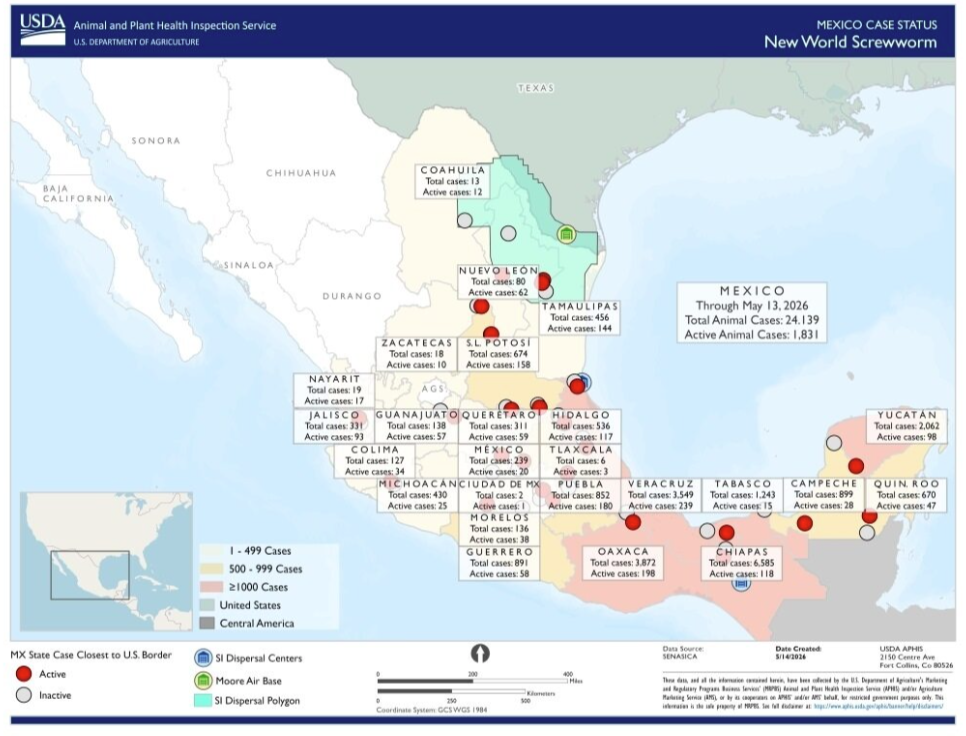
Over 1800 active cases are currently in Mexico; of those, 15 cases are less than 100 miles from the US border. Mostly calves have been reported, but dogs and goats have been reported with cases as well. The current goal is to release sterile flies where they’re most likely to do the most good. Data from traps is vital and tells officials where the flies should be dropped to make the most impact.
“We’re dropping flies mostly on the Northern Gulf side of Mexico. We have about 50 miles where these flies are also being dropped over the US border in Texas.”
“When we make these decisions, we look at a variety of different data based on modeling, and we predict, we forecast, and we assess based on a variety of different things. As far as surveillance, all of those things come together and help us to determine where is the best use of our flies, and how can we distribute what is a limited number that we have at this moment.”
Predicting fly movement for defense
Admiral Schmoyer says it’s important to be deliberate and intentional when dispersing sterile flies because numbers are limited. Data from a variety of sources, including Mexico, helps officials track where screwworm flies are currently located — and, more importantly, where they are likely moving next.
“We take into consideration all of these different things that are data sources for us. And so by and large, the majority of these data sources are provided to us by our partners in Mexico.
This pre-planning helps fight the border battle. ” What we do is we anticipate, not where the fly is right now, but really where can the fly be moving towards. And so in a in a over leaning of preparation, we lean forward aggressively as far as where we disperse our flies, beyond where we know the flies to be, but where they could be in a few weeks.
Ready if Screwworm Arrives
Admiral Schmoyer says the planning extends far beyond the field, with state partners working together through “tabletop exercises” designed to prepare for a wide range of possible scenarios.
“How would we address this situation, if x happens, who would be at the table if y were the situation? Those tabletop exercises are tremendously important that we’ve done with our state partners.”
The USDA has even developed a new world screwworm playbook — a comprehensive guide built from industry feedback, research, and collaboration that outlines what happens, when, and where response actions take place, and how officials would handle a potential outbreak.
“We have the new world screw worm playbook, Version 2.0 is out. That has been developed with feedback and content from our state partners, industry partners, and other federal agencies. This is the element that helps to be able to say, boots on the ground If this situation happened, how would we handle it?
Admiral Schmoyer also notes that new ideas are being developed to combat screwworm, including looking at things they’ve never done before and practices used in similar situations.
“And finally, we’re also very excited, because the Secretary has charged us to lean forward and look at other ways that we can do things. Her five-prong plan that she put forward last summer really helps to address those things in a variety of ways. We’re currently going through those applications to determine the best way to put American taxpayer dollars up to $100 million and to determine what innovations could really make a difference in what we’re already doing are?
The Beef Buzz is a regular feature heard on radio stations around the region on the Radio Oklahoma Ag Network and is a regular audio feature found on this website as well. Click on the LISTEN BAR above for today’s show and check out our archives for older Beef Buzz shows covering the gamut of the beef cattle industry today.







