

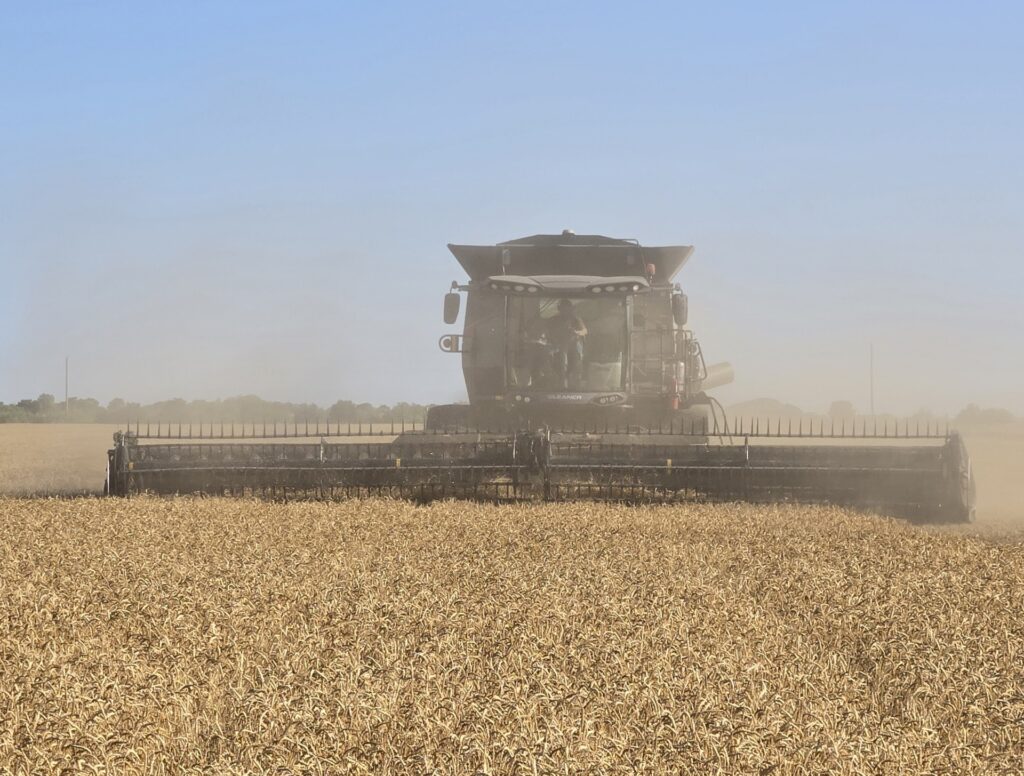
The Oklahoma wheat harvest is officially underway, marking one of the earliest starts in recent memory, according to Mike Schulte, Executive Director of the Oklahoma Wheat Commission. Speaking with senior farm and ranch broadcaster Ron Hays of the Oklahoma Farm Report, Schulte detailed a sharply divided state crop landscape that he described as a literal “tale of two different worlds.” Listen to Hays and Schulte by clicking on the audio bar above.
An Unprecedented Harvest Timeline
What will be one of the smallest crops ever will also be remembered as one of the earliest harvest starts in memory. While the USDA reported Oklahoma’s harvest progress at 2% complete in the May 17th Crop Progress report (one of the earliest ever reported in the weekly reports), Schulte believes the state has advanced the harvest numbers past that mark.
“I think we’re a little higher than that now statewide—probably 7% or 8%,” Schulte said. “We are probably two to three weeks early for harvest in certain regions… I had been talking to a couple of older producers that said, ‘You know, we’ve seen a lot in our lifetime, but this is the earliest harvest that they remember.'”
The geographic progression of this year’s harvest has flipped standard traditions on their head. Typically, harvesting begins on the Texas border and moves north, but erratic spring rainfall patterns bypassed central Oklahoma entirely. Because southwest Oklahoma received late rains that delayed maturity, central Oklahoma took the lead.
“The harvest is probably 5 to 10 days away from what it is in central Oklahoma, which is very unusual to be harvesting in the central regions in the amount that we are compared to southwest Oklahoma,” Schulte observed. However, activity is ramping up quickly across Kingfisher, Canadian, and Blaine counties, as well as along the Oklahoma-Texas border and just north of Enid.
Yields and Test Weights Vary Widely
Early data rolling in from elevator intake points shows highly volatile numbers that depend entirely on highly localized rainfall, variety type, and management choices.
- Yields: Most early data aligns with the Oklahoma Grain and Feed Association’s earlier projections. “We’re seeing yields kind of vary pretty much from hearing things from 12 to 25 bushels per acre,” Schulte said. He added that while exceptional instances of yields hitting the 40s and 50s have happened, “that’s very few and far between instances.”
- Test Weights: Early test weights are ranging wildly from 52 to 61 pounds per bushel. “I think right now currently on early harvested wheat, we’re looking at like a 57 to 59-pound average on early reports,” Schulte noted. He clarified that fields testing below 52 pounds will likely be zeroed out or abandoned entirely rather than hauled to town.
Looking Ahead: A Simultaneous Statewide Push?
With widespread rains forecasted across Oklahoma through the Memorial Day holiday weekend and into early next week, producers are currently racing against the clock.
Oklahoma’s farming communities desperately need the moisture to recharge subsoil levels for future crops, but they also want to avoid a repeat of last year’s prolonged, rain-delayed harvest. If the upcoming weather system allows the fields to dry quickly, it will likely set off a massive, simultaneous harvest from border to border.
“I think if machines could get rolling again… there’s going to be a lot of areas from the Oklahoma-Texas border all the way to the Oklahoma-Kansas border that we’re going to see all at once be ready, ready to go,” Schulte concluded.
Deep Divide in the Panhandle
Meanwhile, the Oklahoma Wheat Commission recently wrapped up its final variety plot tours in the panhandle, specifically observing dryland and irrigated trials in Texas and Beaver counties. The findings highlight severe regional disparities driven by a lack of moisture since planting.
“A lot of the dryland wheat in Texas County just has really never had a chance from planting, and so there’s going to be a lot of abandonment in that region,” Schulte stated bluntly. While some dryland wheat may see a combine in the central parts of the panhandle, Schulte noted that expectations are incredibly low, estimating yields in the meager 12 to 25 bushels per acre range.
The news is slightly better for irrigated fields, though still heavily impacted by the lack of natural precipitation. “Irrigated wheat in places where we’ve seen it does look favorable, but certainly not going to be like in years where we have had moisture to help us along the way,” Schulte explained.
Editor’s Note- the picture above was provided by Fred Schmedt- Wheat Harvest in Jackson County on May 14, 2026- the variety is Ok Corral







