
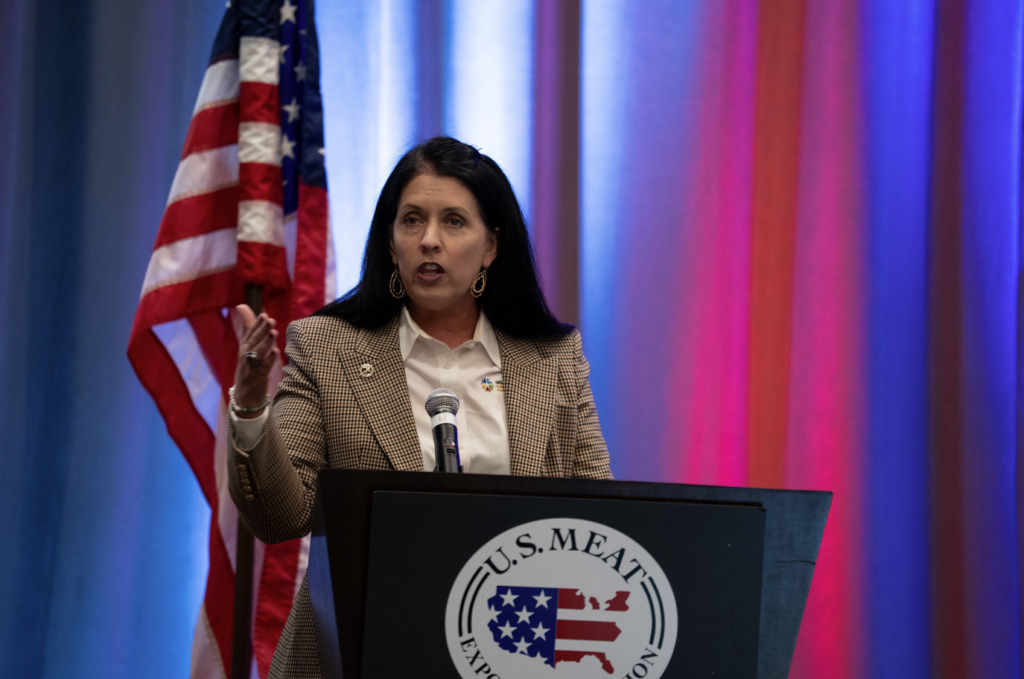
Livestock and grain producers, red meat processors and exporters, and other key stakeholders gathered in Oklahoma City Wednesday for opening day of the U.S. Meat Export Federation (USMEF) Spring Conference.
Oklahoma Secretary of Agriculture Blayne Arthur welcomed the group, detailing the importance of international trade to Oklahoma’s agricultural economy. Sec. Arthur, who is also a cattle producer, shared highlights from a recent visit to Japan in which she met with USMEF staff and saw firsthand how U.S. red meat is merchandised and served in the Japanese market.
“I don’t know that I’ve ever consumed so much animal protein as I did when we were on that trip in Japan,” Arthur said. “They made sure that we got a sampling of everything. It makes you very proud as a United States beef producer to be in another country and to see our products displayed, and see the work that is happening across the world.”
USMEF Chair Jay Theiler, executive vice president of corporate affairs for Idaho-based Agri Beef Co., also shared recent experiences from international markets. Last month Theiler led a USMEF delegation to Mexico City for a market tour and a two-day USMEF symposium that attracted importers and other prospective customers from throughout Mexico. In late April, Theiler traveled to London to participate in events celebrating the return of duty-free access for U.S. beef in the United Kingdom. See full highlights from these events here:
USMEF President and CEO Dan Halstrom gave attendees an overview of the latest export results for U.S. pork, beef and lamb. He also offered insights on key developments affecting market access for U.S. red meat, including last week’s announcement that China had finally renewed registrations for U.S. beef establishments. This impasse had kept most U.S. beef ineligible for export to China for about the past year, but some shipments have now resumed. Halstrom cautioned, however, that China must remove significant technical barriers before the market can be considered fully reopened.
“While that wasn’t solved last week, it’s going to be focused on in the very near future,” Halstrom said. “And I can tell you this – we have customers in China who are ready to go now.”
Halstrom also applauded a recent breakthrough with Saudi Arabia, in which Saudi officials agreed to remove barriers that had effectively locked most U.S. beef out of the market for the past dozen years.
“That’s a big, big deal that could lead to exports as high as a couple hundred million dollars per year, once the business gets going,” he said. “For both China and Saudi Arabia, I want to thank the Office of the U.S. Trade Representative and the U.S. Department of Agriculture for their tireless efforts to reopen these markets. These are tremendous wins for our industry.”
Wednesday’s meeting concluded with an economic and political overview of Central America, one of the fastest growing regions in the world for U.S. red meat exports. Last year Central America took nearly $600 million in U.S. pork exports and more than $200 million in U.S. beef, with significant potential for further growth.
Ricardo Zúñiga, founding partner of consulting firm Dinámica Americas, offered an optimistic outlook for Central America going forward, thanks in large part to the stability provided by the Central America-Dominican Republic-U.S. Free Trade Agreement, commonly known as CAFTA.
“Let me give you the headline right up front – CAFTA survived a very tough year,” Zúñiga said. “CAFTA was not in the news, and that’s some of the best news there could be, because it’s not the case for many free trade agreements that the United States has been either renegotiating or setting aside. In the case of CAFTA, it’s been largely respected.“
But Zúñiga cautioned that political transitions can have a rapid impact on market conditions in Central America, so U.S. companies should monitor these situations carefully. He added that U.S. migration enforcement can dramatically impact remittances to Central America, which represent a significant portion of consumers’ disposable income in the region.
“I don’t know if people realize how much remittances from the United States are a part of the growth story for U.S. meat exports to Central America,” Zúñiga explained. “But they are a huge part of why U.S. beef and pork products are becoming more and more a part of the diet in the region.”
The USMEF Spring Conference continues Thursday with a panel discussion featuring Dr. Derrell Peel, professor of agricultural economics at Oklahoma State University, industry consultant Dr. Nevil Speer, and Don Close, senior animal protein analyst with Terrain. They will break down the current landscape for U.S. beef and pork, as well as examine the forces shaping consumer demand and how these trends compare with USMEF’s insights from global markets. Thursday’s agenda also includes breakout sessions for USMEF’s pork, beef, exporter and feedgrain/oilseed sectors.
The conference will conclude Friday with detailed USMEF staff presentations from Latin America and the Asia-Pacific region.