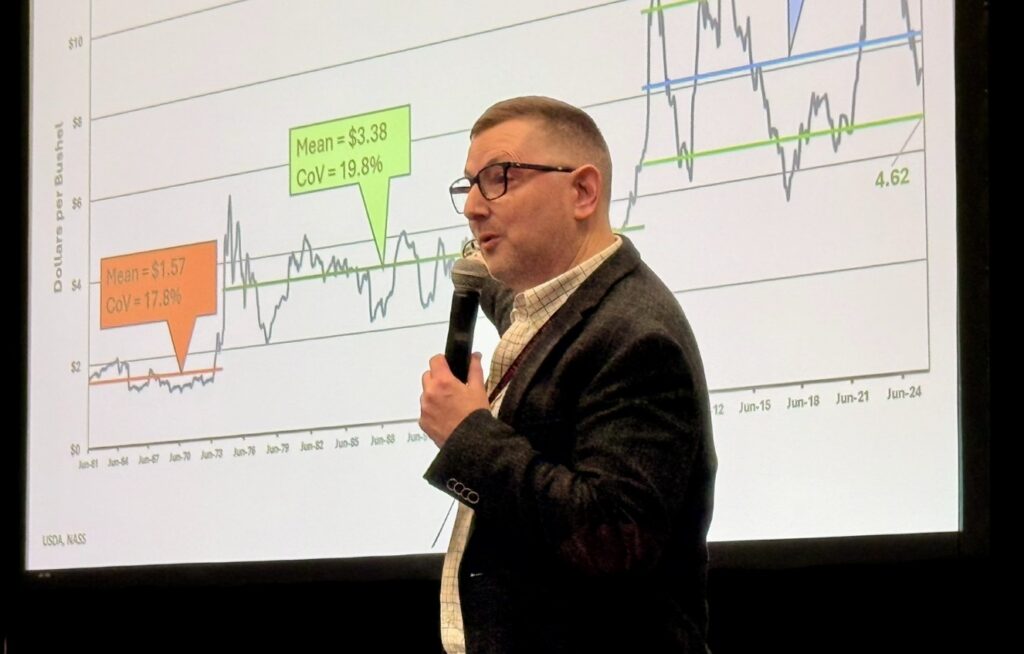
The agricultural markets are experiencing notable volatility, driven by international political developments and shifting economic forecasts. Farm Director KC Sheperd recently sat down with Todd Hubbs from Oklahoma State University (OSU) to discuss the current state of the markets and what producers can expect in the coming weeks. The conversation highlighted how global events, particularly recent discussions between the United States and China, are affecting commodity prices, such as grain and soybean prices.
Global Factors Dampen Market Rallies
While there was an initial boost in the markets following high-level international meetings, that momentum has faced headwinds. The market initially reacted positively to a meeting between the U.S. President and Chinese President Xi Jinping, but those gains have since receded.
“We got a little jump out of the announcement with the President’s meeting with Xi in China, and that was nice, but we’ve just sort of been fading out of it ever since then,” Hubbs noted. “I would love to see us get back to where we were after the WASDE report kicked off, but I think there is just too much uncertainty with everything going on geopolitically.”
Beyond geopolitical tensions, broader financial factors are also influencing the agricultural sector. Hubbs pointed out that “there’s probably some questions about this deal we have with China, and in general, just economic growth around the world—this long tail on this energy supply shock.” Consequently, a brief period of weakness has emerged, though current positions remain stronger than in previous months, with July futures hovering near $6.60 after previously approaching $7.50 following the May production report.
Soybeans Show Resilience Amid Volatility
Soybeans have been a primary focus of recent trade discussions with China. Although prices rallied slightly following the bilateral meetings, they have since flattened out. Hubbs explained that broader global economic pressures are limiting sustained upward movements across multiple crops.
“The crops in general, I think just everything going on in the world is sort of taking the juice out of our rallies,” Hubbs stated. “Just loads of uncertainty, both macro and geopolitically, and we’re just having a tough time keeping prices moving higher.”
Despite these challenges, specific indicators for the soybean market remain positive:
- November beans are trading around $11.95, while July contracts are near $12.04.
- The market is experiencing sideways-to-down actions, alongside ongoing volatility linked to trade dynamics in the Strait of Hormuz.
- Recent crush numbers from the National Oilseed Processors Association (NOPA) came in strong early in the week.
- Demand for soybean meal remains robust, and soybean oil prices are holding in the mid-70s due to a rally in biofuels.
“I think there’s some real support under soybeans, and hopefully, it drags some of these other crops up higher with it,” Hubbs added.
Wheat Harvest Underway Early in Oklahoma
In addition to market analysis, Hubbs shared details regarding his recent travels to Enid, Oklahoma, where he co-hosted an annual educational event alongside Dr. Phil Kenkel. The grain grading school focuses on teaching elevator employees how to properly grade Hard Red Winter wheat to ensure fair pricing during transactions.
This training coincides with what is shaping up to be an unusually early harvest season. “This is one of the earliest harvests we’ve had in a while,” Hubbs confirmed, noting that recent rainfall across the Southern Plains may have arrived too late to significantly alter production outcomes.
“I don’t think it’s going to help us as much at this point in large parts of the Southern Plains,” Hubbs explained regarding the recent rain. “It’s probably a little bit too little, too late. Maybe there’s some places that get a little boost, but yeah, it’s already kicking off.”
This early start is also being reported anecdotally in Kansas, with wheat beginning to arrive at elevators in scattered trickles, a trend expected to accelerate significantly over the next two weeks. While the USDA previously released a bullish price outlook coupled with a bearish production estimate for the region, Hubbs believes those production figures are likely accurate for Oklahoma. “I think this has been a really rough year for Hard Red Winter wheat,” he concluded.
Strategic Advice for Producers
Given the rapid shifts in market conditions, Hubbs offered guidance for agricultural producers looking to manage their risk effectively. With cash prices in Oklahoma currently topping out at around $6.97, producers must remain vigilant about weather patterns in the Midwest corn belt, where emerging dryness could trigger sudden market movements.
“If you missed this last rally, I’d really start thinking about what kind of price is profitable for me,” Hubbs advised. “Hopefully we know that, start setting some targets on where you might want to sell your wheat, and maybe keep your bids active.”
Because daily price fluctuations can reach 25 to 30 cents per bushel, automated target bids can help producers capture brief upward spikes that they might otherwise miss during a busy harvest season.