

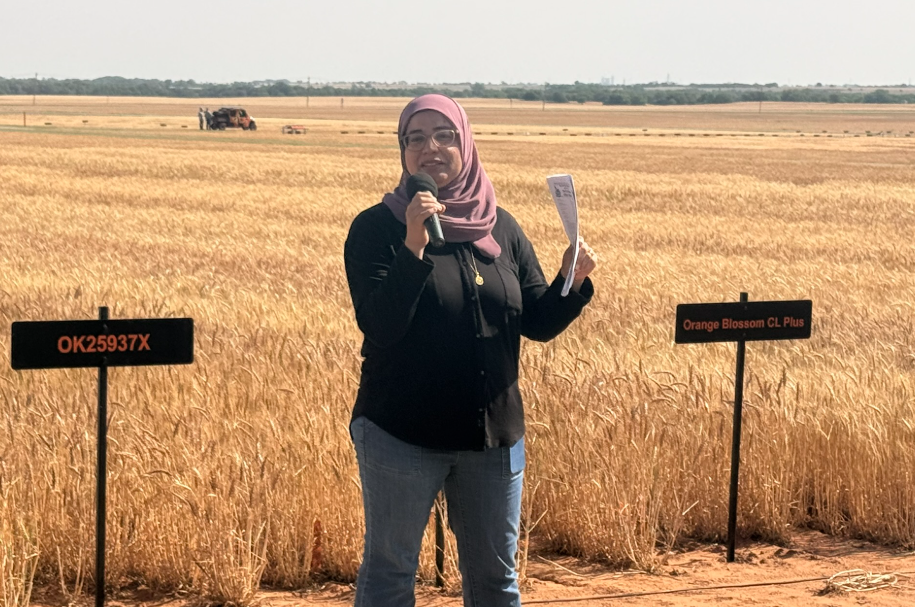
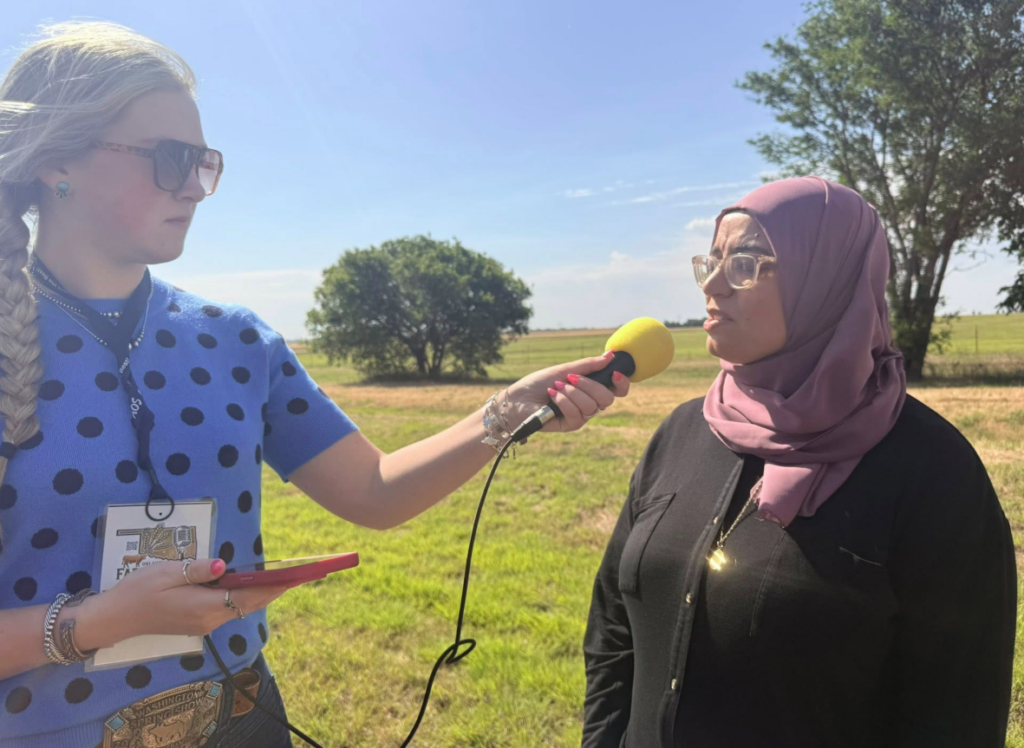
Wheat disease pressure in Oklahoma has intensified this season, with multiple viruses and fungal infections affecting fields across the state, according to Oklahoma State University plant pathologist Dr. Meriem Aoun. Speaking during the Lahoma Wheat Field Day with summer intern Presley Strickland, Aoun said growers are seeing unusually widespread disease activity, particularly from wheat streak mosaic, barley yellow dwarf, and leaf rust.
Wheat Streak Mosaic Expands Across Oklahoma
Aoun described wheat streak mosaic as the most significant issue facing producers this season and noted that it has expanded well beyond its traditional footprint.
“This season, the main disease that we saw is a wheat streak mosaic,” Aoun said. “This is the second year in a row that we have this disease widespread, not only at the Panhandle, where we usually see it, but also down the state, and in southern counties in the state.”
She explained that wheat streak mosaic is not a single disease but rather a viral complex transmitted by wheat curl mites. “It is comprised of a complex virus,” she said. “We have the wheat streak mosaic virus, and we have the triticale mosaic and the high plains mosaic, so all three viruses are transmitted by the wheat curl mites.”
According to Aoun, what stands out in 2026 is the frequency of triticale mosaic virus compared to prior years. “The frequency of triticale mosaic virus was very high compared to what I saw in previous years, like in 2022 or last year in 2025,” she said. “Wheat streak mosaic virus is still there, but at very low frequency, we are seeing high plains mosaic virus.”
Barley Yellow Dwarf Showing Up Statewide
Beyond wheat streak mosaic, Aoun said another virus is proving especially noticeable across Oklahoma fields.
“We are seeing barley yellow dwarf, so that’s another virus,” she said, explaining it is spread by cereal aphids. “It was almost everywhere I went. I was seeing barley yellow dwarf. It is a common virus in Oklahoma, but I didn’t see this level of infection compared to previous years.”
Leaf Rust Defies Dry Conditions
The third major concern is leaf rust, a fungal disease that has surprised researchers because of the state’s dry conditions. “Although we have a dry season — fungi usually like humidity — this year we are seeing a high level of leaf rust, although we don’t have that much rainfall,” Aoun said.
She added that similar observations are being reported farther south. “This was similar to what our colleagues are seeing also in Texas, so usually the inoculum that is in Texas gets spread north to Oklahoma, and I think it goes all the way north to Canada.”
Why Disease Pressure Research Matters
Strickland also asked about comments from wheat breeder Dr. Brett Carver regarding disease pressure and why variety testing matters. Aoun said resistance and tolerance become especially important during heavy disease years. “Some varieties have some tolerance to the disease,” Aoun explained, pointing to Double Stop as an example. “Although it doesn’t have a resistant gene like WSM1 or WSM2 genes, it has tolerance. We don’t know why that is in Double Stop, but under high pressure it may not perform well.”
She cautioned producers not to assume resistant genetics guarantee protection, especially as triticale mosaic pressure increases. “Many of the varieties that carry WSM1 and WSM2 provide resistance to wheat streak mosaic virus, but not to the tritical mosaic virus,” Aoun said. “Because we are having higher frequency of tritical mosaic virus, high pressure of the disease, those varieties that we think have the resistant gene, they may not perform well.”
What Causes a Bad Wheat Streak Mosaic Year?
When asked why some years produce heavier wheat streak mosaic outbreaks than others, Aoun pointed to a combination of lingering virus pressure, mite survival, planting timing, and weather patterns. “For this year, we already had the curl mite population that had the virus from the last season,” she said. “If we plant early, usually the virus is going to be transported to the new crop.”
A mild winter also likely contributed to increased disease pressure. “We didn’t have a cold winter, and if we don’t have that cold, the population of mites can still survive in the winter,” she said. “That’s going to cause a problem in the field.”
Looking Ahead: Disease Pressure Remains Hard to Predict
Even with growing research, Aoun acknowledged there is still unpredictability surrounding outbreaks. “Sometimes it’s unknown,” she said. “We cannot predict when the disease will happen. It happened in 2022, then 2023 and 2024 were fine, but 2025 and 2026 we had high disease pressure.”
Ultimately, she believes this year’s challenges may stem from a continuation of last season’s problems. “Last year, I think the inoculum was transmitted to this year,” Aoun said. “It’s a continuation of what we saw last year.”







