

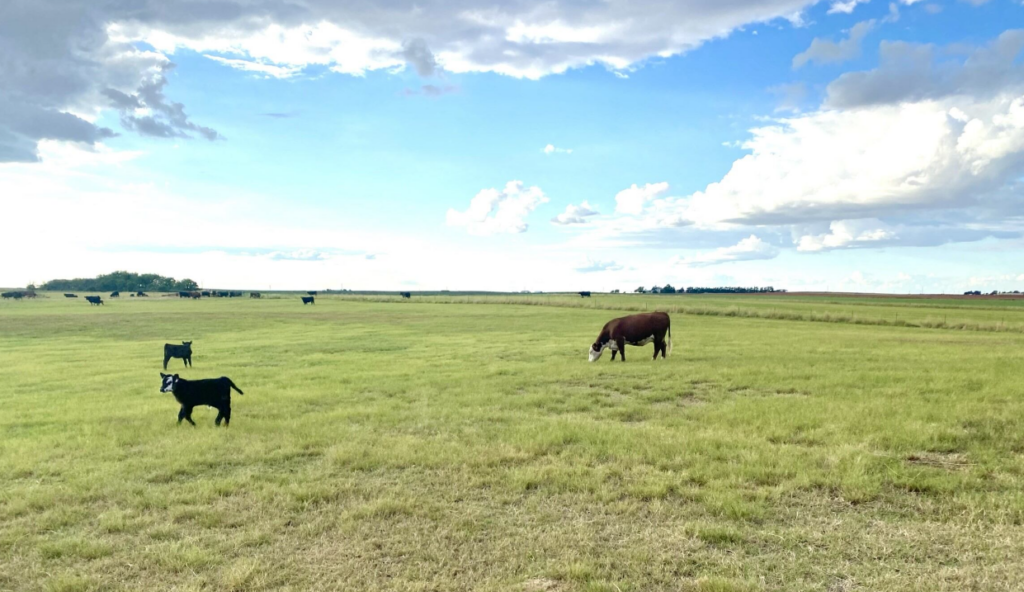
The ten days leading up to Memorial Day were very busy and touched on many aspects of cattle and beef markets – with lots of driving.
Days 1-3 The adventure began with travel from Oklahoma to New Mexico. Pasture conditions were very dry, punctuated by numerous wildfires across the Texas Panhandle and in New Mexico. New Mexico is currently reporting 60 percent of pasture and range in poor to very poor condition. The Livestock Marketing Information Center (LMIC) meeting in Las Cruces included, among others, a presentation on cattle and sheep predation losses due to Mexican wolves.
Day 4 The following day, the LMIC group toured the (very quiet) cattle border crossing facility at Santa Teresa, New Mexico. The border has been mostly closed since November 2024. The group included numerous university and agency folks who had not been to the border before. It’s an impressive facility that accounts for roughly 50 percent of Mexican cattle entering the U.S. when it is operational. Presentations on the history and operation of the facility were augmented by comments from the current president of the Union Ganadera Regional de Chihuahua on the impact of the border closure in Mexico and ongoing developments.
Days 5-6 Next was a return to Oklahoma City for the U.S. Meat Export Federation (USMEF) Spring conference. I was part of a very dynamic panel discussion on U.S. and international cattle and beef markets. Take-home messages in this discussion included the importance of rebuilding the market in China and the vital need to maintain the U.S. – Mexico – Canada Free Trade Agreement (USMCA) in the upcoming review.
Day 7 This was the one day in the office at OSU to catch up on email. Featured that day was the release of the May Cattle on Feed report showing the first year over year increase in feedlot inventories in 18 months. April placements were up 5.5 percent over last year and marketings were down 10.0 percent year over year. The numbers do not suggest any significant change in feedlot supply fundamentals but some changes in timing with feedlots slightly more front-loaded in the next few months. The day included five media interviews about the COF report and other topics.
Day 8 The day was filled with driving north from Oklahoma, across Kansas to I-80 in Nebraska and turning west. Passing Grand Island brought to mind the JBS plant there and the challenges packers are having due to reduced cattle volume. A few miles west and we passed Lexington, Nebraska – home of the first casualty of prolonged reductions in cattle inventory with the closure earlier this year of the Tyson plant there. Farther west yet was North Platte, home to the new Sustainable Beef packing facility. Nebraska is home to the most commercial cattle slaughter of any state. Approaching Scottsbluff, the dry conditions were evident. Nebraska is currently reporting 83 percent of pasture and range in poor to very poor condition.
Day 9 Pushing west out of Nebraska, we passed through Torrington, Wyoming where the livestock auction has reported unusually large volume sales in recent weeks due to drought liquidation in the region. Wyoming pasture and range conditions are currently reported at 65 percent poor to very poor. Ranges were slightly greener in northern Wyoming compared to most of the eastern part of the state.
Day 10 Memorial Day in Montana. The kickoff to summer grilling – with boxed beef prices this week at $392.65/cwt., up 9.3 percent compared to the same time last year. The boxed beef cutout has averaged 14.8 percent higher year over year every week thus far in 2026. Beef demand continues to be very robust and resilient, which combines with the multi-decade low in cattle inventories to support unprecedented cattle and beef markets.
I have driven about 3100 miles the last ten days with a wide range of cattle industry sights and conditions from the Mexican border almost to the Canadian border. I’m headed to the Beef Improvement Federation (BIF) meeting in Boise, Idaho next week before returning to Oklahoma.







