

The digital divide remains a significant challenge for many rural areas, but a long-standing program in Oklahoma is successfully bridging the gap. Through a strategic partnership between Oklahoma State University Extension and rural Oklahoma libraries, local communities are finding new ways to access the modern digital world. In a recent interview, Radio Oklahoma Ag Network Farm Director KC Sheperd sat down with OSU Extension Specialist for Rural Economic Development Brian Whitacre to discuss the ongoing success of this initiative and the shifting landscape of Oklahoma’s digital infrastructure. The audio file brian.mp3 contains the full context of their discussion.
“This is a program we’ve had running for almost a decade now, and it is one where we partner with rural libraries across the state,” Whitacre explained. “We partner with those libraries to loan out hotspot devices.”
Meeting a Critical Community Need
The program targets smaller communities, ranging in population from a few hundred to 10,000 residents. For families lacking reliable home internet, these library-brokered hotspots provide a critical connection point for smartphones, tablets, and computers.
More than 90% of participating libraries choose to continue the hotspot program after their initial year, demonstrating a profound local reliance on the service.
“We try to go in and look at how many people in the community either don’t have a regular home connection or are relying only on their smartphone,” Whitacre noted. “You have to pay a lot of money for a regular monthly connection for your smartphone, and you can use up all that data—they charge you for overages. If you’ve got kids trying to do homework and trying to stay in touch with family and friends, it goes away quick. So yeah, there is a huge need for this.”
Expanding the Initiative
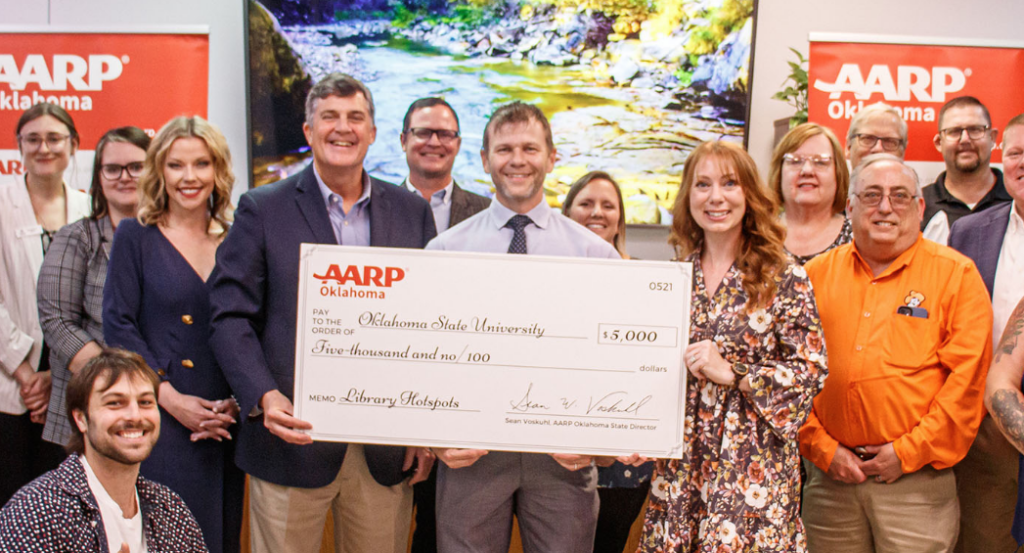
To keep the momentum going, the program is actively looking to recruit more locations. Supported by continued funding from AARP, the initiative provides substantial assistance to new libraries in establishing their own hotspot lending systems.
“We are looking for three or four more libraries, probably by the end of the summer,” Whitacre said. “We would love to connect with them. AARP has once again provided a check for this next year, so we are looking to fund rural libraries. We usually partner with three or four, and we give them about seven to 10 devices and the full unlimited data for that first year.”
Whitacre encourages interested library directors to reach out directly via email by searching for his contact information through Oklahoma State University.
The Digital Literacy Challenge and AI
While physical connectivity is the first step, navigating the internet safely and productively requires specific skills. As artificial intelligence continues to emerge as a powerful tool, digital literacy has become even more critical for rural residents.
“There’s still kind of a digital skill component of this,” Whitacre said. “It’s great to have connectivity, but if you don’t have an email account yet, you can’t really go in and do a whole lot. Or if you don’t know how to set up a banking account online, there’s a need to help people productively use the internet.”
He noted that the same learning curve applies to emerging technologies.
“The same thing is true with AI. If you’ve explored ChatGPT or Claude or some of the other ones that are out there, you can see how powerful they are, but it really takes some digging and some skills to help people use those tools productively,” Whitacre stated. “That’s something we’re hoping to partner with this program. If we can lend out hotspots to people and then have some sessions where we explain things that they might struggle with, that’s really something we would like to do.”
Oklahoma’s Broader Broadband Outlook
Beyond local library initiatives, a massive statewide infrastructure expansion is underway. Managed by the Oklahoma Broadband Office, three active programs are working concurrently to establish robust, permanent internet infrastructure across all 77 counties.
Infrastructure Progress Timeline
| Program Type | Target Scope | Completion Timeline |
| ARPA Programs | ~70,000 unserved/underserved households | Complete by December 2026 |
| BEAD Program | ~40,000 remaining households | Estimated completion by 2029 |
The strict federal guidelines tied to the ARPA funds ensure that the largest phase of the buildout will be finalized rapidly.
“The good news is that the two biggest of those programs that are going to connect about almost 70,000 of the households that still need good service will be done by the end of this year,” Whitacre said. “These are ARPA programs… you got to spend the money by December 2026. So we’ve got a lot of providers out there actively working on this.”
The remaining funding, allocated through the Broadband Equity, Access, and Deployment (BEAD) Act, will tackle the final, most remote locations over a four-year implementation window.
“The last chunk of money through BEAD was just allocated,” Whitacre explained. “Those programs won’t get rolling probably till the end of this year, and then they still have four years from then to hopefully finish off this piece. Those are going to be about another 40,000 households, and those probably will be done—again, they got four years to finish up, so we’re talking 2029—by the time we have good connectivity everywhere across the state.”
A Diverse Mix of Technologies
To achieve total state coverage, Oklahoma is utilizing an omnichannel technology strategy rather than relying on a single delivery method. While fiber-optic cable remains the primary target due to its speed and reliability, fixed wireless and satellite systems fill critical gaps in topographically challenging areas.
“Fiber is still the gold standard, and the good news for Oklahomans is that the vast majority of the money that’s being spent across those three programs is for fiber,” Whitacre emphasized. “I think 70% of the households that will get service will be through fiber, and then another 10% will get the satellite connections… and another 20% will get those fixed wireless that are often really good solutions in rural communities.”
Residents seeking details on active construction and local service availability can access updated maps and monthly progress bulletins directly on the Oklahoma Broadband Office website.







