Conformation of the teats and udder of beef cows are economically important traits in cow-calf operations. Correct teat and udder conformation are traits essential to a productive cow. Beef females with poor teat and udder conformation are a management problem that can drain profitability. Substandard teat and udder conformation requires extra management intervention to physically “milk-out” quarters to prevent infection, save the quarter and permit new born calves to nurse. As well as increasing the likelihood of mastitis and calf sickness while reducing weaning weights and cow longevity.
Teat and udder scores are moderately heritable meaning improvement can be made when selection pressure is applied. Since teat and udder conformation is a challenge to evaluate at selection time in weaned or yearling heifers, it is best to monitor in the cow herd and avoid keeping replacement heifers from dams with substandard teat and udder conformation. Teat and udder conformation can also be considered in sire selection. For example, since 2025, the American Angus Association generates EPDs for Teat Size and Udder Suspension. Higher EPD values indicate smaller teats and tighter suspension. These EPDs are generated using breeder submitted data, pedigrees and genomics. The guidelines for collection of teat and udder score phenotypes are as follows:
- Collect within 24 hours of calving
- Use the worst quarter to score teat size and udder suspension
- Best if the same person scores all the females in a management group
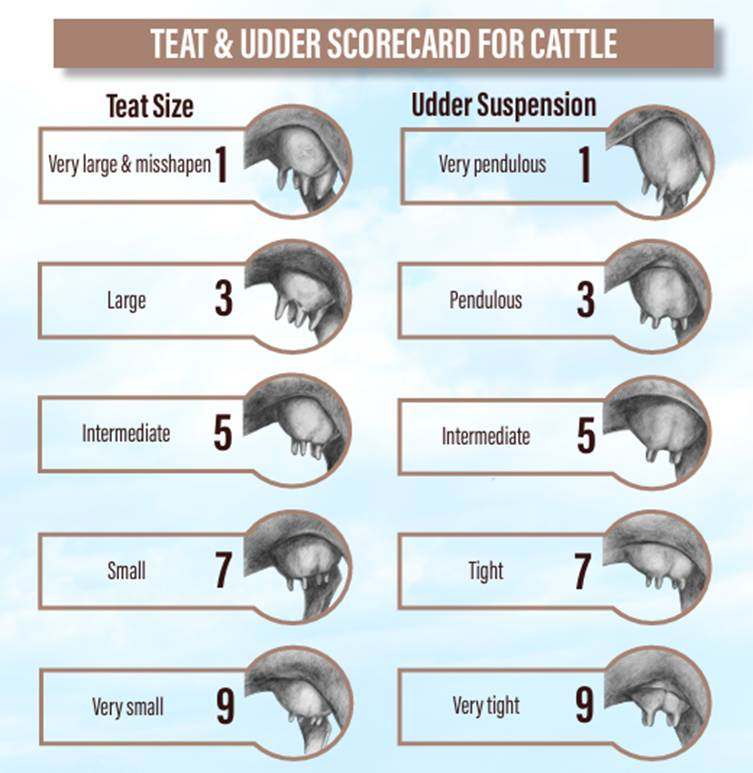
- Score teat size and udder suspension independently on a scale ranging from 1 – 9. Using the following chart as a guide: