

During a Thursday afternoon USDA briefing led by U.S. Agriculture Secretary Brooke Rollins and other federal and state officials following the confirmation of a New World Screwworm case in Texas, Texas State Veterinarian Dr. Bud Dinges outlined the state’s response efforts, quarantine measures, and the steps livestock owners should take to help prevent the spread of the pest. Dinges emphasized that Texas and USDA officials have been preparing for this scenario and are already implementing response plans designed to contain the outbreak quickly.
The first confirmed U.S. case of New World Screwworm since 1966 was detected in a 3-week-old beef calf near La Pryor in Zavala County, Texas. The infestation was found in the calf’s umbilical wound, and state and federal officials report no additional cases have been identified on the operation.
Infested Calf Improving as Investigation Continues
Dinges provided an update on the infected premises, noting that officials visited the location and found encouraging signs. “Staff visited the premises with the infested calf yesterday,” Dinges said. “The infested calf’s doing much better.”
According to Dinges, inspections of other cattle on the property have not uncovered additional cases. “They looked at the cattle on the premises there and didn’t find any other infested animals,” he said.
The investigation has also shown no evidence that livestock have recently moved onto or off the property. “From our EPI investigation, there is no evidence of a recent movement of animals onto or off of that premises,” Dinges said.
Years of Preparation Put Into Action
Dinges thanked Secretary Rollins for her leadership and stressed that Texas, USDA, and their partners have been preparing for a New World Screwworm detection long before this week’s confirmation. “The USDA and Texas and partners have taken a forward-leaning approach in this suspicion and to response preparedness in general, so that we can tackle the first confirmation of New World Screwworm with confidence in all the tools at our disposal to ensure an efficient response,” Dinges said.
He added that response teams are already on the ground gathering information and assessing conditions. “Our responders are already in the area, conducting site visits and evaluating the situation to ensure we have the correct information we need to mitigate the spread,” he said.
Dinges said response structures are already in place and established plans are now being activated. “Our response structure is established, and we are enacting existing response plans to minimize the impact of this pest.”
Quarantine Established Around Infested Zone
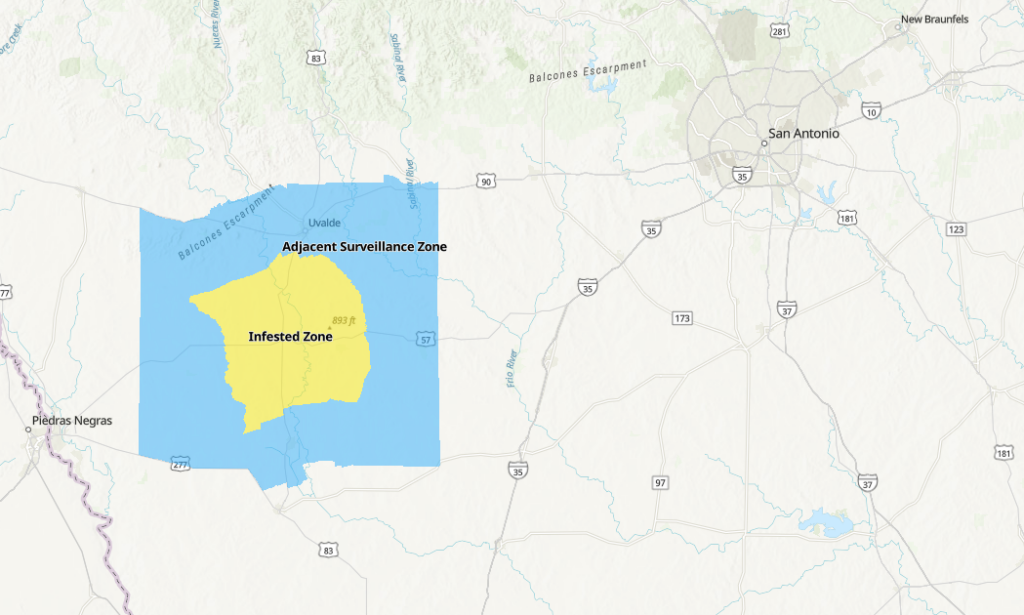
One of the most significant actions announced by Dinges was the creation of an infested zone around the affected area. “Some of these actions include establishing an infested zone that Secretary Rollins mentioned earlier,” Dinges said.
To support that effort, he has issued an executive order placing movement restrictions on susceptible animals. “With the zone, I have issued an executive order that places a quarantine on all warm-blooded animals.”
Dinges urged producers and animal owners to comply with the restrictions. “It is very important that all animal owners understand the importance of not moving their animals out of this zone at this time,” he said. “Please help us prevent any further movement of this pest by staying put and contacting the Texas Animal Health Commission if you have animals that need to be permitted out of the zone.”
He explained that animals may still be allowed to move, but only after proper inspection. “No movement of warm-blooded species will be allowed out of this zone without an inspection by an animal health official.”
Increased Surveillance and Producer Outreach Underway
Texas Animal Health Commission personnel have increased their presence throughout the affected area.
“Currently, an increased presence of Texas animal health personnel are in the infested zone, conducting animal surveillance and epidemiological investigations, meeting with producers, providing resources in the infested zone, and raising awareness of key actions like inspection points,” Dinges said.
He emphasized that producer cooperation will be critical to preventing additional cases.
Four Key Messages for Animal Owners
Dinges outlined four primary points livestock owners and animal caretakers need to understand as the response moves forward.
1) Report Suspected Cases Immediately
The first priority is rapid reporting of any suspicious infestations. “If you suspect your animal may be infested with New World Screwworms, notify the Texas Animal Health Commission or your local veterinarian immediately,” Dinges said. “Quick notification leads to quick detection and quick response to stop this pest from spreading.”
He reiterated that animal movement can continue when done safely. “Animals will still be able to move. We just need to make sure that they are moving safely and not moving the screwworm with it.”
2) This Is Not a Food Safety Issue
Dinges made a point to distinguish the threat posed by New World Screwworm from food safety concerns. “This is not a food safety issue, this is a food production issue,” he said. “New World Screwworm does not infest meat, fruits, vegetables, or other food sources.”
3) Prevention Starts With Vigilance
Animal owners should closely monitor livestock and other animals for wounds that could attract screwworm flies. “Infestations from this pest can be prevented,” Dinges said. “Animal owners need to look at their animals as often as possible and stay vigilant, monitoring for wounds that can be covered and treated.”
He explained that the pest is not spread through animal-to-animal transmission. “This is not an infectious disease, and these flies have to lay their eggs in, or on, or near a wound for an animal to be infested.” “Treat and cover wounds as quickly as possible.”
4) Cases Are Highly Treatable
While New World Screwworm is a serious threat, Dinges stressed that infestations can be successfully treated when identified quickly. “This is a highly treatable condition,” he said.
“If you do get a case, we may have tools in our toolkit to prevent devastating impacts.”
Commitment to Transparency
Closing his remarks, Dinges sought to reassure producers, veterinarians, and the public that officials are prepared and actively responding. “I want to reassure all of you that we have been preparing for this and are taking rigorous action to protect the state and the nation from this pest,” Dinges said.
He pledged that state and federal officials will continue providing updates as the situation develops. “We’ll continue to be transparent, provide updates of the situation as we receive them.”
Secretary Rollins announced that USDA is adding a new account on X that will focus on all the news related to the New World Screwworm situation- follow @Screwworm_RR for those updates.







