The number of New World Screwworm (NWS) cases in the United States is now at eight according to USDA.
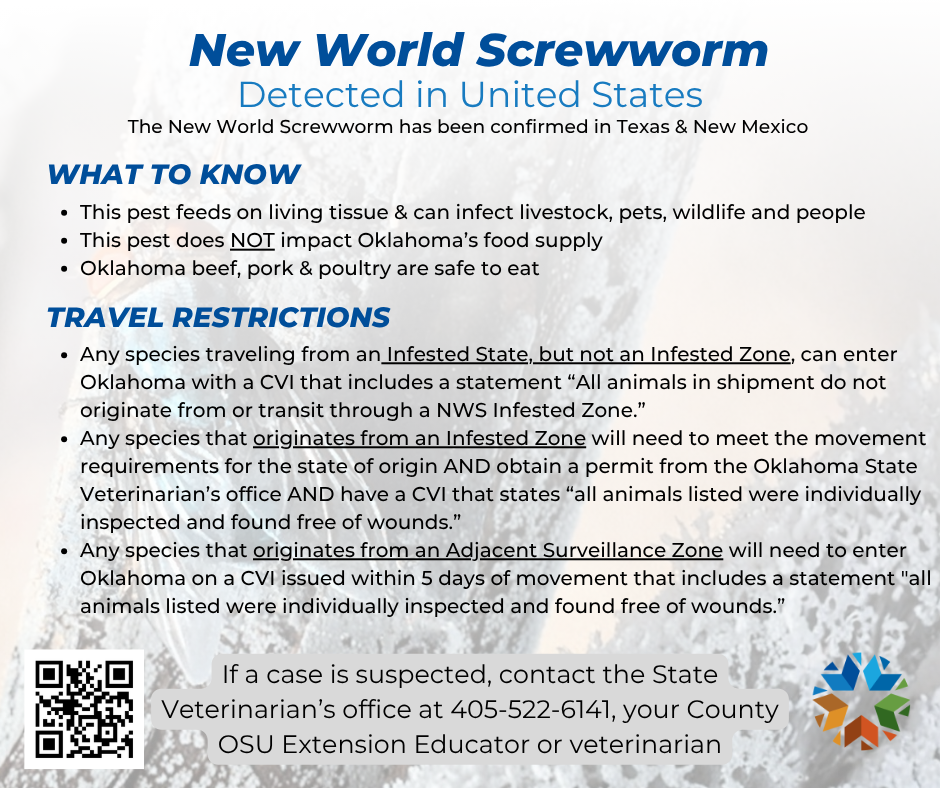
Yesterday, the Oklahoma Department of Agriculture, Food and Forestry issued updated movement requirements for animals that originate from an NWS Infested Zone or NWS Adjacent Surveillance Zone. The information for the updated movement restriction is below. Here is a summary of terms related to the zones:
– An Infested Zone (IZ) is defined as an area approximately 20 kilometers (12 miles) around an active case of NWS.
– A Surveillance Zone is defined as an additional area of approximately 20 kilometers beyond an IZ.
OCA has been in active communication with Secretary Blayne Arthur and Dr. Rod Hall at the Oklahoma Department of Agriculture, Food and Forestry (ODAFF) over the past several days and will continue to do so. We continue to appreciate their excellent leadership and the partnership they foster with animal agriculture.
NOTE – for those planning to haul cattle out of Oklahoma:
Many states have issued requirements for the movement of livestock INTO their states. As always, if you plan to transport cattle out of or into Oklahoma, it is important to understand the rules issued by each state veterinarian’s office. Your local veterinarian will know these requirements and can help guide you through the process. You can also contact the ODAFF State Veterinarian’s office for clarification at 405-522-6141.
Important resources for OCA members:
· Livestock producers can visit screwworm.gov for specific information on how to prepare, available resources and the most current official updates.
· Oklahoma State University Extension has excellent resources available by clicking here.
· For a list of animal drugs approved for use for NWS, click here.
Important information for OCA members:
· The food supply is safe. NWS is a live-animal pest and does not impact the food supply. Meat, eggs, dairy and other food products remain safe.
· Livestock producers should remain vigilant by inspecting their livestock, continuing to educate themselves and staying aware of current conditions. Early detection and rapid response are the most effective strategies. Report any suspicious wounds or cases immediately to your veterinarian or contact the ODAFF State Veterinarian’s office at 405-522-6141.
· OCA encourages all livestock producers to create and maintain a valid veterinary-client-patient relationship (VCPR) with their local veterinarian in order to be prepared.
· Contact the OCA office at 405-235-4391 if you have any questions or need additional information.