Disclaimer: The information contained below is current as of 8:00 AM on Monday, June 15th.
On Wednesday June 3rd, 2026, USDA confirmed that New World screwworms, Cochliomyia hominivorax (Coquerel), were found infesting the umbilicus of a calf in Zavala County in Texas. This marked the first time since 1982 that New World screwworms have been found in Texas, and was the first domestic case resulting from the current outbreak that began in 2023. Since that initial case in Zavala County, infested animals have now been found in five additional counties in Texas and one county in New Mexico. Impacted species include cattle, goats, sheep, and a dog (Figure 1). The current total number of cases is 12.
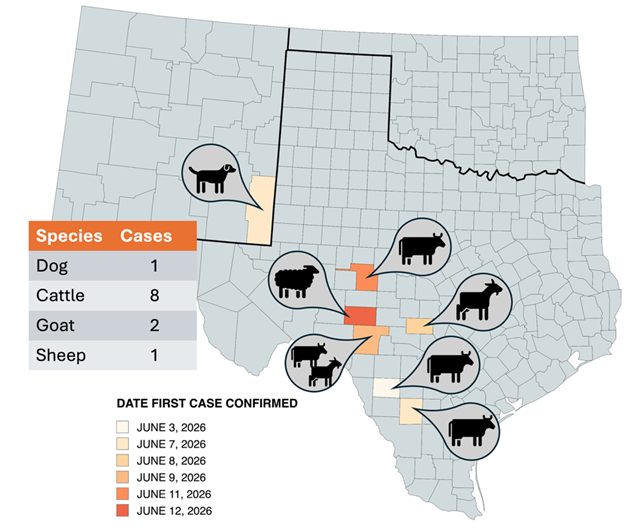
Figure 1. New World screwworm detections in the United States, including county, species impacted, and number of cases per species. Data are current as of 8:00AM on Monday, June 15th, 2026. Data from the USDA New World screwworm Detections Dashboard. Map created using www.mapchart.net.
Although Oklahoma cattle (and other livestock, pets, and wildlife in the state) are currently not impacted by New World screwworms, being prepared, and knowing what factors can contribute to an infestation are critical. The most important step in this process is wound prevention and management on animals. New World screwworms require an infected natural body opening or an open wound on an animal around which to lay their eggs; this wound can be as small as a horn fly or tick bite, as large as a cut or scrape, or the unhealed umbilicus of a newborn/young animal. Reducing the number of fly and tick bites can be achieved through proper pest management (see the March 3rd, 2025 Cow-Calf Corner Newsletter article for information on horn fly management); it’s not too late to implement a horn fly management plan. The management of larger wounds can be achieved through regular and frequent monitoring and inspection of animals. Daily monitoring and inspection of livestock is preferred, but animals should be inspected at least twice weekly. As I say in many of my Extension presentations: Our cows aren’t walking around with Neosporin and Band-Aids, so it’s up to us to provide that wound treatment for them. Noticing a wound early, and providing treatment so that it heals quickly, will help reduce the risk of a New World screwworm infestation. Additionally, if you notice multiple animals within your herd with the same wound in the same location: identify the source. Rusted and/or broken hay rings, feed troughs, creep feeders, and other items and equipment in your pastures can all cause scrapes and cuts if animals rub up against them.
Regular and frequent monitoring of animals, and subsequent wound care, will become increasingly more important as New World screwworms continue to move northward. Getting into practice now of frequently checking your animals for wounds and treating those wounds will go a long way to help stop the spread of screwworms. However, if during your monitoring, you notice a living animal with a wound infested with fly larvae (maggots), contact your county Extension office or veterinarian immediately. For additional resources, and the most up-to-date information, visit screwworm.okstate.edu.
Dr. Jonathan Cammack, explains the biology of the New World screwworm, how the fly moves across regions, and the parasitology behind infestations in livestock and other animals, and how the USDA is working to address the issue on SunUpTV from June 9, 2026 at https://www.youtube.com/watch?v=Yd6HwqamHjQ