

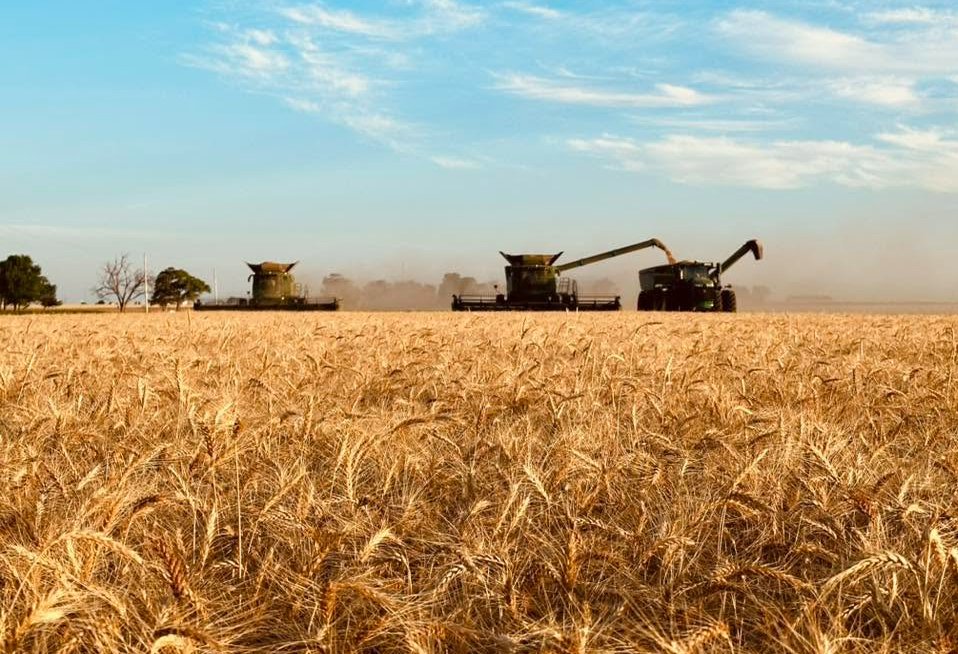
The Oklahoma wheat harvest is rapidly approaching the finish line, with the Oklahoma Wheat Commission reporting the statewide harvest at 90% complete. While combining is wrapping up across most areas, operations have shifted focus to the northern tier of the state, where frequent rain events are creating a delicate balancing act between high yield potential and declining grain quality.
A Tale of Two Progress Reports
A significant disparity exists between recent federal data and state-level observations regarding the pace of this year’s harvest. The USDA National Agricultural Statistics Service (NASS) crop progress report rated the Oklahoma winter wheat harvest at 73% complete. By comparison, last year’s harvest at this time stood at 26% complete.
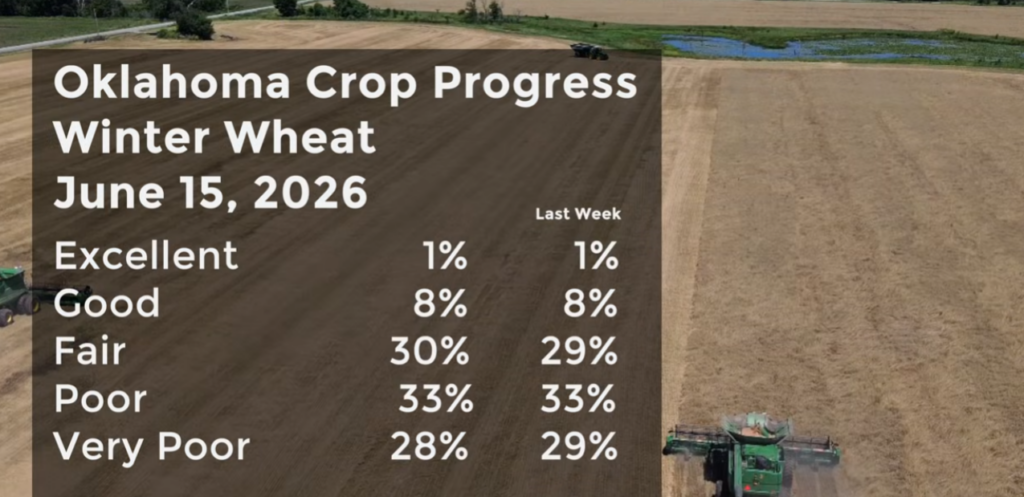
The USDA report also highlighted the heavy toll that challenging weather conditions took on the crop during the growing season, rating Oklahoma winter wheat condition as:
- 28% very poor
- 33% poor
- 30% fair
- 8% good
- 1% excellent
This places the crop at a combined 61% poor to very poor, with only 9% registering in the good to excellent categories.
High Variability in North Central and Northeastern Oklahoma
As the harvest moves through north central and northeastern Oklahoma, producers are seeing extreme variability in performance. Dr. Amanda Silva, Oklahoma State University Extension small grain specialist, noted that yield levels in the north-central region range from 1 to 70 bushels per acre. This extreme variation is appearing not just across regional lines, but even between different fields within the exact same county.
In northeastern Oklahoma, combines are rolling despite persistent wet weather. In Ottawa County, producer Brent Rendle reported that fields received roughly 8 to 10 inches of rain split across five or six separate weather events over the past month.
Rendle noted that while his wheat headed early—initially signaling a potential May harvest—temperatures pulled back significantly when April turned to May. This weather shift slowed plant maturity, allowing the heads to build bigger and the grains to grow larger. However, persistent wet conditions delayed the start of cutting until last week.
On his soft wheat acres, Rendle reported fabulous yield numbers, with the first three harvested fields averaging over 70 bushels an acre. He anticipates his hard wheat fields will perform similarly, projecting a final average of 70 to 80 bushels per acre across most of his operation.
The primary threat now is the recurring moisture. Rendle noted that his farm received 2 inches of rain recently, with another inch or more forecast in the next few days. Producers face a narrow window to cut wheat before consecutive rain systems knock down test weights and degrade overall quality, mimicking quality struggles seen during the previous harvest season.
Panhandle and Western Oklahoma Face Structural Loss
In the Oklahoma Panhandle, irrigated wheat harvest is roughly 35% complete. Yields on these irrigated acres are mostly running between 40 and 60 bushels per acre, though some fields are trending lower. Test weights on the irrigated grain are averaging a solid 60 pounds per bushel—with some fields testing higher—while protein content is holding steady at 12.5%-13%.
Despite these stable irrigated numbers, the Oklahoma Wheat Commission expects the panhandle region to bring in roughly half of its normal total crop. This deficit is driven by the widespread abandonment of dryland wheat fields across the panhandle, a factor that will significantly impact the final statewide yield totals.
Drought and Mesonet Soil Moisture Insights
The latest U.S. Drought Monitor map, released on June 11, indicates a shrinking drought footprint across Oklahoma, with 64% of the state currently in drought. While this is a notable improvement over previous weeks, the hardest-hit areas remain concentrated in western Oklahoma and the panhandle.
The statewide breakdown shows:
- 20% of the state is in moderate drought
- 13% in severe drought
- 24% in extreme drought
- 7% in exceptional drought
Oklahoma Mesonet data reflects this geographic divide. Early in a recent six-day stretch, intense heat gripped the state, driving heat index values to between 105 and 110 degrees Fahrenheit along the I-44 corridor, with Cherokee and Fairview pushing past the 110-degree mark. Subsequent rainfall provided widespread relief, with many areas of the state receiving more rain in the first half of June than they did during the entire month of May. However, localized areas like Goodwell, Watonga, Forgan, and Hollis continue to miss out on critical moisture.
Soil moisture indicators highlight the ongoing disparity between the eastern and western halves of the state:
- 2-Inch Depth: Central and eastern Oklahoma show favorable moisture levels, registering between 0.8 and 1.0 on the fractional index. Meanwhile, west-central Oklahoma and the far panhandle remain dry, with values between 0.1 and 0.4.
- 4-Inch Depth: Central and eastern areas maintain a solid profile between 0.7 and 1.0, while western Oklahoma and the panhandle continue to show highly depleted levels ranging from 0.1 to 0.5.
Evaluating the Factors Behind Yield
When analyzing the driving forces behind this season’s erratic numbers, Dr. Silva emphasized that environmental moisture is the single most critical element for Oklahoma wheat production.
Silva explained that while wheat has a limited capacity to grow using stored profile moisture, successful seasons rely heavily on timely in-season rain events, making rainfall the primary yield-limiting factor by a wide margin.
Beyond moisture, Silva pointed to management decisions that help mitigate these climate challenges:
- Planting Date: Adjusting planting dates allows producers to manipulate crop maturity timelines. This strategic timing can position the crop to better capitalize on seasonal rainfall events when they occur, though the ideal window varies with the specific year’s weather patterns.
- Variety Selection: Data from state variety trials underscore a strong genetic component in performance. Choosing the right variety directly influences a crop’s built-in drought tolerance, overall resilience, and nitrogen-use efficiency.
Ultimately, Silva noted that these management practices must work in tandem with available moisture to determine the crop’s final success.
To see the complete harvest update from Dave Deken, click on the video below:







