

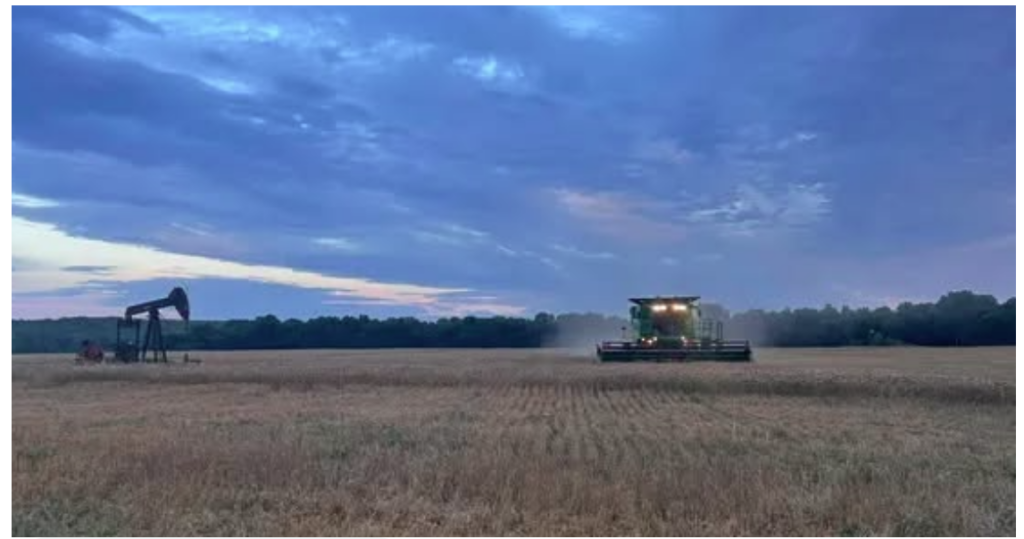
Oklahoma’s 2026 wheat harvest is nearing the finish line, but according to Oklahoma Wheat Commission Executive Director Mike Schulte, this year’s hard red winter wheat crop has been defined by drought, abandonment, and sharply reduced production across much of the state. In a recent conversation with senior farm and ranch broadcaster Ron Hays, Schulte said harvest moved faster than normal in many areas, though rain delays continue in parts of northern and northeastern Oklahoma. “We’re right in the middle of June here, and certainly unusual, we’re really winding down the harvest in many parts of the state,” Schulte said.
He noted that north central Oklahoma still has about 10% of the crop left to harvest, while northeast Oklahoma is only 30% to 40% complete due to repeated rainfall interruptions. In the Panhandle, irrigated wheat remains behind other regions, though progress improved significantly this past week. “Producers have made great strides on the irrigated wheat out there, and probably about 40% complete as we speak today.”
Northeastern Oklahoma Producing Strong Yields Despite Rain
Despite delays, Schulte said northeastern Oklahoma has delivered some of the strongest yields in the state, particularly in soft red winter wheat. “They did get the timely rains all throughout the year,” he said. “A lot of it’s lying on the ground, but they are able to pick it up and still yield, making 70 to 80 bushels on the soft red winter wheat.”
Even hard red winter wheat in that region has held up better than expected. “We’re still looking at maybe some 70 bushel averages over there.”
However, excessive rainfall has hurt grain quality. “If they could have just got to it on some of the earlier cuttings, they were in that 60 to 62 pound test weight average, but when you get an inch to two inches of rain a week in the middle of harvest—and that happens every week for four weeks—it really creates some challenges.”
High Protein Levels Stand Out Statewide
Statewide, Schulte said protein levels have been a major bright spot. “Protein has been exceptionally high across the state, just off the charts for the entire year,” he said, attributing that largely to crop stress. “We’ve had a lot of reports of anywhere from 13 to 15% proteins, but going to call the average for the state 12.5 to 13%, so that’s just not going to be a problem for us.”
Yield, however, remains the biggest issue. Southern and central Oklahoma saw many fields produce only 15 to 25 bushels per acre, though pockets along the Texas border reached the mid 40s to mid 50s thanks to timely rains.
Schulte believes USDA’s estimate of 28 bushels per acre may be too optimistic. “I think we’re going to be maybe somewhere around 25 to 26.”
Abandonment Cuts Deep Into State Production
Harvested acreage is expected to fall below USDA estimates because of widespread abandonment, especially in western Oklahoma and the Panhandle. “There has just been so much abandonment across the state,” Schulte said.
Dryland wheat in the Panhandle was largely lost, while irrigated wheat has also underperformed. “We’re looking at 40 to 60 bushel yields… where typically those yields are 80 to 120 bushels an acre.”
That steep decline will weigh heavily on total production. USDA currently projects Oklahoma at 64 million bushels, while grain and feed estimates were closer to 48 million bushels.
Schulte expects the final number to land somewhere in between. “Hopefully be somewhere around 53 to 55 million bushels,” he said. “That’s still higher than what we had in 2014 when we came in under 50 million bushels—that was just an awful year—but this year, in many cases, really has mirrored that year of 2014.”
Smaller Crop Still Offers Marketable Quality
Even with the smaller crop, Schulte believes Oklahoma wheat remains marketable because grain quality has held together better than expected. “It really still is amazing that we have test weights that we’re talking about with 57 to 59 pound test weight averages,” he said.
While that is below the preferred 60 to 61 pounds, he said the crop still has strong milling value thanks to protein and varietal quality. “We can certainly do something with that as far as quality is concerned.”
The bigger concern is supply. “The main problem is that we just don’t have the amounts to work with that we typically try to put into the export market.” That reduced volume will ripple through rural economies. “It is going to have an economic impact for the state, certainly for our agricultural producers, our custom harvesters, [and] the local economies.”
Outlook Offers Hope for 2027
Looking ahead, Schulte said improving moisture in parts of Oklahoma offers hope for future crops. “Things certainly look different on the drought monitor today than they did a month and a half ago,” he said. While drought remains severe in western Oklahoma, improved rainfall in the north has benefited summer crops.
On the global front, Schulte said wheat markets remain mixed. Strong production from Russia, Turkey, and Ukraine could pressure prices, but shifting supply-and-demand trends may help producers. “Production was outpacing consumption last year, and those numbers are changing,” he said. “It looks like the possibility does exist that consumption is going to be outpacing production again, and so hopefully that’s going to create some opportunities for agricultural producers as well.”







