

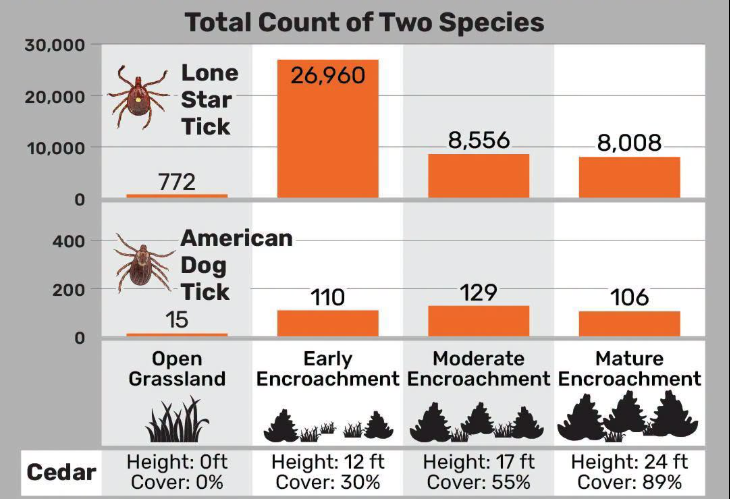
New research from the U.S. Great Plains reveals a direct link between eastern redcedar encroachment and a dramatic spike in disease-carrying tick populations, with the most severe population explosions occurring during the earliest stages of woody plant invasion.
The study, published by Propst et al. (2025), tracked tick abundance across varying levels of cedar density. Researchers found that as open grasslands give way to cedar trees, the environmental change creates a highly favorable habitat for both the Lone Star tick and the American dog tick.
Tick Abundance Is Higher in Cedar-Encroached Areas
Lone star tick was by far the most abundant species across sampling sites.
Two tick species were more abundant in cedar-encroached areas than in grasslands. The greatest increases were in the earliest stage of encroachment.
Lone Star Tick Total Counts
- Open Grassland (0% Cover): 772
- Early Encroachment (30% Cover): 26,960
- Moderate Encroachment (55% Cover): 8,556
- Mature Encroachment (89% Cover): 8,008
American Dog Tick Total Counts
- Open Grassland (0% Cover): 15
- Early Encroachment (30% Cover): 110
- Moderate Encroachment (55% Cover): 129
- Mature Encroachment (89% Cover): 106
Cedar Height & Cover
– Open Grassland: Height 0ft, Cover 0%
– Early Encroachment: Height 12ft, Cover 30%
– Moderate Encroachment: Height 17ft, Cover 55%
– Mature Encroachment: Height 24ft, Cover 89%
Why Early Encroachment Matters
The rapid spike in the early stages of encroachment suggests that even a small amount of cedar cover alters the microclimate enough to favor tick survival. Cedar trees provide shade, retain moisture, and offer leaf litter that protects ticks from the drying effects of direct sunlight and wind typical of open prairies.
As the cedar canopy thickens toward maturity (reaching up to 24 feet in height and 89% ground cover), tick numbers remain elevated compared to open pastures, though they level off below the initial early-stage peak.
This data provides land managers and livestock producers with another critical reason to manage brush and control invasive redcedars early. Preventing the initial wave of woody encroachment is not only vital for preserving forage production and grazing land but also a key factor in limiting the spread of tick-borne diseases affecting both livestock and humans.
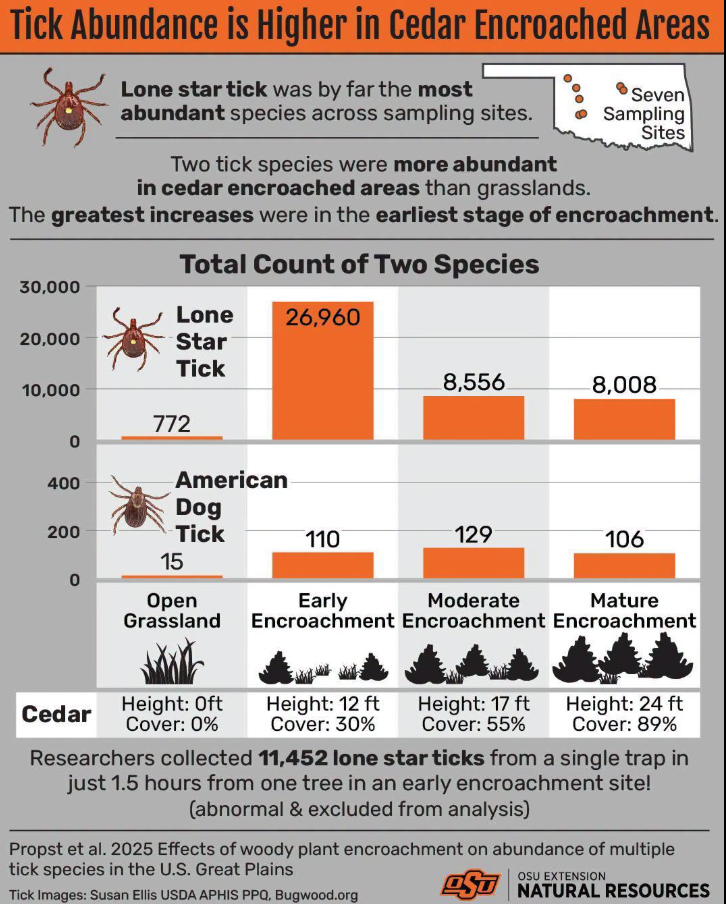
Researchers collected 11,452 lone star ticks from a single trap in just 1.5 hours from one tree in an early encroachment site. (abnormal & excluded from analysis)
Propst et al. 2025 Effects of woody plant encroachment on abundance of multiple tick species in the U.S. Great Plains https://journals.plos.org/plosone/article?id=10.1371/journal.pone.0332832
Tick Images: Tick Images: Susan Ellis USDA APHIS PPQ, Bugwood.org used and edited under CC BY-NC 3.0 https://creativecommons.org/licenses/by-nc/3.0/deed.en