
Total beef imports for the first five months of 2026 are up 9.9 percent year over year. This is the smallest increase for the period since 2023 (Figure 1). For the month of May, beef imports were down 5.0 percent from one year ago, the first monthly year over year decrease since November 2025 and the largest monthly decrease since March 2023.
The decrease in May beef imports was led by a 41.5 percent year over year decrease in beef imports from Brazil. In fact, while Brazil remains the largest source of beef imports, imports from Brazil are down 6.8 percent year over year for the January to May period. Also, Uruguay, the number six source of beef imports, was down 45.7 percent year over year in May, but is up 5.2 percent for the year to date. Simultaneously, beef imports from Argentina are up as a result of the country-specific increased Tariff Rate Quota (TRQ) this year. Beef imports from Argentina are up 113.8 percent year over year so far this year, with Argentina currently accounting for 4.3 percent of total beef imports. This moves Argentina into seventh place, up from eighth last year among beef import sources. In Figure 1, Argentina accounts for 32.5 percent of the “Other” category in 2026.
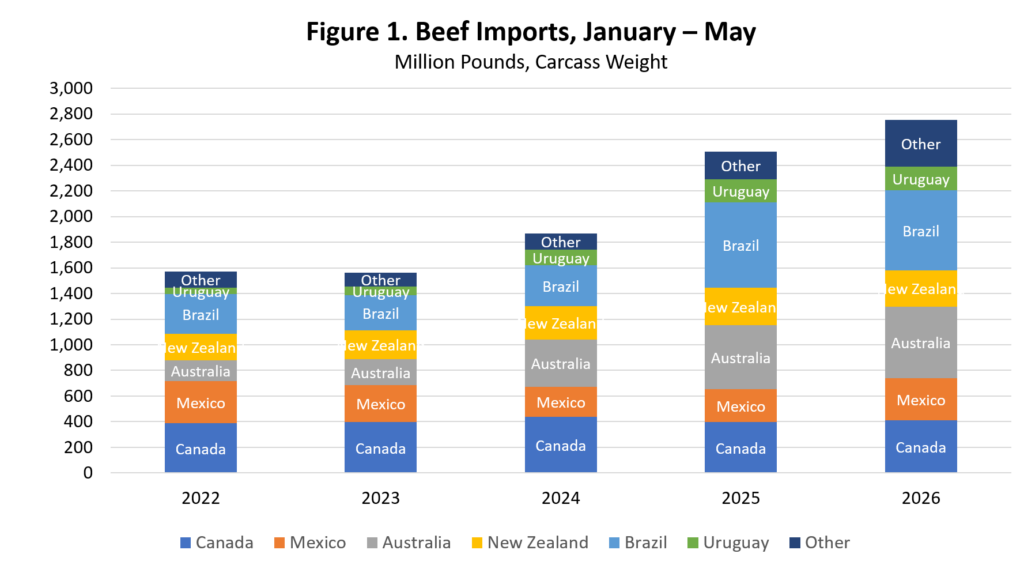
Australia is the number two beef import source, up 11.8 percent in May and 12.0 percent for the year. In the January-May period, Australia increased to a 20.3 percent share of total imports narrowing the gap with number one Brazil which decreased to 22.3 percent of the total. With 15.0 percent of total imports, Canada is the number three beef import source, up 12.3 percent year over year in May and up 4.0 percent for the year to date. Mexico is the fourth largest source of beef imports, up 27.4 percent for the year to date and accounting for 11.9 percent of total beef imports. The year-to-date quantity increase in beef imports from Mexico was the largest among all import sources and moved Mexico ahead of New Zealand in the first five months of the year. New Zealand is now the number five source of beef imports, down 3.6 percent thus far in 2026 and accounting for a 10.3 percent share of total imports.
Beef imports continue to increase in 2026, albeit at a slower rate than the previous two years. Demand for beef imports remains strong as U.S. beef production, especially nonfed processing beef, is still declining. Beef cow slaughter has decreased 45 percent since 2022, contributing to a 27.2 percent decrease in nonfed beef production. Beef imports are providing an important contribution to total beef supplies and especially supporting ground beef markets while U.S. cattle inventories are reduced.
As expected, increased beef imports from Argentina have been significantly offset by decreased imports from other sources – in this case Brazil and Uruguay. Changes in TRQs and tariffs change the mix of beef import sources but have relatively little impact on the total import quantity. Sharply higher beef imports from Mexico – likely the result, in part, of decreased imports of Mexican cattle – also illustrates the integrated nature of cattle and beef trade.