
In southwestern Oklahoma, Fred Schmedt is carrying on a family farming tradition four generations deep.
In 1887, when Altus, Oklahoma, was part of Greer County, Texas, Schmedt’s great-grandfather homesteaded a quarter section of land. Today, Schmedt and his brother have expanded upon the original section and operate a wheat crop and certified seed wheat business.
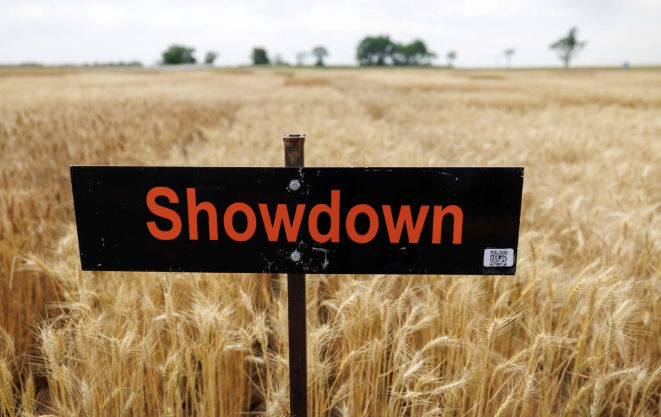
On their no-till operation, they plant 1,000 to 1,500 acres of wheat every year and grow OSU varieties, including Showdown, OK Corral and Butler’s Gold.
As a producer and salesman, Schmedt benefits from the OSU Wheat Variety trials. He has been following the wheat harvest results from the Altus plot since the 1980s. He attends the Altus plot tour every year and often visits the Walters plot, as well.
“We greatly utilize the OSU Wheat Variety Trials to help us decide which varieties we’re going to grow,” Schmedt said. “The Altus trial is on the same soil type as probably 80% of our land, so that information is really valuable to us. It’s in our environment. It’s on the same soil that we’re farming.”
Schmedt sees the impact of the variety trials in his seed operation, as well.
“We have some customers look at the variety trials somewhat religiously,” Schmedt said. “People will call and ask about a variety as soon as they see the results.”
He said when other customers who don’t follow the trials ask for a recommendation, he likes to be able to refer to the trial results in his suggestions.
As a smaller seed operation, Schmedt said he doesn’t have the labor to run his own variety trial like larger certified seed wheat producers can.
“That makes the variety trials really important to us because we wouldn’t have that kind of information at all,” Schmedt said. “We’d just be flying by the seat of our pants, more or less.”
The OSU Wheat Variety Trials are a valuable resource for producers, especially those involved in the seed industry, said Amanda Silva, OSU Extension small grains specialist. It provides unbiased, local performance data that helps farmers choose the varieties best suited for their region and gives seed dealers confidence when advising their customers.
“Fred has been an outstanding cooperator with our program over the years,” she said. “In fact, one of our recent research projects on late-planted, short-season wheat originated from a conversation with him. He is also usually one of the first producers to call asking about the harvest results. Producers like Fred play a critical role in our Extension program by sharing real-world challenges and ideas that help shape research focused on the needs of Oklahoma wheat producers.”
To continue to impact the wheat industry, OSU Agriculture is creating the Agronomy Discovery Center as part of the Agronomy Research Station to modernize the facilities. Plans include creating a new headhouse, research greenhouse and a multipurpose classroom and lab building.