

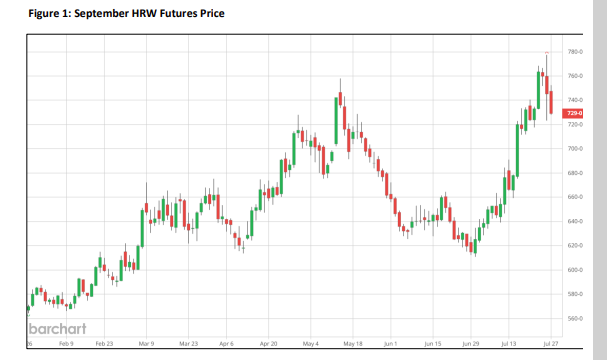
In His latest Newsletter, OSU’s Dr. Todd Hubbs says Grain and oilseed futures prices rallied last week only to fade on Friday and Monday. The geopolitical issues in the Black Sea, Arabian Gulf, and the Red Sea will maintain prominence over the near term. Weather in the U.S. and EU regions continues to impact summer crops. Major rallies in crop prices may be ephemeral given the levels of uncertainty, and sales on large rallies appear prudent.
Wheat Market Outlook
Amid concerns of continued disruptions to Black Sea exports and higher energy prices, the wheat complex rallied to levels not seen this year over the last week. HRW futures prices touched $7.77 per bushel only to retreat on Friday and Monday. September futures prices closed at $7.29 and sat in the middle part of the range seen in March and early April. Basis sits at -45 to -55 across the state. Weather impacts in the EU, shipping disruptions in the Black Sea, and resurrection of hostilities in the Iranian conflict create a very volatile market. A continuation or consolidation of the HRW price rally is linked to production and trade overseas.
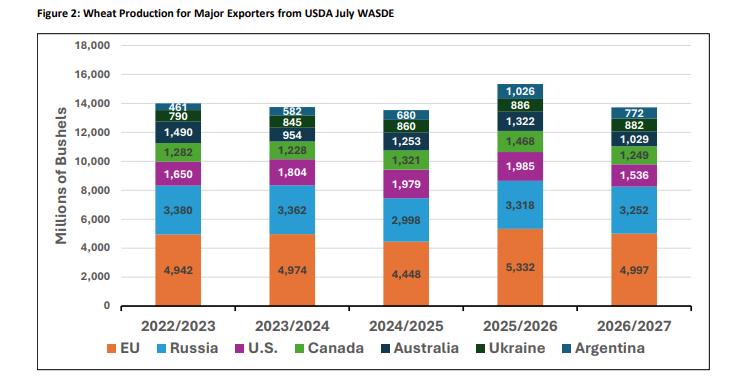
USDA’s production estimates from major exporting countries over the last five marketing years show that while production is below last year’s great crop production totals, expected production levels remain on par with previous trade years. At present, production outcomes vary in the Northern Hemisphere, with positive news coming out of the Southern Hemisphere.
EU production updates provided by the EU’s MARS bulletin confirmed issues with the wheat crop, lowering EU yield to 5.66 tons per hectare—down two percent from the previous month. USDA had yield at 5.79 tons per hectare last month. If USDA adopted this yield projection, EU production would fall to 4,908 million bushels. While supportive for prices, the yield drop is not nearly as severe as private estimates put forth recently. Additionally, Turkey wheat production increased to 920 million bushels, up from 706 million last year. The strong wheat crop out of Turkey is another indicator of the crop potential seen in the Middle East and North Africa.
Canada’s wheat crop saw better conditions for crop development recently, with warmer weather improving production prospects. Heavy soil moisture has been reported in areas, but the crop is seen primarily in good to excellent condition across the prairie provinces. Conditions in Saskatchewan are particularly favorable, and Canadian forecasters place spring wheat production above the five-year average. Barring a particularly punishing August, Canada’s spring wheat crop looks better than expected during the cool, wet start to the year.
Black Sea fighting still hangs over the global wheat market. Rumors of de-escalation are yet to be confirmed amid strikes on Ukrainian commercial vessels and ports that have dissuaded shipowners from entering those areas. Russia still limits shipping in the Sea of Azov, with exporters looking to move wheat through Baltic ports. Russian wheat is reported to still be moving from deep water ports. Russian production estimates from private entities sit between 3.2 and 3.3 billion bushels. While export numbers for July out of Russia have been adjusted down, an expectation of continued movement should limit Russia’s wheat export downside.
Southern Hemisphere crops in Argentina and Australia are off to a good start. Australia saw greater yield potential from the wheat crop on good moisture in the Western and Southern states. Argentina’s crop is nearly planted with good and excellent conditions reported at 70 percent, up 19 percent from a year ago. The next few months will determine crop potential in the Southern countries. Discussion of “Super” El Niño issues will continue and may impact crop potential.
Wheat exports thus far in the marketing year trail last year’s pace as one would expect given the small winter wheat crop. Outstanding sales thus far in the marketing year for all wheat sit at 161 million bushels, down from 221 million bushels at this point last year. Total commitments of wheat through July 16 total 244 million bushels. At 32 percent of the USDA forecast, wheat total commitments sit five percent below the five-year average for this early point in the marketing year. Mexico, Japan, South Korea, and the Philippines constitute our strongest wheat buyers thus far with 23, 14, 11, and 12 percent of wheat commitments, respectively. HRW total commitments in the 2026-27 marketing year sit at 60 million, down from 119 million bushels at this time last year. Thus far, Mexico and Japan dominate HRW exports with 34 and 26 percent of commitments, respectively. At present, all wheat and HRW exports trail the pace to meet forecasted totals despite the issues going on in the Black Sea and EU.
Soybean Market Outlook
Soybean futures prices moved sharply higher last week and gained almost 50 cents per bushel. Monday saw soybean futures prices give back 40 cents of that rally, with a positive forecast for Corn Belt weather and lower energy prices providing pressure in the market. September futures closed at $12.00 on Monday. The November contract closed at $12.14. Cash prices in Oklahoma are around $11.34 – $11.44. Harvest prices came in near $11.24 with basis at 90 under the November contract. Crop conditions came in at 63 percent good and excellent, down three percent from last week. Last year saw good and excellent at 70 percent. At present, the USDA yield forecast of 53 bushels per acre remains reasonable given the uncertainty still in place leading into August. The U.S. drought monitor places 18 percent of the soybean crop in drought conditions, down from 28 percent in early June. Crop conditions reflect the improvement in drought levels with trouble spots remaining in the western Corn Belt.
NOPA released soybean crush data for June last week and placed crush at 214.3 million bushels during the month. This level of NOPA crush implies a USDA number around 220 million bushels and places the crush pace slightly above USDA’s current estimate of 2,650 million bushels for the 2025-26 marketing year. Implied crush through June totals 2,216 million bushels, 175 million bushels above last marketing year’s pace. Crush needs to average 217 million bushels a month to hit USDA’s forecast of 2,650 over the remaining two months of the marketing year. Soybean crushers’ margins remain strong, driven by increased demand for soybean oil for biofuels and global demand for soybean meal.
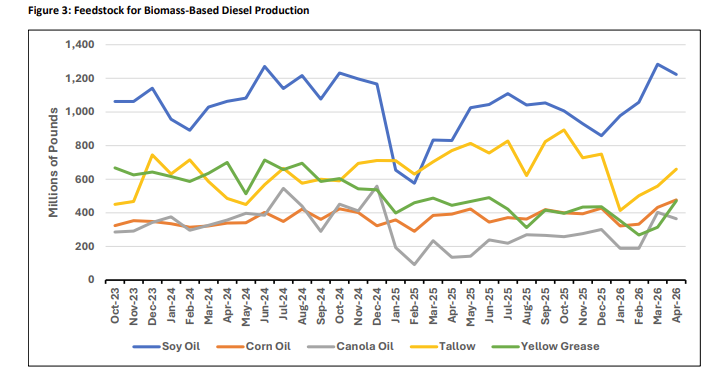
Soybean oil (SBO) usage for biofuel production continues to grow. Biomass-based diesel usage sits at 7,338 million pounds through seven months, but preliminary data for May and June point toward a total usage of 10,060 million pounds. If those estimates materialize, SBO usage for biofuels needs to average 1,496 million pounds a month to hit USDA’s forecast of 14,550 million pounds. Feedstock usage across the board continues to increase as supportive D4 RIN prices spur production and blending. Considerable speculation remains on whether obligated parties will hit the RVO mandates this year, with an expectation of stronger feedstock usage in place regardless.
Soybean meal demand remains supportive of crush. Soybean meal export sales data place total commitments through July 16 at 19,335 thousand short tons and on track to meet or exceed the USDA forecast of 20,300 thousand short tons. Soybean meal exports averaged 228 thousand short ton sales a week over the last month. Sales need to average 96.5 thousand tons per week through the end of September to hit the forecast. U.S. soybean meal remains competitive with major competitors and domestically in feed rations.
Soybean export sales data through July 16 place U.S. total commitments for soybeans at 1.521 billion bushels. Exports continue to converge on USDA’s current marketing year forecast of 1.53 billion bushels. New weekly sales averaged three million bushels per week over the last month. The recent price rally saw U.S. Gulf soybean prices maintain parity with port prices in Paranaguá, Brazil. Exports above current projections appear like a limited possibility given the recent price dynamic.