In the latest newsletter from OSU’s Dr. Todd Hubbs, he says Weather and geopolitical developments continue to drive crop markets and promise continued volatility. Black Sea and Iranian conflicts seem far from coming to any resolution at this point. Next Wednesday’s crop production report provides USDA’s first indication of spring crop yields and may be a large market mover.
Wheat Market Outlook
Geopolitical premiums pulled back over the last week despite continued conflict in the Black Sea disrupting grain flows. Reports out of the region show a shifting of Russian wheat exports away from the affected region. Slower exports out of Russia materialized but the magnitude of the decline may not be as large as expected. Ukrainian exports remain under stress with port and ship strikes bringing trade flows to a crawl. A smaller EU crop and Black Sea issues have yet to show up in higher wheat exports for the U.S.
September HRW futures moved over forty cents lower during the last week reflecting the uncertainty on U.S. trade prospects and weather developments in the Corn Belt. September HRW prices closed yesterday at $7.17 per bushel, up ten cents. HRW cash prices around Oklahoma vary in the $6.67- $6.77 range after Monday’s close. NASS reported the average price received in Oklahoma for HRW in June at $5.93 per bushel, down 17 cents from May but up $1.03 from June 2025. Another rally for HRW prices relies on geopolitical developments and exports becoming more competitive on the global market.
Wheat exports remain well below last year’s pace. Total commitments of wheat through July 23 sit at 33 percent of the USDA forecast for 2026-27, below the five-year average of 39 percent at this point in the marketing year. Total commitments came in at 256 million bushels, behind last year’s 352 million bushels. Outstanding sales for all wheat sit at 160 million bushels, down from 232 million bushels at this point last year. In confirmation of the slow export pace for U.S. wheat, export inspection data released yesterday showed wheat inspections for the week ending July 30 at 12.3 million bushels, down from 15 million last week. Total inspections of 107 million bushels are 27 percent below last year’s level.
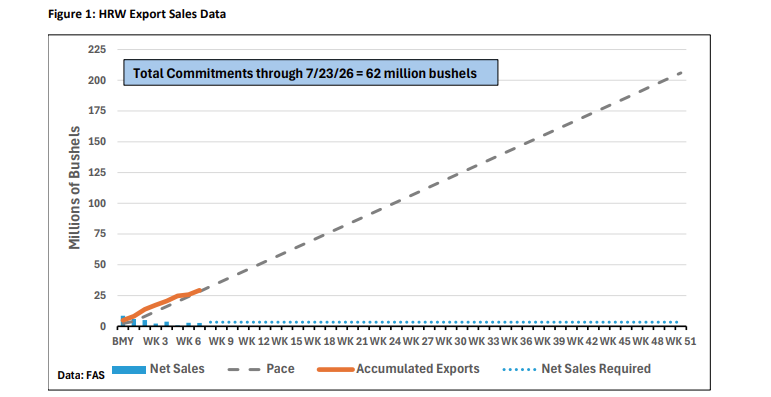
HRW total commitments in the 2026-27 marketing year sit at 62 million, down from 119 million bushels at this time last year. Net sales for HRW averaged 2.5 million bushels over the last month. At present, 3.4 million bushels a week of new sales for the remainder of the marketing year are required to hit USDA’s 210 million bushels forecast. Mexico and Japan dominate the HRW exports with 33 and 25 percent of commitments, respectively.
All wheat and HRW exports are moving toward trailing the pace to meet forecasted USDA totals despite the issues in the Black Sea and EU. The slower pace of trade in general has generated questions about potential global demand. HRW Gulf prices remain above Northern Hemisphere competitors. Gulf HRW prices at $8.00 per bushel sat over two dollars above Romania, Ukraine, and Russian export prices at the end of last week. Gulf prices also eclipsed European origins in Rouen, France and Hamburg, Germany by approximately $1.25. Meanwhile, Gulf soft red winter wheat came in at $6.71 per bushel. HRW prices may struggle to move higher and stay there under these price differences.
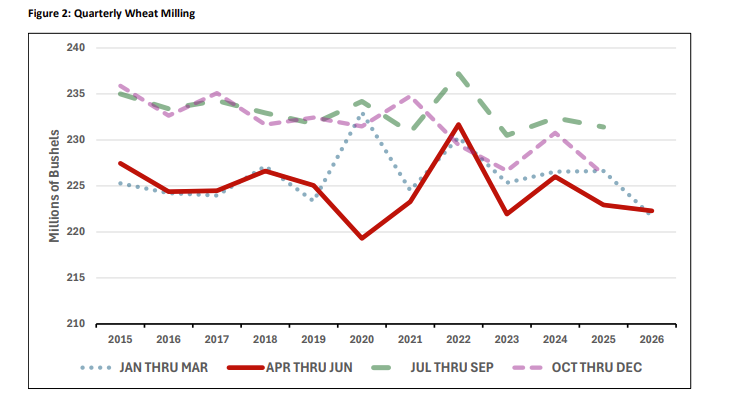
On the domestic demand front, USDA released the quarterly wheat milling report yesterday. April – June milling totaled 222.28 million bushels, on par with last year’s 222.939. Flour production in the second quarter totaled 103 million hundredweight, up one percent from last year and the first quarter of 2026. Wheat milling over the last decade has a slight downward trend across all quarters. Wheat milling excluding durum wheat came in at 206.19 million bushels, down somewhat from the second quarter last year. Domestic demand remains stable and places emphasis, as usual, on export markets.
Corn Market Outlook
December corn futures moved higher to close at $4.88 yesterday. The December future price sits in the middle of the range of prices encountered from the start of July. The September contract closed at $4.49 on Monday. Despite recent rains through the heart of the Corn Belt over the last week, conditions continued to deteriorate in the USDA progress report. Domestic demand remains stable with exports continuing to be a bright spot.
Corn crop conditions showed no improvement this week after the rain event over the weekend. Good and excellent conditions for August 2 sat at 61 percent, down two percent from the previous week and twelve percent from last year. Corn area in drought through July 28 was 29 percent, a ten percent jump from the start of July. The poorest crop condition ratings that impact national corn yield came in the western Corn Belt which continues a pattern seen over the last month.
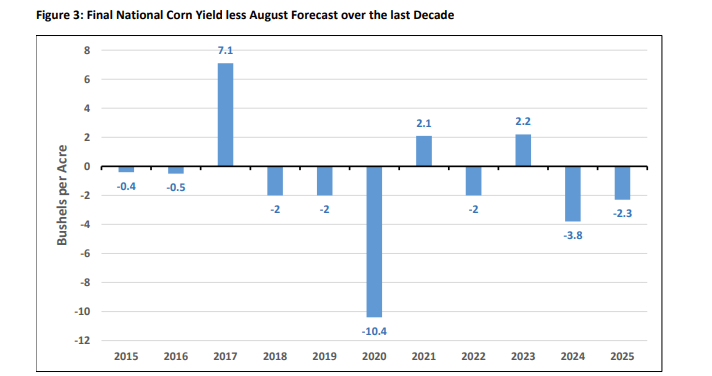
Next week’s crop production report provides the first yield survey of the year. The agricultural yield survey put forth in August is an operator survey. Over the last decade, the August yield forecast tends to be above the final yield. The potential for huge misses exists and is highly correlated with crop conditions in August and September. Market observers reported potential national corn yield between 180 – 188 bushels per acre over the last few weeks. USDA’s current yield forecast of 183 bushels per acre remains a decent forecast.
Exports have been strong with export sales data indicating total commitments of 3,424 million bushels through June 23. Commitments sit at 103 percent of the USDA forecast, above 102 percent over the last three marketing years. Export inspections through July 30 equal 3,042 million bushels, up 25 percent over last year’s total through the same period. The potential for USDA’s estimate of 2025-26 corn exports exceeding USDA’s 3,325 million bushels is looking more probable. Recent weather in the EU indicates the potential for adjusting trade flows in the next marketing year.
Weather in the EU has been difficult for the EU corn crop. MARS, an EU crop agency, recently lowered corn production for the region by six percent. Most countries in the EU have had their corn crops impacted by the difficulties. An expectation of the crop totals falling even further should be in place given a punishing heat wave over the region. The losses could be extremely high indeed. USDA forecasts EU corn production at 2.11 billion bushels, down 112 million bushels from the previous trade year. Adjustments to EU production and global trade, particularly EU corn imports, should be expected in next week’s WASDE report.
On a less positive outlook note for U.S. exports, Brazil’s corn crop got pegged at almost 143 million metric tons by AgRural in Brazil, 4 million tons above USDA’s current forecast. Conditions for the safrinha crop remain supportive of the elevated number with harvest well underway. Any reduction in EU production could see a competitive market for increased trade from the Black Sea region or South America.
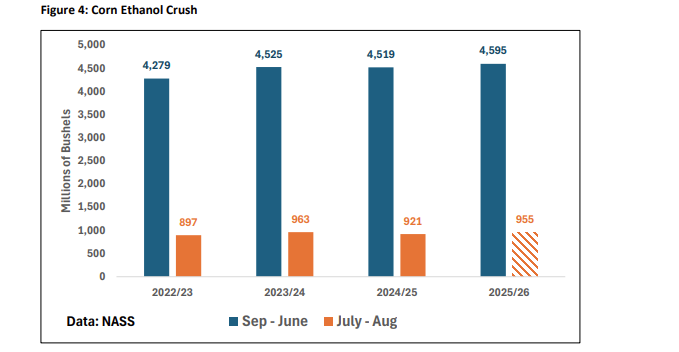
Ethanol usage for corn looks on track to meet USDA’s recently lowered estimate for old crop corn of 5.5 billion bushels. Corn use for ethanol through the first ten months of the marketing year equals 4.595 billion bushels, slightly above last year at this point. Ethanol grind for corn requires 955 million bushels over the last two months to hit the total. Gasoline demand is on par with last year and ethanol exports remain on a pace to hit 2.35 – 2.4 billion gallons for 2025-26. Corn usage for ethanol seems destined to be close to USDA’s latest estimate based on weekly production levels through the end of July.