
Liu Yangxuan writes in Southern Ag Today: If risk alone determined outcomes, farms facing the same market conditions would experience similar results. Yet, as discussed in my previous article (Part 1), that is clearly not what we observe in practice. Some farms remain resilient during difficult times, while others struggle under the same economic pressures. Understanding why requires looking beyond the risk or shock itself and examining the accompanying decision process.
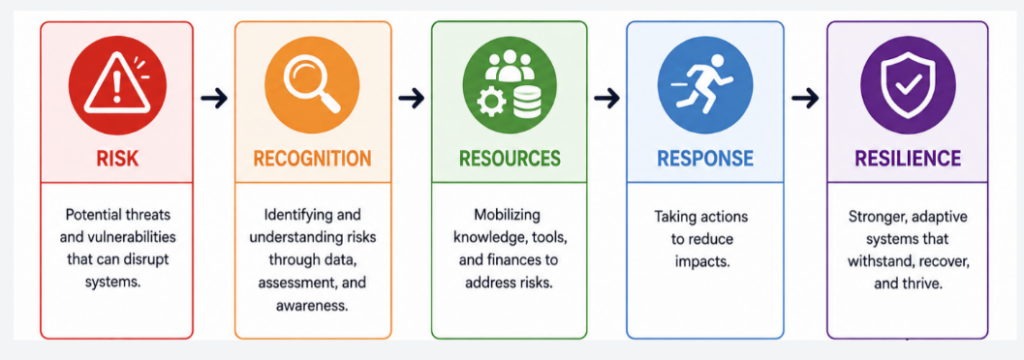
To help explain this process, I propose Liu’s 5Rs of Risk Management Model, a framework that explains how risk is transformed into outcomes. The model consists of five stages: Risk → Recognition → Resources → Response → Resilience. Each stage plays a critical role in determining how individuals and organizations navigate uncertainty.
Risk refers to the external sources that generate either threats or opportunities. Examples include commodity price volatility, weather events, rising input costs, policy changes, and trade disruptions.
Recognition describes how risk is perceived, identified, and interpreted. Two producers facing the same conditions may perceive the nature or severity of a risk very differently. Some people are naturally more cautious, while others are more comfortable taking risks. A person’s attitude toward risk is often described as risk preference, whether someone is risk-averse, risk-neutral, or risk-seeking. These differences influence how people view a given situation and the decisions they make.
Resources represent the capacity available to respond. These include financial capital, information, management skills, technology, insurance coverage, policy support, and broader institutional support. Resources determine which responses are feasible.
Response refers to the actions taken. These may include adjusting marketing strategies, controlling costs, diversifying enterprises, altering investment timing, or adopting formal risk management tools.
Resilience is the resulting outcome. It reflects the ability to withstand disruption, adapt to changing conditions, and recover over time. Resilience is not a fixed trait of a farm or firm; it is the cumulative result of the entire pathway from risk to response.
The key insight of the 5Rs model is that outcomes are not determined by risk alone, but by the full chain of interpretation, capacity, and action that follows. For producers, lenders, advisors, agribusiness managers, and policymakers, the 5Rs of Risk Management provide a practical lens for understanding performance differences under stress and identifying opportunities for improvement. In this sense, understanding risk is necessary, but understanding the pathway from risk to resilience is essential.
Liu, Yangxuan. “5Rs of Risk Management: A Framework for Understanding Risk and Resilience.” Southern Ag Today