The August Crop Production report released tomorrow provides the most pertinent information impacting market dynamics over the near term. Industry expectations place production levels for major spring crops near current USDA levels. Volatility due to geopolitical events remains an issue. A major surprise in the Crop Production report holds the potential for large price swings.
Soybean Market Outlook: Soybean prices continued to fall last week after the November contract rallied to over $12.50 per bushel on July 24. Prices remain responsive to supply potential in the U.S. since the South American crops are practically done. The August Crop Production report on Wednesday will set the stage for price movements over the near term with the trade expecting yield to come in at 52.9 bushels per acre and acreage to increase slightly from the June Acreage report. Soybean production is expected to be near 4.47 billion bushels, on par with USDA’s current forecast. Monday saw soybean futures prices gain three cents as the market waits for the USDA reports. September futures closed at $11.62. The November contract closed at $11.79. Cash prices in Oklahoma are around $11.09 – $11.19. Harvest prices came in at $10.89 with basis at 90 under the November contract.
Crop conditions were reported to be 62 percent good and excellent yesterday, down one percent from last week. Last year at this point in the year saw good and excellent conditions at 68 percent. The USDA yield forecast of 53 bushels per acre remains a decent placeholder for yield expectations now. The models used in my analysis place national soybean yield at 52.7 bushels per acre. A moderate increase in acreage of 100 – 200 thousand acreage is plausible in the upcoming report.
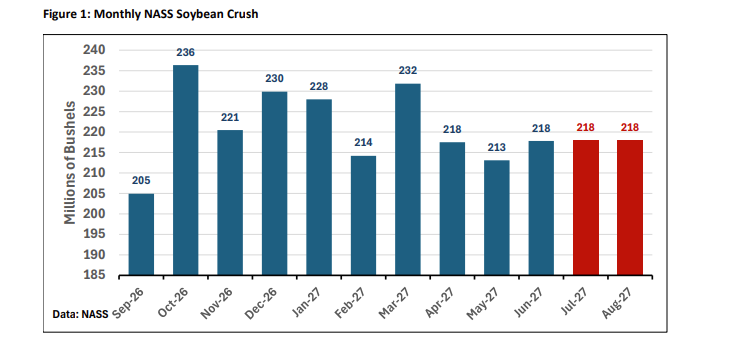
USDA NASS released the soybean crush totals for June on August 1. Crush totaled 218 million bushels and brought cumulative crush totals for the marketing year to 2.214 billion bushels. 218 million bushels per month are required over the last two months to reach USDA’s 2.65-billion-bushel estimate. Over the last three months, soybean crush averaged 7.13 million bushels per day despite a slowdown in May that saw the daily pace drop to 6.87. Soybean crushers’ margins remain strong. If the soybean production estimates meet the trade’s expectations, expect the new crop balance sheet to stay at current projections. Old crop demand could see some shifting around before the end of the marketing year, but overall demand appears set to be close to USDA’s 4.282 billion bushels.
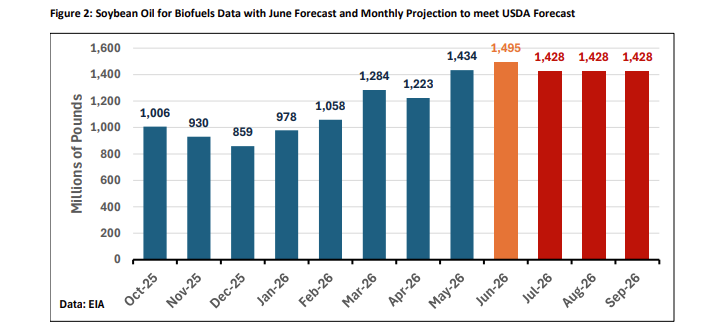
Soybean oil (SBO) produced thus far this marketing year is at 26,651 million pounds through June, up 1,429 million pounds from last marketing year. SBO used for biomass-based diesel jumped in May to 1,434 million pounds. Total biofuels usage came in at 8,772 million pounds through May. My projection for June SBO usage for biofuels sits at 1,495 million pounds. If that projection materializes, SBO usage for biofuels needs to average 1,428 million pounds a month to hit USDA’s forecast of 14,550 million pounds. The potential to hit USDA’s estimate increased dramatically with the EIA’s release of the May numbers.
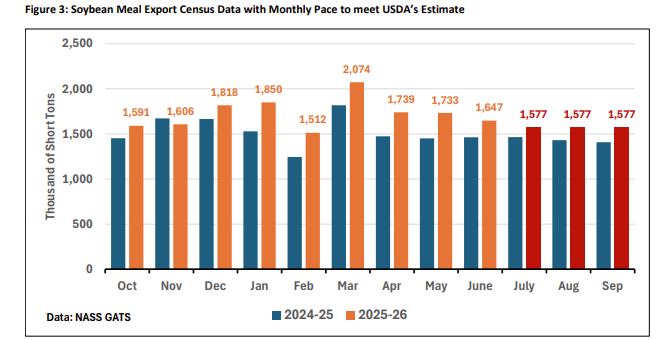
Census trade data released last week showed soybean meal exports well above last year’s totals through June. Cumulative SBM exports through June sit at 12,373 thousand short tons. USDA’s forecast of 20,300 thousand short tons needs 1,577 thousand short tons a month over the last quarter of the marketing year. Export sales data indicates July SBM exports may fall short of that level. Total commitments through July 30 came in at 19,517 thousand short tons with 3,301 thousand outstanding sales. Sales need to average 98 thousand tons per week for the remainder of the marketing year to hit the forecast. U.S. soybean meal remains competitive on the global market and domestically in feed rations.
Soybean exports continue to converge on USDA’s 1,530 million bushels estimate for the old crop marketing year. Sales data through July 30 place U.S. total commitments for soybeans at 1,531 million bushels. Outstanding sales for the 2026-27 marketing year total 308 million bushels, well above last year’s trade conflict impacted level of 110 million bushels. China and unknown destinations (often considered China) have sales of 114 and 122 million bushels, respectively. Reports suggest China bought another ten cargos of soybeans last Thursday. The recent price weakness saw U.S. Gulf soybean prices fall below port prices in Paranaguá, Brazil last week. Expect U.S. exports to remain competitive leading into the new crop marketing year.
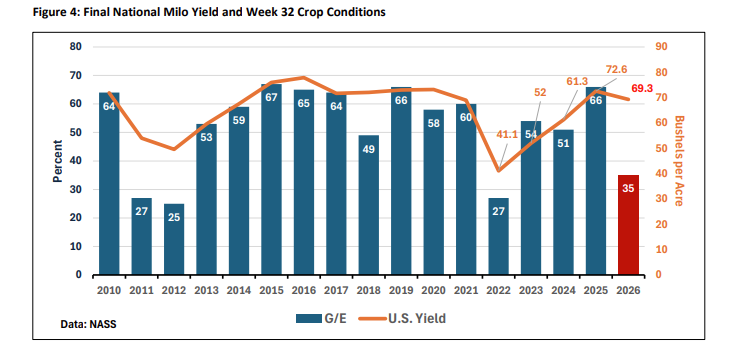
Milo Market Outlook: Milo crop conditions indicate a national yield well below USDA’s current projection of 69.3 bushels per acre. Good and excellent conditions for Week 32 sit at 35 percent, well below the 66 percent at this time last year when the U.S. milo crop totaled 72.6 bushels per acre. Conditions in Week 32 indicate the yield put forth in the August Crop Production report could move significantly lower and tighten the milo balance sheet for the 2026-27 marketing year. My models place milo yield nationally at 48.8 bushels per acre. The variance on this forecast is quite high.
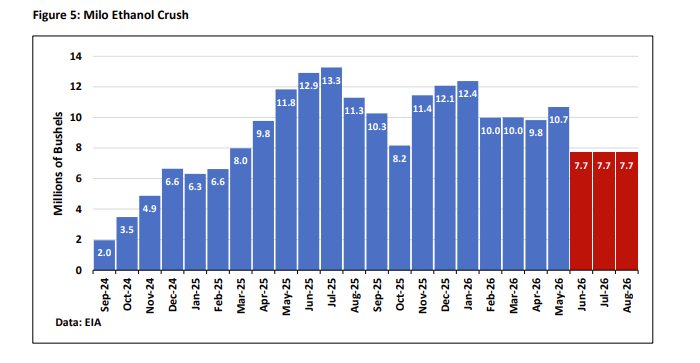
Domestic demand for milo remains steady. Milo usage for ethanol was 10.7 million bushels in May. Over the last quarter of the marketing year, ethanol usage needs to average 7.7 million bushels per month to hit USDA’s estimate. Milo grind for ethanol has not come in that low for any month thus far in the marketing year. Given the strong margins for ethanol grinding, a continuation of previous month’s usage levels seem appropriate. Cumulative usage sits at 95 million bushels through May. An expectation of ethanol usage eclipsing USDA’s 118-million-bushel estimate seems reasonable given the slower pace of exports in July and the significant difference between spot corn and milo prices.
Export sales data place total commitments of milo at 200 million bushels through July 30. Outstanding sales sit at 6.7 million bushels of commitments. Weekly sales have not recovered from the weakness that began in early July. Census export data place milo exports at 190 million bushels through June with China taking 76 percent of the total thus far in the marketing year. Exports are fading from 220 million bushels estimated for the 2025-26 marketing year with an expectation that USDA lowers milo exports at some point on the old crop balance sheet. A major change in production will see an adjustment to new crop exports as well.
December corn futures moved lower to close at $4.62 yesterday. The December future price sits in the lower part of the range of prices encountered from the rally that began in early July. The September contract closed at $4.38 on Monday. Oklahoma cash prices came in at $3.43 – 3.48 with basis at 85 – 90 cents under. Depending on location, the milo-corn basis spread shows milo 70 – 100 cents under corn. The large spread between milo and corn is the impetus for a new contract at the CME.
CME Group announced on July 21 that it is launching a new milo basis futures contract (MILO product code), with trading expected to begin on August 24, pending regulatory review. The contract is designed to track the price difference between milo and corn. The idea is to provide a dedicated marketing tool for milo and address the basis risk so familiar to elevators and producers in the western Corn Belt. Contracts will be physically settled, with grain loaded out by truck or rail from a network of elevators in Kansas. By using the established Kansas City Hard Red Winter Wheat delivery network, the CME is using existing infrastructure rather than building a new delivery system from scratch.
The core issue the contract addresses is basis risk and the unpredictable gap between sorghum and corn prices. Historically, while sorghum prices tend to track corn closely, trade events and regional supply changes can disrupt that relationship. The sorghum-to-corn spread experienced considerable volatility, swinging from sharp premiums to steep discounts in recent years. This volatility matters because of what the spread signals about demand. Milo’s premium over corn usually signals export demand, particularly Chinese demand, driving values higher. A deep discount indicates weak export demand and induces domestic buyers to grind milo for ethanol and shift feed rations toward cheaper sorghum.
A major issue market participants will be watching is the ability of the milo basis contract to generate liquidity. The contract will need to attract enough trading volume and open interest to function as an effective hedge. Oklahoma growers sit close to the physical delivery network and may benefit from the expected ability of elevators to provide bids and hedge basis risk. An open question about attracting trading volume involves the mechanism that drives the large swings in milo basis, which is Chinese purchases. Speculation on Chinese milo buying seems fraught with potential issues given one major player in the market to overly influence export volumes.