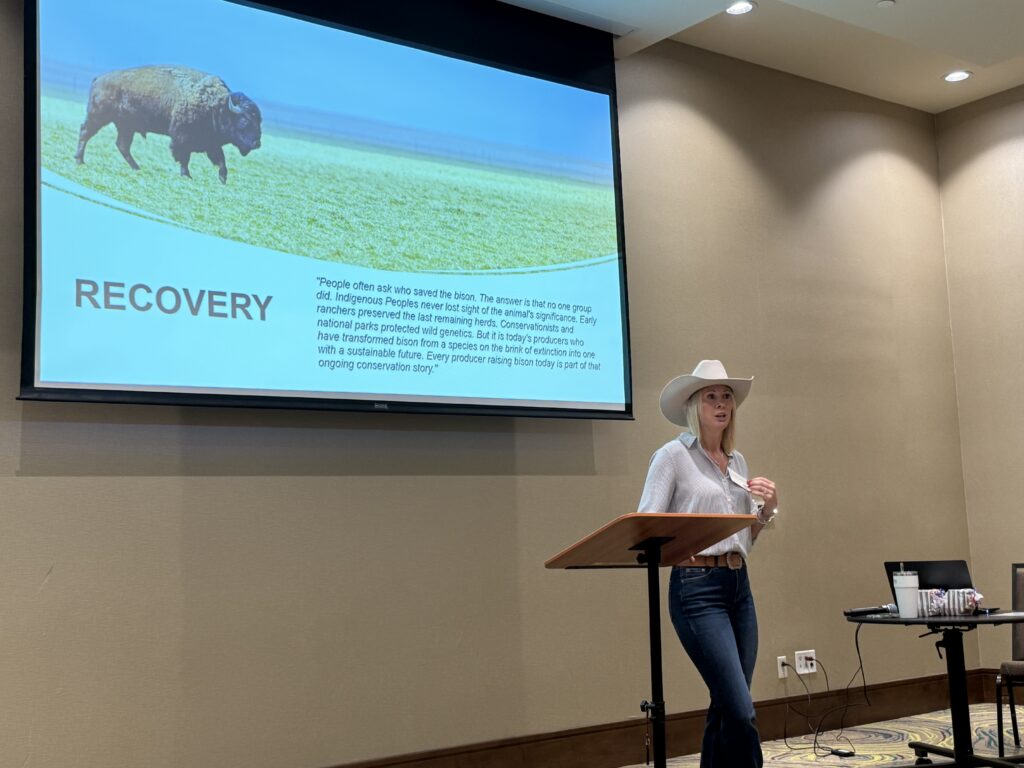
The bison industry is growing as producers and consumers show increasing interest in the animal’s meat, environmental benefits and role in American agriculture. Speaking with Oklahoma Farm Report intern Presley Strickland at the Oklahoma Women in Agriculture Convention, National Bison Association President Jessi Deardorf discussed the business of bringing back bison, from production and management to conservation and consumer awareness.
Bison Meat Offers a Nutrient-Dense Option
For Deardorf, her interest in the bison industry began with the meat side of the business. “Honestly, for me, it started with the meat side of the business,” Deardorf said. “Bison meat is incredibly healthy.”
She said bison meat is lower in fat and cholesterol while providing important nutrients.
“It is lower in fat and cholesterol, comparable sizes in grams to beef, and even you can compare it to a leaner, healthier opportunity than even turkey, chicken, and salmon,” she said.
Deardorf also highlighted the nutrient density of bison meat, particularly for women.
“It’s also nutrient dense,” she said. “I promote it a lot for females. Very high in iron, high in selenium, zinc, B12.”
Bison Industry Sees Significant Growth
Deardorf said the bison industry has experienced significant growth in recent years, both in government engagement and consumer demand.
“It has grown significantly,” she said. “We have really grown on the legislative side of things of being able to get into Congress and speak about issues that we’re encountering, working on research funding, grant opportunities for our producers.”
At the same time, she said the consumer market has expanded substantially.
“The escalation of the consumer market has just doubled in size,” Deardorf said. “And so that consumer awareness that we’ve been doing marketing and advertising for is really starting to kick off.”
Understanding the Difference Between Bison and Buffalo
One issue Deardorf wants consumers to better understand is the distinction between American bison and animals commonly referred to as buffalo.
“The American bison is the one we’re all picturing when we think of bison and seeing them out on the fields,” she said.
Deardorff said the word “buffalo” is commonly used as slang for American bison, but the terminology can become confusing when other animals are involved.
“I call it the term buffalo, I say it’s slang,” she said. “It’s historically what everyone knows.”
Her recommendation is simple.
“If someone says buffalo, just add the word American in front of it,” Deardorff said. “It helps us really know that we’re talking about the same animal.”
She explained that Asiatic water buffalo and Cape buffalo are imported into the United States and can be used for meat and other products.
“There is no current label regulation that deciphers the two,” Deardorf said. “And so, American bison can be labeled as buffalo, and that’s what we all think. And then these other byproducts that are imported in can also be labeled buffalo.”
Bison Production Requires a Different Approach
While bison production shares some similarities with cattle production, Deardorf said there are important management differences.
“We do a lot less feeding,” she said. “We do much more grass and pasture.”
There are also bison feeding operations, she said, but those operations require more land because bison cannot be kept in the same confined conditions as some cattle operations.
“The feeding operations allow there to be so much more bison meat on the market,” Deardorf said.
For producers raising bison primarily on grass, however, the timeline to revenue can be longer.
“For us on grass, we do not process our animals until they’re about three years old,” she said. “So that is thinking about how having that animal for three years before you’re getting any revenue-generating opportunity from it.”
The scale of the bison industry is also relatively small compared with cattle.
“About 80,000 bison are processed a year,” Deardorf said. “By about noon on January 1st of the new year, there’s more cattle processed than bison in the entire year.”
Bison Restoration Marks a Conservation Success
Beyond the business opportunity, Deardorf said the recovery of the American bison represents a major conservation success.
“Just over 100 years ago, so about 150 years ago, there were supposedly just less than 1,000 animals coming down from tens of millions,” she said. “So the decline happens so much quicker.”
Despite the dramatic decline, bison numbers have rebounded significantly.
“The restoration with much less land opportunity, a lot more private lands, the fact that we’ve been able to reach just shy of half a million in the last 150 years is phenomenal,” Deardorf said.
She credited multiple groups for helping make that recovery possible.
“It goes a lot of recognition into how it started with the American Bison Society and the contribution from conservationists, tribal affiliations, and the private sector as well,” she said.
Bison Can Benefit Grassland Ecosystems
Deardorf said bison also play an important role in grassland ecosystems because of how they interact with soil, forage and other wildlife.
“Bison are great for several reasons,” she said.
Their hooves can help disturb and aerate the soil, while their grazing habits can leave more plant material available for continued growth.
“They are great aerators for the soil,” Deardorf said. “They also consume their forage a little differently. They only eat the tops and do not consume all the way down to the base.”
That grazing behavior allows remaining forage to continue receiving sunlight.
“That allows for more photosynthesis for the forage that’s still on the ground to get sunlight and come back,” she said.
Bison can also help spread plants through their interaction with vegetation and soil.
“Their fur is great for collecting seeds and forbs that blow through the air,” Deardorf said.
She also described wallowing, a behavior commonly associated with bison.
“When they wallow, which is the famous part where they dig in—they dig their own dirt holes and they roll around in it,” she said. “That releases all the forbs and seedlings from their fur that blew in from another pasture and helps replant that area.”
Those wallows can also benefit wildlife.
“They are known for bringing a great partnership with Audubon Societies as well, because of all of the ground nesting birds,” Deardorf said. “They have very strong capability of letting those wallow sites be great for helping those species.”
Working With Bison Means Taking a Hands-Off Approach
For producers, managing bison requires understanding their behavior and avoiding unnecessary stress.
“Less is more,” Deardorf said. “We call it working on bison time.”
She emphasized that calm handling is important for both the animals and people working with them.
“A calm bison is a safe bison,” she said. “They, for the most part, don’t want to be bothered.”
Rather than forcing animals in a particular direction, Deardorff said producers can use their natural herd behavior.
“Since they’re herd animals, we always say it just takes one,” she said. “You need to get one bison moving in the right direction, and then the rest will follow.”
Deardorf said bison generally require a very hands-off management style.
“We are very tame, very hands off,” she said. “There is no clapping. There’s no hooting. There’s no hollering.”
Some producers use horses, while others rely on side-by-sides or trucks to move bison across large pastures.
“Sometimes our issue with working with horses is the horses run out of steam quicker than the bison do,” Deardorf said.
She also said producers generally do not need to intervene heavily during breeding and calving.
“We do not have to do very much in regards to management of bison, in particular during breeding season and calving season,” she said.
Deardorf added that producers do not use growth hormones and use very minimal antibiotics.
Strong Fencing and Quality Forage Are Important
For anyone considering getting into bison production, Deardorf said infrastructure should be a major consideration.
“My first recommendation is always have a great fence,” she said. “Fences are only needed when there’s issues, and when there are issues, you’re going to be wanting that great fence.”
Bison are athletic animals capable of challenging fencing.
“Bison, since they are so athletic, you need something that then can keep them in,” Deardorff said. “If they see a fence, they honestly can jump it.”
She recommended strong infrastructure that can withstand pressure from the animals, particularly during breeding season.
“I’m a big advocate of piping and strong cabling,” she said.
Forage management is also critical.
“Having a great forage opportunity, having the right ratio of acre to animal, which varies per the amount of forage or what type of forage you have,” Deardorf said.
She said protein, fiber and other nutrients should all be considered, along with reliable water.
“Water—you always want to have water,” she said. “Bison consume a large amount every day.”
For cattle producers already managing grass-fed cattle, Deardorf said some of those practices can transition to bison production.
“If you have grass-fed cattle and you have that water available, a lot of that is going to be pretty good and transitionable to the bison side of things as well,” she said.
Resources Available for Bison Producers
Deardorf encouraged producers interested in learning more about bison to use resources available through the National Bison Association.
She said producers can also reach out to her through her Oklahoma bison operation, Benjamin Lee Bison.
“I’m the president of the National Bison Association, which works with information and, like I mentioned, all the science and research as well,” Deardorf said.
The association can also help producers find information specific to their region.
“That has great opportunities for learning details that are very specific to your region if you’re outside of Oklahoma,” she said.
Deardorf said the organization also provides information about legislative and grant opportunities.
“Also all the legislative and grant opportunities that are provided,” she said. “And that is nationalbison.org.”