

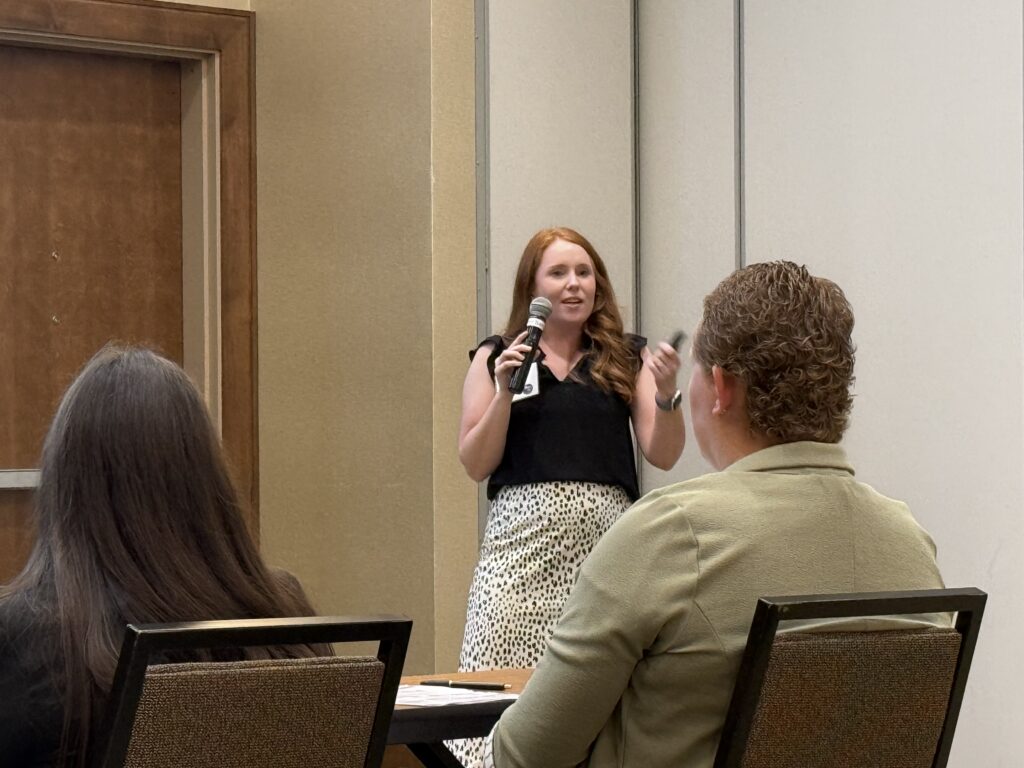
As data centers in rural communities continue to receive more attention, Oklahoma communities are weighing the potential economic benefits against questions surrounding infrastructure, taxes, resources and agriculture. Mckenzie Boyce, an Oklahoma State University assistant professor, discussed the growing interest in rural data center development during the Oklahoma Women in Agriculture Convention with Oklahoma Farm Report intern Presley Strickland.
Why Data Centers Are Looking to Rural Communities
Boyce said the growing demand for data centers across the country is creating a need for additional locations, and rural communities can offer one important resource: available land. “As we see data center development or the demand for data center development increasing across the country, these data centers need additional places to locate,” Boyce said.
“In a lot of rural areas, there’s obviously land available, and it can often be available at relatively lower costs.” Boyce said that availability and affordability are among the primary reasons rural areas are receiving more attention from data center developers.
Economic Benefits Can Vary by Community
While data centers can bring economic opportunities to rural communities, Boyce emphasized that there is no universal list of benefits or drawbacks. “I think there are a lot of different potential economic benefits as well as potential limitations or pitfalls of data centers locating in rural communities or any community,” she said. “Unfortunately, there’s not a clear set of benefits and limitations.”
Boyce said the outcome can depend heavily on the individual project and the agreements reached between developers and local communities. “Any of the economic considerations of data centers can be either a benefit or a limitation or drawback, depending on how it plays out in that community,” she said.
Among the major economic considerations, Boyce identified revenue, employment, infrastructure and opportunity costs. “We can think about data centers generating potentially jobs in communities at maybe higher wages,” Boyce said.
She also noted that communities could see additional revenue through several different avenues. “Additional revenue” could come through “sales tax revenue, property taxes, payment in lieu of tax agreements,” she said.
Infrastructure investment is another consideration. Boyce said data centers are investing heavily in infrastructure, and some of that investment could potentially benefit the surrounding community.
“We also know that these data centers are investing in a lot of infrastructure, which there’s a chance that that infrastructure investment can spill over to the local community,” she said.
Communities Must Consider Opportunity Costs
Boyce said local leaders also need to consider what a community could be giving up by choosing to develop a data center. “We also know that data centers are not the only type of development opportunity,” she said.
“While evaluating data centers and deciding whether it is a benefit or drawback to the community, especially in rural areas, we can think about what other types of developments they may be foregoing in order to say yes to that data center.”
Ultimately, Boyce said the impact will depend on the specific project and the negotiations between the developer and the community. “Whether it’s a benefit or a pitfall across all of these different economic considerations will really depend on the specifics of the project, as well as some of the negotiations that the host community is able to work out,” she said.
Data Centers Could Affect Local Tax Revenue
One area Boyce and her colleagues have examined is the potential impact of data center construction on local sales tax revenue. “Our work so far has focused on looking at sales tax revenue,” Boyce said, explaining that the research primarily examines construction spending and the money data center development projects spend in local communities.
In some Oklahoma communities, Boyce said that spending has translated into increased sales tax revenue. “We have seen in some communities in Oklahoma that this is increasing sales tax revenue,” she said.
“There does appear to be some increased spending occurring as a result of this construction, but we also see in other communities that this isn’t occurring.” That means the potential for additional sales tax revenue exists, but communities have to be positioned to capture that spending. “There’s the potential for increased sales tax revenue, but that will depend on the community’s ability to capture that local spending,” Boyce said.
She said that means having places where data center developers and employees can spend money locally, as well as having goods and services that developers need to purchase within the community. “That’s going to vary a lot from community to community,” she said.
Property taxes can also be part of the equation. “These data centers have the potential to also generate revenue for the community through both real and personal property,” Boyce said.
That could include the physical infrastructure of the facility, along with “all the servers and hard drives and networking equipment that’s needed to support these facilities.”
What Should Rural Leaders Ask?
Before approving a data center project, Boyce said local leaders need to ask a wide range of questions.
OSU Extension has developed a fact sheet addressing many of those considerations. “I think about 130 different questions that might be considered or reflected upon when evaluating these proposals,” Boyce said.
Those questions range from water and energy considerations to economic and community impacts. Boyce said communities should focus on both sides of the equation rather than looking only at the potential benefits. “I think, in general, I think it’s important that communities consider both or ask both what is the benefit and really outline and make sure that they have a clear understanding of what the potential benefit is,” she said. That includes asking, “What is the community getting out of this project?”
At the same time, she said leaders should ask what the community could potentially lose. “Ask what is the community maybe losing out on as a result of this project,” Boyce said. “And really make sure that they have a firm grasp on both the potential benefits as well as the potential limitations.”
Boyce stressed that the decision should be based on a balanced evaluation. “It really needs to be a balanced discussion and making sure that communities are really aware of how the project could impact them on both sides,” she said.
Can Data Centers and Agriculture Coexist?
As data centers move into more rural areas, questions are also being raised about how the facilities could coexist with agricultural operations.
Boyce said coexistence is possible, but it will require cooperation among developers, communities and agricultural producers. “I think obviously we’ve seen a rise in data centers across the country and in rural areas,” she said. “I think there is a way for them to coexist, but I think that will be really dependent on the partnership between the data center developer and the community, as well as the agricultural community.”
Boyce said there is potential for the two industries to maintain a working relationship. “I think that it will be possible to likely have a working relationship, and make sure that both are able to operate and continue,” she said.
However, she acknowledged that there is already tension surrounding the issue. “I recognize that there is a lot of tension around that,” Boyce said.
She believes additional research could help communities better understand whether agriculture and data centers can successfully operate alongside one another. “Additional research could help to kind of further determine how these agricultural operations and data centers can collocate,” she said.
Boyce said that research should extend beyond economics and include other areas of agriculture. “Research from animal science, plant and soil sciences, even that I think that research outside of economics will also probably shed a lot of light on kind of the feasibility of that colocation,” she said.
OSU Extension Working to Fill Information Gap
For Oklahoma communities facing decisions about data center development, Boyce said OSU Extension is becoming an important source of information. “In terms of Oklahoma-specific information, I think OSU Extension is becoming a great resource for communities that are facing these considerations,” she said.
Boyce added that additional resources are expected to become available. “There is a lot of additional resources planned to come out throughout the fall on data centers from OSU Extension,” she said.
While other organizations, including Farm Bureau, have provided information on the issue, Boyce said resources remain somewhat limited. “That is part of the reason OSU Extension has kind of stepped up to try to help fill that gap,” she said.
As rural communities increasingly face questions about data centers, Boyce said having reliable information will be important. “Communities increasingly have questions and concerns about data centers, and there is kind of a lull and lag in the information and resources available to them,” she said.
Boyce encouraged community leaders and others interested in the issue to look at the resources already available through OSU Extension and watch for additional information coming later this year. “I would definitely encourage checking out the OSU Extension resources already available and staying tuned for some additional resources that will be available soon,” Boyce said.