

Authors Yangxuan Liu and Michael R Langemeier write in Southern Ag Today: The One Big Beautiful Bill Act (OBBBA) changes how U.S. Department of Agriculture (USDA) payment limitations apply to different farm business structures. On June 2, 2026, USDA released the final rule (link) explaining how this provision will be administered beginning with the 2026 program year.
Prior to passage of OBBBA, business structure affected the number of payment limitations an operation could receive. General partnerships and joint ventures were permitted to multiply the applicable payment limitation by the number of eligible partners. In contrast, a Limited Liability Company (LLC) or S corporation was generally treated as a single legal entity—and limited to a single payment limitation—regardless of the number of members actively engaged in the farming operation. As a result, many producers organized as general partnerships to preserve eligibility for multiple USDA payments, despite the additional personal liability associated with that business structure. This disparate treatment of entities was highlighted in a previous Southern Ag Today article (link) by Ferrell, Lashmet, and Fischer (2024).
To address this imbalance, OBBBA established the Qualified Pass-Through (QPT) Entity classification (Table 1). Eligible QPT entities include Partnerships, Joint ventures, S corporations, and LLCs that are not taxed as C corporations. Beginning with the 2026 program year, QPT entitiesmay qualify for USDA payment limitations based on the number of eligible members, provided each member satisfies USDA eligibility requirements, including the actively engaged in farming provisions. Now, Qualified Pass-Through LLCs and S corporations are treated similarly to general partnerships and joint ventures for USDA payment limitation purposes.
Table 1. Payment Limitations for Qualified Pass-Through (QPT) Entities Before and After the One Big Beautiful Bill Act (OBBBA).
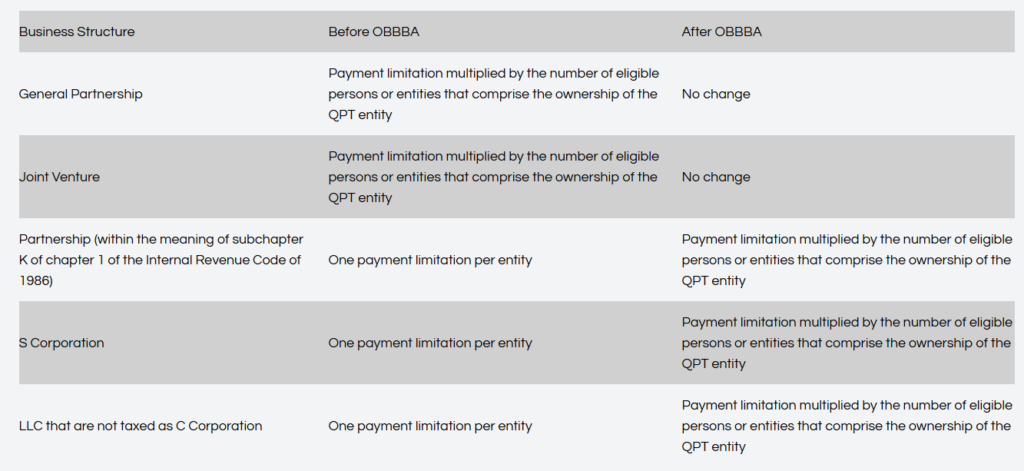
As noted in Table 1, for LLCs that elect to be taxed as C corporations, the payment limitation remains unchanged. These entities continue to be limited to one payment limitation per entity.
The new QPT entity provisions are effective for the 2026 program year. As a one-time exception, for the 2026 program year, USDA will determine an operation’s business structure based on its organization status as of September 15, 2026. Beginning with the 2027 program year, the business structure determination date will revert to the standard June 1.
Example
Consider a family farming operation owned by four siblings, all of whom meet USDA’s eligibility requirements. Table 2 summarizes the changes in payment limitations under different business structures for this family operation before and after OBBBA.
Under the 2026 payment limitation of $164,000 per eligible person for the Agriculture Risk Coverage (ARC) and Price Loss Coverage (PLC) programs, a family farm operating as a QPT LLC or S corporation may increase its maximum USDA payment eligibility from $164,000 to $656,000, while retaining the liability protection offered by these business structures. Importantly, while the changes in OBBBA make each member of this farm eligible for their own separate payment limitation, it does not guarantee a payment. Payments are still a function of losses incurred.
Table 2. Payment Limitation Changes for a Family Farming Operation with Four Siblings Before and After the One Big Beautiful Bill Act (OBBBA)
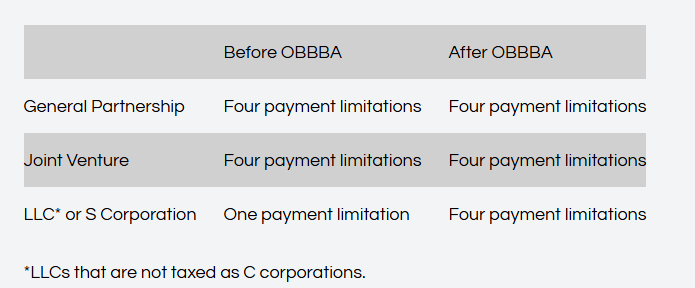
*LLCs that are not taxed as C corporations.
Why Does This Matter?
The new rules have the potential to substantially increase total USDA program payments for eligible farms organized as QPT LLCs or S corporations. USDA programs include ARC, PLC, and certain USDA disaster assistance programs.
Perhaps more importantly, producers no longer must choose between maximizing USDA program benefits and obtaining the liability protection offered by an LLC or S corporation. This new QPT entity treatment gives eligible operations greater flexibility to organize their business structures to meet liability protection, legal, tax, succession, and management objectives while maintaining eligibility for multiple payment limitations under USDA programs.
Disclaimer: This article is for educational and informational purposes only. Because every operation is unique, producers are encouraged to consult with their attorney, accountant, and crop insurance agent before making any changes.
Additional Information:
Ferrell, Shannon L., Tiffany Dowell Lashmet, and Bart L. Fischer. “Paved with Good Intentions: Unintended Impacts of Farm Bill Payment Limitations.” Southern Ag Today 4(19.4). May 9, 2024.
Federal Register. Payment Limitation and Payment Eligibility. Department of Agriculture, Commodity Credit Corporation, 7 CFR Part 1400, [Docket ID FSA-2026-0100], RIN 0560-AI86. June 2, 2026. https://www.federalregister.gov/documents/2026/06/02/2026-11002/payment-limitation-and-payment-eligibility (accessed July 23, 2026).
Kristine A. Tidgren. USDA Issues New Payment Limitation and Eligibility Rules. Center for Agricultural Law and Taxation. Iowa State University. June 4, 2026. https://www.calt.iastate.edu/post/usda-issues-new-payment-limitation-and-eligibility-rules (accessed July 23, 2026).
U.S. Department of Agriculture, Farm Service Agency. Payment Limitations. https://www.fsa.usda.gov/tools/informational/payment-eligibility/payment-limitations (accessed July 23, 2026).
Liu, Yangxuan, and Michael R Langemeier. “OBBBA Levels the Playing Field for Different Farm Business Structures for USDA Payment Limitations.” Southern Ag Today