There is lots of speculation on both sides of the border about what to expect with the resumption of cattle trade between the U.S. and Mexico. How many cattle? What type of cattle? How fast?
There are many questions about if and how much the world has changed since the border closed and whether the impacts are long-lasting or perhaps permanent. We can’t be sure, but history is probably still the best guide on what to expect.
Mexican cattle imports averaged 1.17 million head in the twenty years from 2004-2023 with a minimum of 702.6 thousand head in 2008 to a maximum of 1.47 million head in 2012. Mexican cattle imports are highly correlated to drought conditions in Mexico, with severe drought causing unsustainable spikes in cattle imports which tend to average out. A five-year moving average of Mexican cattle imports only shows about 222 thousand head variation across years.
On average, 36 percent of annual Mexican cattle imports cross from September through December. If the border was fully open, the average of 1.17 million head annually implies that roughly 421,000 head could cross by the end of the year. Based on history, it might be possible for 90-100 thousand head of cattle to cross at the Douglas port in the last four months of the year. If we suppose that Santa Teresa and Columbus, New Mexico open one month later, an additional 125-175 thousand head could be imported by the end of the year. It is unlikely that many, if any, spayed heifers will be imported initially, so the above estimates are likely too high. It will likely take several weeks for ports to return to full capacity. For the remainder of 2026, up to 250 thousand head total might be possible but 150 thousand head is probably a more reasonable estimate of Mexican cattle imports by the end of the year.
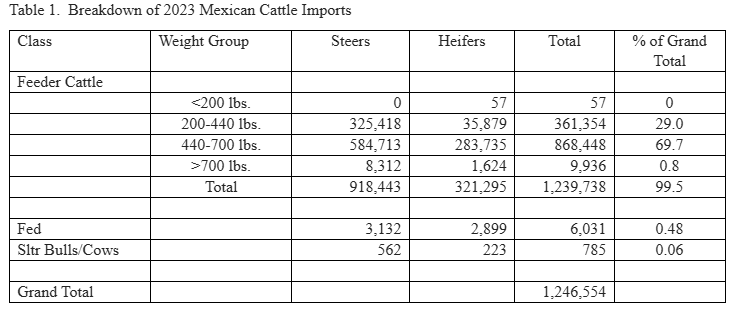
The majority of Mexican cattle imports are feeder cattle and generally lightweight. Table 1 shows the breakdown of Mexican cattle imports in 2023. Feeder cattle weighing less than 700 pounds accounted for 98.7 percent of Mexican cattle imports, including 29 percent under 440 pounds. Many of the lightweight feeders will be utilized in stocker programs before feedlot placement. Tight feeder cattle supplies in the U.S. may mean that more and lighter Mexican cattle may be placed immediately in feedlots. These cattle will be on feed for six to eight months with the first animals potentially available for slaughter by March 2027.
Dr. Peel discusses the continued decline in the U.S. cattle herd, signs that the herd may be trying to stabilize, and the cattle market’s reaction to news of a phased reopening of the Mexican border for livestock imports on SunUpTV from August 17, 2026. https://www.youtube.com/watch?v=6uPYm05EB9M