There are several traits to consider when selecting an alfalfa variety (cultivar). Choosing a variety adapted to the region’s climate and suitable for the intended use should be priorities. Winter survival and fall dormancy are key factors related to adaptability and use. They can affect stand, longevity, and forage yield. As a way to compare winter survival and fall dormancy among varieties, ratings have been given to alfalfa varieties that are eligible for seed certification. The ratings are published each year by the National Alfalfa and Forage Alliance. Winter survival and fall dormancy ratings along with pest resistance ratings can be found on the education link at www.alfalfa.org
Although fall dormancy is somewhat related to winter hardiness, it is not an accurate measure of winter hardiness. Winter hardiness and fall dormancy should be considered as separate characteristics when selecting alfalfa varieties.
Winter Survival Rating: Particularly important in the Northern Great Plains is the ability of an alfalfa plant to survive the winter without injury. Winter survival ratings for alfalfa varieties range from 1-6, with 1 being the most winter hardy and 6 being the least hardy (Table 1). The rating indicates stand longevity and potential to withstand multiple winters. For long term persistence, alfalfa varieties with lower winter survival ratings should have primary consideration in northern climates.

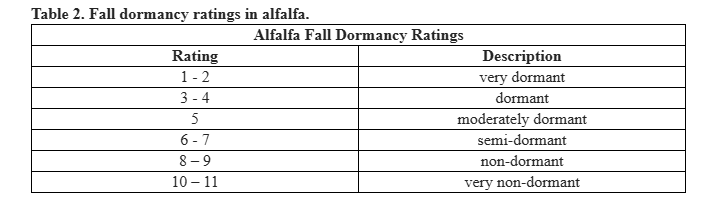
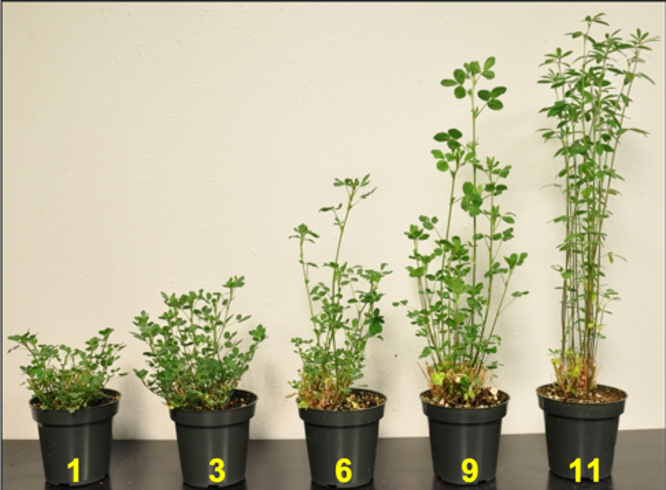
Fall Dormancy Rating: Fall dormancy is the degree of fall alfalfa growth as a response to temperature and day length. Lower dormancy ratings exhibit less fall growth. Fall dormancy ratings are indices assigned by comparing the height of fall growth with standard check varieties and tested across locations and years to accurately represent dormancy response across environments. Fall dormancy is rated on a scale of 1-11, with 1 having the least fall growth and 11 with the greatest fall growth (Table 2). Varieties with low fall dormancy ratings have slower shoot elongation and regrowth after harvest and have shorter prostrate shoots in the fall. Varieties with high dormancy ratings have erect shoot growth in the fall and quicker shoot elongation after harvest (Figure 1). They tend to start growing earlier in the spring, green up faster following cutting during the season, and grow taller in the fall. Fall dormancy ratings are a particularly good indicator of yield potential. The advantage of growing varieties with a larger number on the fall dormancy rating scale is generally higher yields.
Winter survival and fall dormancy ratings are great tool for selecting an alfalfa variety. Other things to consider include purpose of planting, management, and pest resistance.
Reference:
National Alfalfa and Forage Alliance. Alfalfa Ratings Guide, www.naaic.org