
Authors James L. Mitchell and Ryan Loy write in Southern Ag Today: With cattle prices at historical highs, few investments carry more weight for a cow-calf operation than the decision to add replacement females. A producer has several options including buying heifers or mature cows that are either bred or open, buying cow/calf pairs, or retaining and developing a heifer calf of their own. Each option comes with unique upfront costs and timing of returns. Current heifer prices have raised the stakes and financial tradeoffs of this decision, and the best strategy depends on assumptions that vary by operation and year.
Buying a bred heifer means paying today’s price to calve next spring. Raising your own means giving up what a calf could have sold for at weaning, covering a year of expenses, and waiting an extra year for her first calf. Higher heifer prices make buying more expensive but also increases the opportunity cost of holding a heifer calf back rather than selling her.
The Beef Cow and Heifer Investment Analysis tool was developed to help producers with this decision. The tool is a free online dashboard that allows producers to enter their own data, such as heifer price, annual cow costs, weaning weight, calf crop percentage, cull weight, discount rate, and cost inflation. The dashboard returns net present value (NPV), breakeven heifer price, payback period, and average annual net return, all of which update in real time (Figure 1).
Figure 1. Heifer Investment Analysis Dashboard Overview
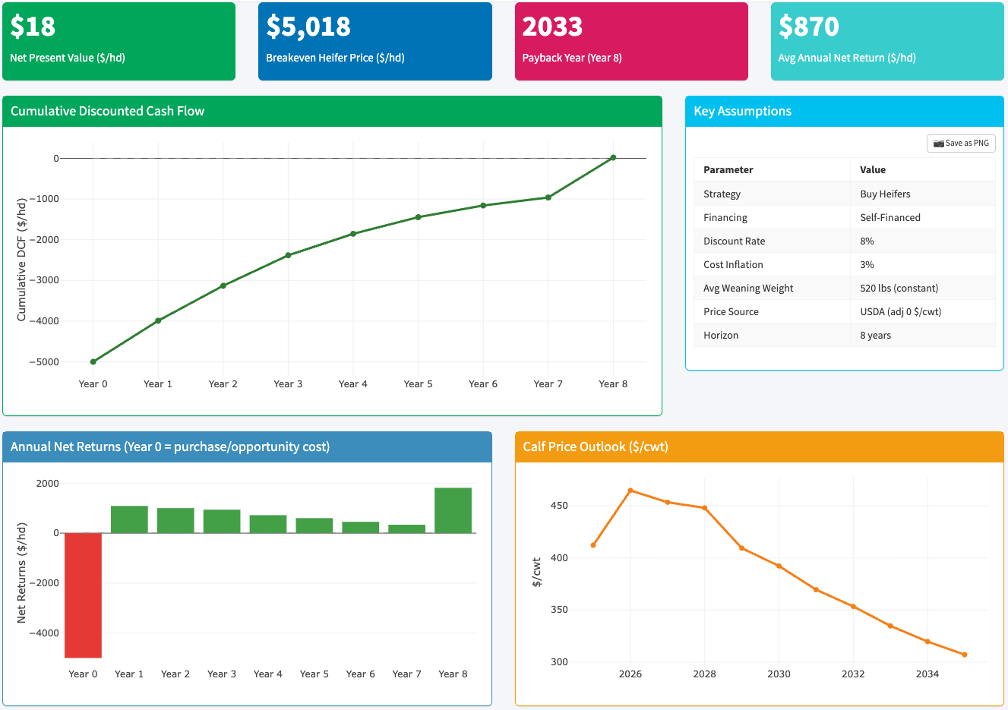
Consider the dashboard’s default assumptions: a 92% weaning rate, 520-pound weaning weight, $1,100 in annual cow costs, an 8 percent discount rate, and an 8-year productive life, with calf prices and cost inflation following the USDA calf price forecast (users can also substitute their own price and cost expectations). Under these assumptions, the tool estimates the maximum price a producer could pay for a heifer while maintaining an 8 percent return ($5,018/hd in this case), as well as the payback period to recover the investment. Changing an assumption can significantly impact the outcome, highlighting how much this decision is operation specific. For example, reducing the weaning rate to 87% (compared to the default 92%), while holding all other assumptions constant, results in a net present value of -$596/hd.
The decision to buy or raise heifers boils down to cash-flow timing and the price paid relative to what a heifer returns over her productive life. The dashboard does not determine which strategy is correct for an operation. However, it provides cattle producers and other agricultural stakeholders with a framework to evaluate the trade-offs between these strategies. The Beef Cow and Heifer Investment Analysis Tool is completely free to use and can be accessed here on any device with an internet connection.
This is part of a series of articles on the new Beef Cow and Heifer Investment Analysis Tool. In forthcoming articles, we will review other features of the tool, the user manual, and interpretation of the results the tool provides.