

Beef imports continue to be the subject of political attention that has resulted in a myriad of variable and inconsistent policies and actions. Cattle and beef markets have been buffeted by a barrage of political interference that has clouded markets and contributed to producer uncertainty and delay in responding to market signals to rebuild cattle inventories.
The latest trade data shows that beef imports continue to increase, up 18.7 percent year over year in July and up 12.9 percent for the first seven months of the year compared to one year ago. Australia remains the largest source of beef imports, up 16.1 percent thus far in 2026 and representing a 21.8 percent share of total imports. Close behind is Brazil, the number two beef import market. More on Brail below. Canada is the third largest source of beef imports, almost unchanged year over year, (up a scant 0.7 percent this year) and representing a 14.6 percent share of beef imports. Monthly beef imports were up 18.6 percent in July from number four Mexico and are up 27.8 percent for the year to date compared to last year. Mexico accounts for 12.2 percent of total beef imports. New Zealand is the fifth largest beef imports source, up 9.3 percent from last year and representing an 11.3 percent share of beef imports. Beef imports from number six Uruguay are down 2.4 percent year over year but still account for 6.3 percent of beef imports.
Several smaller import markets are in the spotlight as well. Beef imports from Argentina, resulting from an expanded tariff rate quota announced in fall of 2025, have increased 155.1 percent in the first seven months this year to a share of 4.8 percent of total beef imports. From Nicaragua, beef imports are up 36.4 percent year over year, totaling 3.7 percent of imports. Similarly, newcomer Paraguay is up 49.1 percent compared to last year and accounts for 3.6 percent of beef imports.
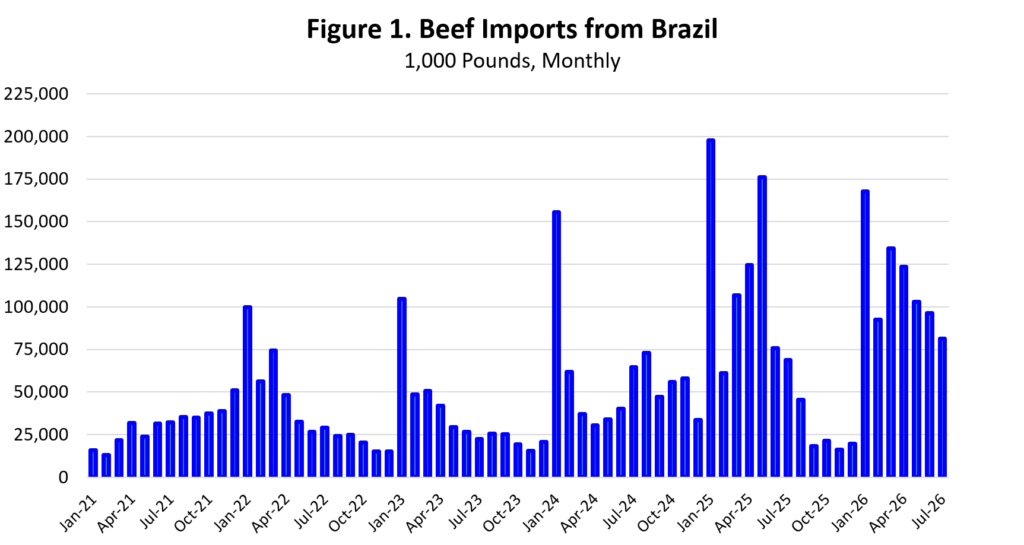
Brazil has emerged as a major source of beef imports. For 20 years from 2001- 2020, Brazil averaged 5.5 percent of total beef imports, ranging from 2.1 to 9.2 percent. Since 2021, Brazil’s share of beef imports have averaged 13.7 percent and Brazil moved into the number two position with 20.8 percent of 2026 year to date beef imports.
Brazil has experienced a roller coaster of impacts amid variable and wildly inconsistent U.S. trade policy. Figure 1 shows the dramatic range of monthly beef imports from Brazil since 2021. In general, Brazil competes for the small “Other Country” quota, which has been filled in the first few days of January in the last five years, mostly by Brazil. This accounts for the January spikes in beef imports since 2022 (Figure 1). As soon as the quota is filled each year, Brazil has been subject to a 26.4 percent over-quota tariff. However, in 2025, Brazil was subject to a flurry of arbitrary federal tariff changes that included at least five tariff levels that ranged from zero up to a maximum of 74.6 before dropping back to over-quota level of 26.4 percent. Such a quagmire of policy changes disrupts business relationships and supply chains and increases uncertainty for international and domestic producers.
Recently, a federal announcement of an additional 300,000 metric tons of quota-free beef imports appears intended to largely benefit Brazil. It’s not clear how much additional beef might be imported as a result because a significant portion of imports would have happened anyway. Most beef imports from Brazil are used in food service, primarily for ground beef, and are unlikely to have any measurable impact on ground beef prices at retail grocery.
The roller coaster continues. Despite recent federal support for increased beef imports, a new executive order last week signals the intent to revisit the perpetual and controversial issue of mandatory country of origin labeling (mCOOL). Voluntary labeling is currently available if desired. Ironically, consumers would be unlikely to benefit much because most Brazilian beef is used in food service (e.g. restaurants) and the proposed mCOOL law does not apply to beef in food service.