

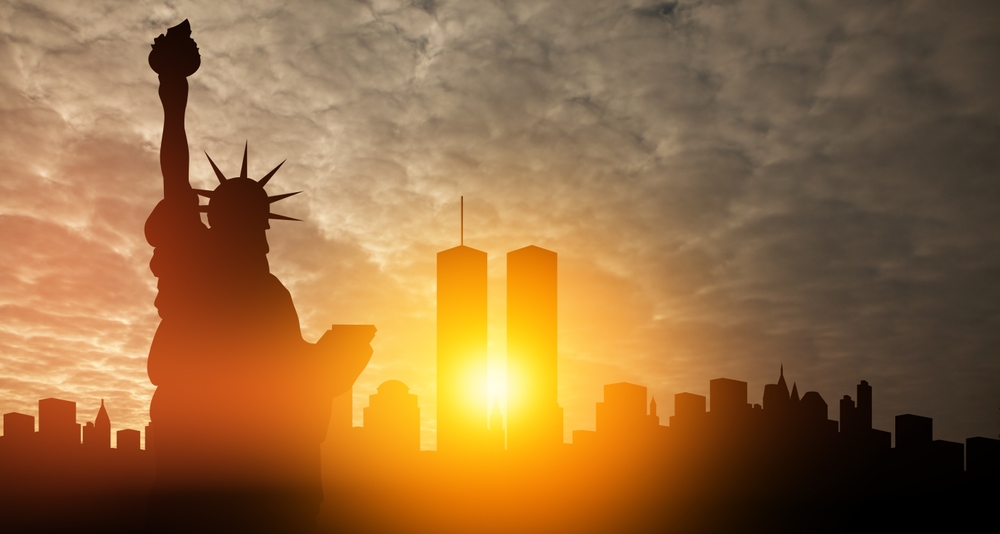
Twenty-five years ago, Americans woke up on a Tuesday morning in September expecting an ordinary day.
Across farm country, crops still needed tended. Livestock needed fed. Equipment needed repaired. Harvest was approaching in many parts of the country.
Then, at 8:46 that morning, American Airlines Flight 11 struck the North Tower of the World Trade Center.
Seventeen minutes later, a second plane struck the South Tower. A third would hit the Pentagon, and a fourth would crash into a field near Shanksville, Pennsylvania.
By the end of September 11, 2001, nearly 3,000 people had been killed, America had been attacked, and life in the United States had changed forever.
American agriculture changed, too.
When the skies went silent over farm country
For farmers and ranchers hundreds or even thousands of miles from New York City, Washington, D.C., and Pennsylvania, chores did not stop because the country was under attack.
But almost everything else did.
At 9:25 a.m., the Federal Aviation Administration stopped takeoffs of civilian aircraft nationwide. At 9:45, the FAA ordered every aircraft already in the air to land at the nearest airport as soon as practical.
More than 4,500 aircraft were in the air at the time.
By 12:15 p.m., the airspace over the contiguous United States had been cleared of commercial and private flights.
For people working outdoors across rural America, the result was something rarely experienced before or since — an almost completely silent American sky.
The shutdown was unprecedented. It was the first unplanned closure of U.S. airspace in the nation’s history.
And while the airplanes stopped, agriculture kept moving.
Cattle still had to be fed. Cows still had to be milked. Crops still had to be tended. Farmers continued doing the work they had started that morning, while radios and televisions carried news that was almost impossible to comprehend.
The immediate impact on agriculture
The attacks also created immediate economic disruptions for U.S. agriculture.
Commodity futures trading was halted. Shipments of perishable agricultural products moving by air were delayed. Trucks carrying agricultural goods encountered delays along the borders with Canada and Mexico.
Those direct economic losses ultimately proved temporary.
But agriculture is heavily dependent on transportation, international trade and global markets, and September 11 demonstrated how quickly a national crisis could reach all the way back to the farm gate.
The attacks — followed weeks later by anthrax letters sent through the U.S. mail — also raised another question that would have a much longer-lasting impact on agriculture:
What if America’s food and agricultural system itself became a target?
Agriculture becomes a national security concern
The possibility of agroterrorism was not invented after September 11, but the attacks brought a new urgency to the threat.
Congressional researchers warned that America’s farms and food system could be vulnerable to deliberate biological attacks.
Unlike an attack on a building or military installation, an attack on agriculture might begin almost unnoticed.
A highly contagious foreign animal disease could be deliberately introduced into livestock. A plant disease could be introduced into crops. Food could potentially be contaminated somewhere along a vast production and distribution chain.
The goal would not necessarily be to kill animals or destroy crops. The larger target could be the American economy and public confidence.
A major livestock disease outbreak, for example, could halt exports, disrupt domestic markets, require the destruction of large numbers of animals and cost the agricultural economy billions of dollars.
The anthrax attacks in October 2001 intensified those concerns. A Congressional Research Service review later concluded that while the immediate economic effects of September 11 on agriculture were largely temporary, the anthrax attacks had a much greater impact on the realization that U.S. farms and the food supply could be vulnerable to bioterrorism.
That realization began changing the way the federal government approached agricultural security.
Protecting the food supply becomes homeland security
In the years following September 11, federal attention and spending on agricultural homeland security increased substantially.
The government expanded efforts involving animal and plant disease surveillance, border inspections, laboratory capacity, emergency response and coordination among federal, state and local agencies.
Then, in January 2004, President George W. Bush issued Homeland Security Presidential Directive 9 — formally titled the “Defense of United States Agriculture and Food.”
For the first time, a presidential directive established a national policy specifically aimed at defending America’s agriculture and food system against terrorist attacks, major disasters and other emergencies.
The directive described American agriculture as extensive, open, interconnected and complex — characteristics that make the system enormously productive, but that can also create vulnerabilities.
It called for stronger surveillance of animal, plant and wildlife diseases; improved laboratory networks; vulnerability assessments of agriculture and food infrastructure; stronger inspection of agricultural products entering the country; and coordinated plans for responding to an attack or major disease outbreak.
In other words, protecting America’s farms, ranches and food supply was officially recognized as part of protecting America itself.
One of the first Americans killed that morning was also a farmer
There is another connection between September 11 and agriculture that is far more personal.
The captain of the first plane to strike the World Trade Center was a farmer.
Captain John Ogonowski was at the controls of American Airlines Flight 11 when terrorists hijacked the Boston-to-Los Angeles flight and crashed it into the North Tower.
When Ogonowski wasn’t wearing his American Airlines uniform, however, he was often wearing work clothes on his 150-acre White Gate Farm in Dracut, Massachusetts.
He raised hay, corn, pumpkins, blueberries and peaches.
And he did something else with that land.
Ogonowski helped Cambodian refugees and immigrants who had been farmers in their home country return to agriculture in the United States.
He made portions of his land available to them and served as a mentor, helping new farmers establish crops and learn how to farm in New England.
His reason was personal.
Ogonowski came from an immigrant farming family himself. His family had come to America from Poland and built a life through agriculture. When he was approached about helping Cambodian immigrants who wanted to farm again, he saw an opportunity to extend the same kind of chance his own family had once received.
Just weeks before September 11, the public radio program “Living on Earth” interviewed Ogonowski at his farm about the project.
The interview was supposed to be part of a story about immigrant farmers.
Instead, after September 11, it became a remembrance of the farmer and airline captain who had been killed aboard Flight 11.
The agricultural program continued after his death, becoming part of Ogonowski’s legacy.
Twenty-five years later
A quarter-century has passed since September 11.
Agriculture faces threats today that would have sounded very different to producers in 2001.
Foreign animal diseases remain a concern. Cybersecurity has become increasingly important. International conflict can disrupt fertilizer, fuel, grain and livestock markets. Disease outbreaks can shut down export markets almost overnight. Protecting the nation’s food supply remains part of America’s homeland security mission.
But perhaps one of the enduring agricultural lessons of September 11 is how interconnected this country really is.
An attack in lower Manhattan could stop airplanes above wheat fields a thousand miles away.
It could interrupt trucks carrying agricultural products across international borders.
It could close commodity markets.
And it could cause the United States to look differently at the farms, ranches, livestock, crops and food systems Americans depend upon every single day.
September 11 reminded the country that agriculture is more than an industry.
It is part of America’s critical infrastructure. It is part of the nation’s economy. And ultimately, the ability to produce and protect our own food supply is part of national security.
On September 11, 2001, while much of America stopped and watched history unfold, farmers and ranchers did what they have always done.
They fed livestock.
They tended crops.
They kept working.
And for a few unforgettable days, they did it beneath an American sky that had gone almost completely silent.







