U.S. corn growers are the most productive and efficient in the world. On average, they produce roughly twice as much corn per acre as their counterparts in Brazil, while using fewer inputs. Productivity reflects how much corn is produced. Efficiency reflects how effectively inputs are converted into output. Both are the result of decades of investment in genetics, agronomy, soil health, and farmer expertise.
From an economic perspective, producing more output with fewer inputs should create a durable competitive advantage. However, this has not proven to be true in recent years. In a commodity market, global competitiveness is shaped not only by how much corn a farmer can grow, but also by what it costs to grow it. Increasingly, higher input costs are undermining some of the advantages U.S. growers have earned through superior productivity and efficiency.
Looking Beyond Cost per Acre and Cost per Bushel
Cost per acre and cost per bushel are the most common ways to compare farm input costs across countries. Both are useful, but neither fully separates two distinct factors: how much input is used and what that input costs.
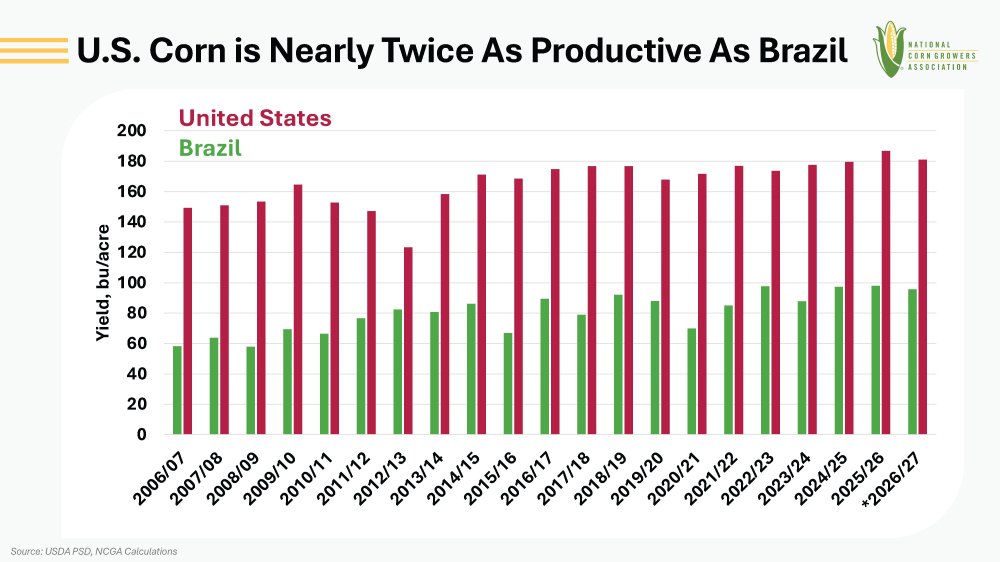
U.S. growers produce roughly twice as much corn per acre as Brazilian growers, averaging about 180 bushels per acre compared to 90 bushels per acre, while using fewer inputs. Yet that advantage is not always evident in conventional cost metrics. As a result, cost-per-acre and cost-per-bushel comparisons can suggest similar outcomes even when production systems, productivity levels, and input-use efficiency differ substantially.
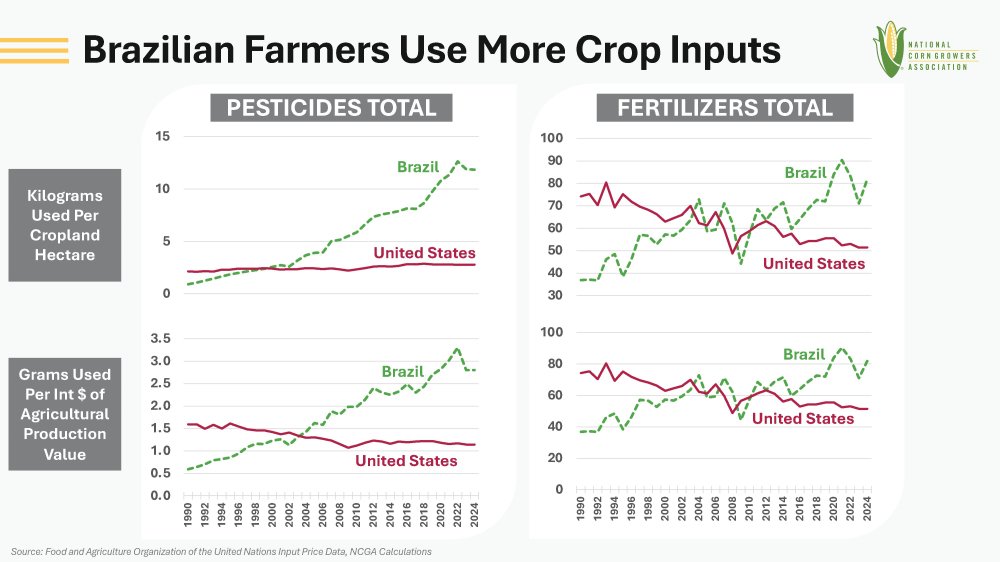
Brazilian growers typically use more inputs per unit of cropland, applying more fertilizer and pesticides than U.S. growers. The Food and Agriculture Organization of the United Nations (FAO) tracks use of these products and confirms this pattern. In 2024, Brazilian farmers applied 11.85 kilograms of pesticides per cropland hectare, compared to 2.78 kilograms in the United States. Many Brazilian farmers plant and harvest two crops per season due to climate conditions, which partially explains the significant difference in pesticides applied annually. However, even when pesticide and fertilizer use is considered across both the corn and soybean phases of a typical rotation, American farmers still use less per hectare.
Measured relative to agricultural production value, Brazilian farmers used 2.80 grams of pesticides per international dollar of output, compared with 1.14 grams in the United States. FAO data also shows substantially higher fertilizer use in Brazil, both on a cropland-area and production-value basis. These differences aren’t limited to a single year. Since the early 1990s, U.S. agriculture has generally reduced pesticide and fertilizer use relative to cropland area and agricultural production value, while Brazil has moved in the opposite direction on both measures.
Those additional treatments reflect real agronomic differences between the two markets, including different soil types, year-round pest pressure, warmer growing conditions, and the absence of a hard winter freeze. At the same time, many of those inputs are available at lower per-unit prices in Brazil than in the United States, making additional applications more economically viable and reducing the cost implications of Brazil’s more input-intensive production system.
What Does Examining Per-Unit Prices Reveal?
Corn is primarily sold as a commodity with market-driven prices. The economic benefit of greater productivity and efficiency should come through a lower cost of production per bushel and stronger margins. When higher input prices erode those savings, productivity and efficiency do not translate into stronger returns as expected.
For that reason, a recent NCGA study intentionally examined the prices paid for individual inputs. Looking at per-unit prices can help separate input pricing from agronomic requirements and provide a clearer view of whether growers in competing markets are paying different prices for comparable products.
The results showed that U.S. growers frequently pay more per unit than Brazilian growers for major seed and crop protection inputs. Across 2023-2025, prices paid by U.S. growers for corn seed averaged 68% higher than those paid by Brazilian growers, while corn insecticide prices averaged 87% higher. Similar patterns were observed in fungicides and herbicides, reinforcing the conclusion that input pricing differences are large enough to influence farm-level profitability and long-term global competitiveness.
Why Input Prices Differ Across Markets
Several factors may help explain why growers often pay different prices for similar inputs in competing countries, including trade policy, regulatory costs, supply chain structures, and pricing decisions made by input suppliers. The costs and length of time required to bring a new product to market in the U.S. are well documented. The regulatory burden in the U.S. is greater than that of many other markets, including Brazil. NCGA is not advocating for weaker safety or regulatory standards. However, the size and persistence of the price gaps suggest that regulatory costs and other systemic factors may not fully explain what U.S. farmers are paying.
The productivity advantage of U.S. agriculture creates substantial economic returns, but when pricing reflects not only the cost of producing and delivering inputs, but also the benefits those inputs generate, a portion of the returns from superior farm productivity can be captured elsewhere in the value chain. In a highly productive U.S. market, that dynamic can allow suppliers to capture more of the value created on the farm, limiting how much of the value created through superior productivity ultimately translates into stronger farm margins and competitiveness.
Implications for Competitiveness
NCGA’s ongoing research into U.S. and Brazilian corn input costs is built around a more fundamental question: not simply which market spends more per acre, but who pays higher prices for comparable inputs and why. That distinction matters because agronomic conditions such as weather, pest pressure, and growing season length can influence how much input is used, but they do not fully explain differences in the prices paid for those inputs. NCGA’s analysis indicates U.S. growers pay more on average for major seed and crop protection products than their Brazilian counterparts.
The findings suggest that the central issue for U.S. corn growers is whether the economic benefits generated by decades of investment and innovation are being fully realized at the farm level. These investments have created substantial productivity and efficiency advantages that should generate stronger economic returns. When higher input prices absorb a portion of the value created through superior productivity, those gains don’t translate as fully into farm margins and global competitiveness. Productivity and efficiency remain among the greatest strengths of U.S. corn growers. Ensuring that those advantages translate into stronger returns for growers may be just as important as maintaining the advantages themselves.