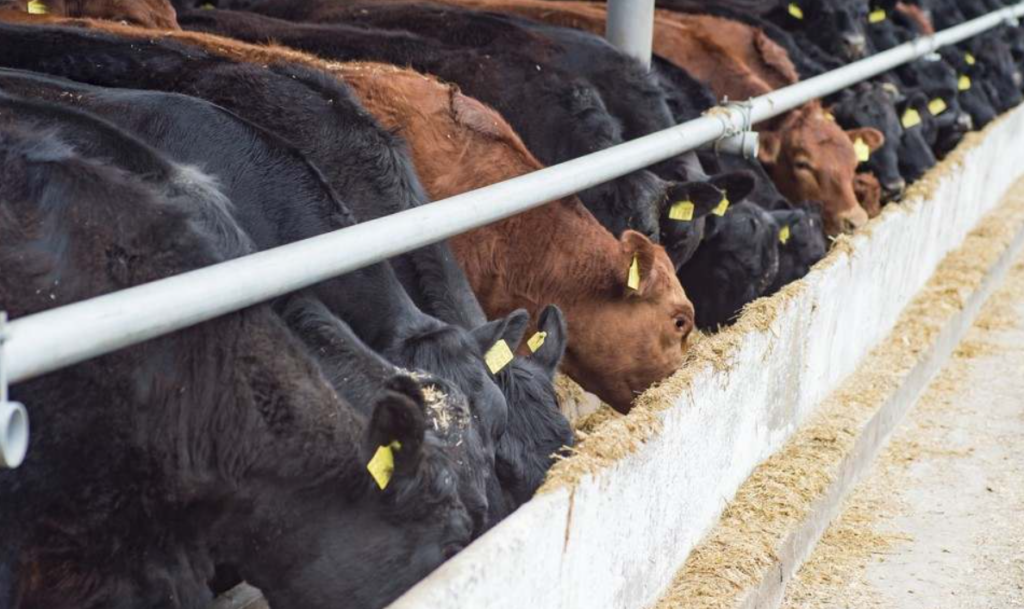
The latest USDA Cattle on Feed shows the September feedlot inventory at 11.163 million head, up 0.7 percent from one year ago. Monthly on-feed totals have been above year earlier levels the past five months. Placements in August were down 9.2 percent year over year and August marketings were down 3.3 percent. Average feedlot placements and marketings have declined sharply in recent months and are now at record low levels in available cattle on feed data (Figure 1).
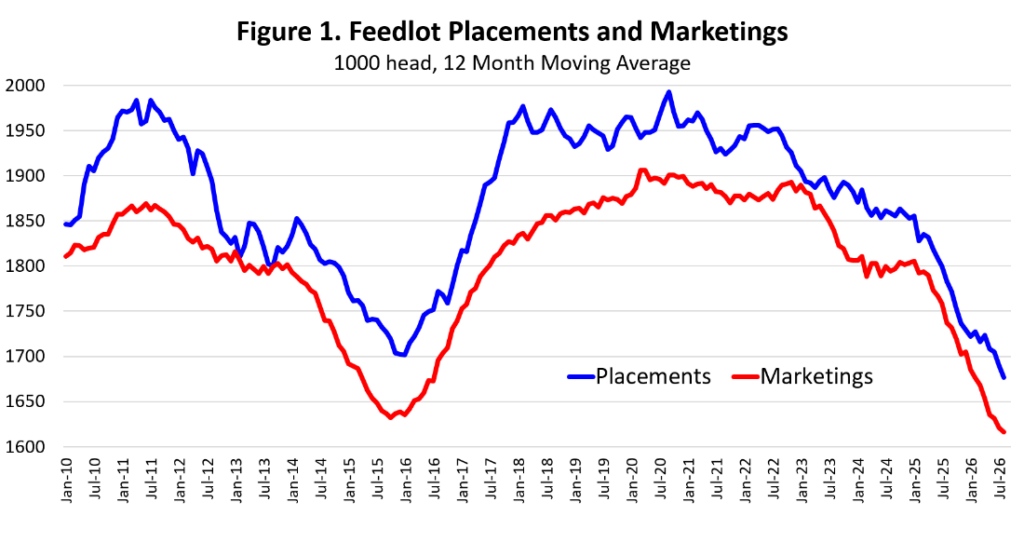
Through the current cattle cycle, the calf crop peaked in 2018 at 36.29 million head and has declined for eight consecutive years, with the 2026 calf crop estimated at 32.5 million head, down 3.79 million head from the cyclical peak. The decreases in average placements and marketings in Figure 1 are generally consistent with the declining calf crop.
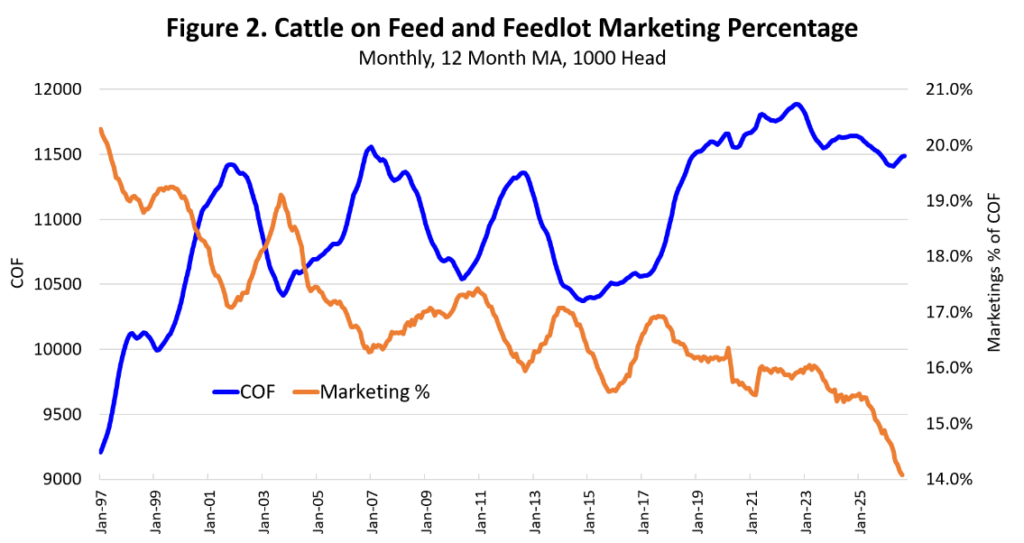
However, cattle on feed inventories have remained relatively high in recent years (Figure 2). Average feedlot inventories peaked in September 2022 and declined to a recent low of 11.4 million head in April 2026, down just 4.0 percent or 480 thousand head. Feedlot inventories have remained elevated due to a slow marketings rate. The feedlot marketings rate – the percentage of inventory marketed each month – was at 16.0 percent in July 2023, having averaged 16.0 percent since 2018. The average marketings rate began declining and dropped below 15.0 percent in October 2025. Currently, the twelve-month average marketing rate in August 2026 is a record low 14.1 percent (Figure 2). The low marketing rate has even allowed on-feed totals to be higher year over year for the last five months. The sharp decrease in placements in July and August likely means that feedlot inventories will drop below year earlier levels soon and for the foreseeable future.
Several consequences have emerged resulting from the ever-lower feedlot marketing rate. The low marketing rate is accomplished mostly by extending days on feed. This has led to a dramatic increase in carcass weight since 2023. For example, steer carcass weights increased 23 pounds in 2024, 24 pounds in 2025 and are up 32 pounds thus far in 2026. From 1960-2022 the average annual increase in steer carcass weights was 4.0 pounds/year. Though there have been individual years of significant increase in carcass weight, there have never been multiple years of much heavier carcasses. The roughly 75-pound increase in steer carcass weights in the last three years is equivalent to the increase over the previous 18 years. The dramatic increase in carcass weights has also resulted in sharply decreased average yield grades. Recent data shows that the average Y4/5 percentage for the past twelve months is 29.2 percent, more than double the rate just six years ago. The increased incidence of bovine congestive heart failure has emerged as a major feedlot health issue and is very likely related to extremely heavy fed cattle weights.
Going forward, it will be increasingly difficult to maintain feedlot inventories. Feeder supplies are expected to tighten into 2027 with a smaller calf crop. Resumption of Mexican cattle imports may relieve some of the pressure, at least regionally. Delayed beef cow culling the past three years means that more replacement heifers will be needed just to stabilize the cow herd with additional heifers needed for any potential herd rebuilding. The feedlot marketing rate may stay low but is unlikely to keep dropping as it has in the past 18 months. In that case, lower placements will push feedlot inventories lower in the coming months.
Derrell Peel, OSU Extension livestock marketing specialist, talks about how beef demand is holding steady going into fall on SunUpTV from September 12, 2026. https://www.youtube.com/watch?v=D1nprnMk_Dk