For Oklahoma hunters, landowners and wildlife managers, managing the public resource of wildlife game begins with a deceptively simple question:
What is the size of an animal’s population in the landscape?
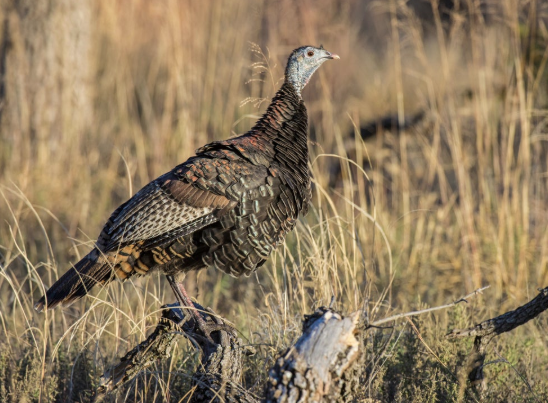
An Oklahoma State University research team is working with the Oklahoma Department of Wildlife Conservation to answer that question in Roger Mills County, home to the Black Kettle Wildlife Management Area and a popular destination for turkey hunters from Oklahoma and other states. The four-year study launched in December 2025 in response to concerns about population declines and a lack of information on winter flocks and spring harvest.
Using GPS locations, camera images and recorded calls, researchers are studying whether the local population is stable, how turkeys move between public and private land, where they roost and how harvest affects the population over time.
“We know a lot about wild turkey ecology,” said Colter Chitwood, an associate professor in the OSU Department of Natural Resource Ecology and Management and the project’s lead principal investigator. “The one thing we don’t do well is knowing how many are out there.”
To help close that gap, the team captured and banded 171 wild turkeys during the first capture season, fitting 90 of them with small GPS transmitters that sit on the birds like backpacks. The devices show where the turkeys travel and sleep. Trail cameras photograph birds at fixed locations, while autonomous recording units listen for turkey calls. Together, the three sources help researchers estimate the local turkey population and understand how the birds use the landscape.
How OSU researchers are tracking wild turkey populations
The project combines Chitwood’s field research on game species with the work of Anna Moeller, research assistant professor of wildlife ecology, who estimates wildlife numbers and population changes.
Doctoral student Mitchell Nagel and master’s student Lydia Laughlin are studying the wild turkey population, harvest rates and how the turkeys use the landscape. They also handle communication with landowners, monitor alerts from GPS transmitters and service the cameras and audio equipment as needed. The project also depends on field technicians, ODWC biologists, public land managers and dozens of private landowners.
By early June, the team had processed more than 1.6 million images from trail cameras and recorded more than 75,000 hours of audio. The team completed its first field season in June, and researchers will capture birds again this winter. They will collect camera and audio data for two more years.
How the research could improve wild turkey management
Chitwood said early results are not enough to support management changes.
“Only five turkeys were harvested on private land in the spring, and it’s too early to know what that might mean,” Nagel said.
The full four years of data will allow the team to connect winter flock size, movement, roosting behavior and harvest. ODWC could use the findings to guide habitat and harvest decisions on public land, while private landowners could use the same information to improve turkey habitat on their property.
The findings could also help other states managing wild turkeys in similar landscapes. The team will continue to gather the data needed to understand the population and to support the long-term management of wild turkeys as a public resource.
“The results are going to inform how Oklahoma manages turkeys for the future,” Chitwood said. “We want the ODWC to have the best data possible to make those decisions.”
Kurt Kuklinski, wildlife diversity and research supervisor for the ODWC, said the agency greatly values its research partnership with OSU.
“OSU research faculty repeatedly deliver applicable results from research grants, which inform the critical fish and wildlife management and regulations implemented by the ODWC,” Kuklinski said. “The beneficiaries of this conservation partnership are the hunters, anglers and citizens of Oklahoma, who enjoy their personal relationship with our state’s diverse wildlife resources.”
This material is based upon a four-year project supported by the Oklahoma Department of Wildlife Conservation under award number F25AF00906 for $1 million.
OSU Ag Research is Oklahoma’s premier research and technology development agency in agriculture, natural resources and the life sciences.