


Authors Mariah Beverly, Kimberly L. Morgan, and Elizabeth Canales write in Southern Ag Today: As artificial intelligence (AI) technology becomes cheaper and more prevalent in everyday life, it is only a matter of time before the banking industry implements some type of AI to streamline workflows, if they have not already. AI technology is hailed as being faster, more efficient, and more accurate than your average human worker, and there are certainly cases where AI is welcomed and necessary. However, the implications of using AI for automatic underwriting and credit scoring should be carefully considered before being fully implemented.
The problem with using AI in underwriting is rooted in the fact that AI models are trained on historical data to predict an operation’s repayment capacity. Because the quality and representativeness of the data used could influence lending decisions, this can create significant problems for portions of the farming population, particularly when operational context is lacking from the data used or when little historical data are available.
Beginning farmers and ranchers, for example, can have little to no historic data for their own operations. Similarly, specialty crop producers, urban producers, or agritourism-reliant farms might have historical data for their operation, but AI models can lack sufficient training on the context of these types of operations due to little publicly available data for these segments of the agriculture industry to make comparisons. This matters, because typical financial metrics can vary greatly across size, scale, and scope of farm operations.
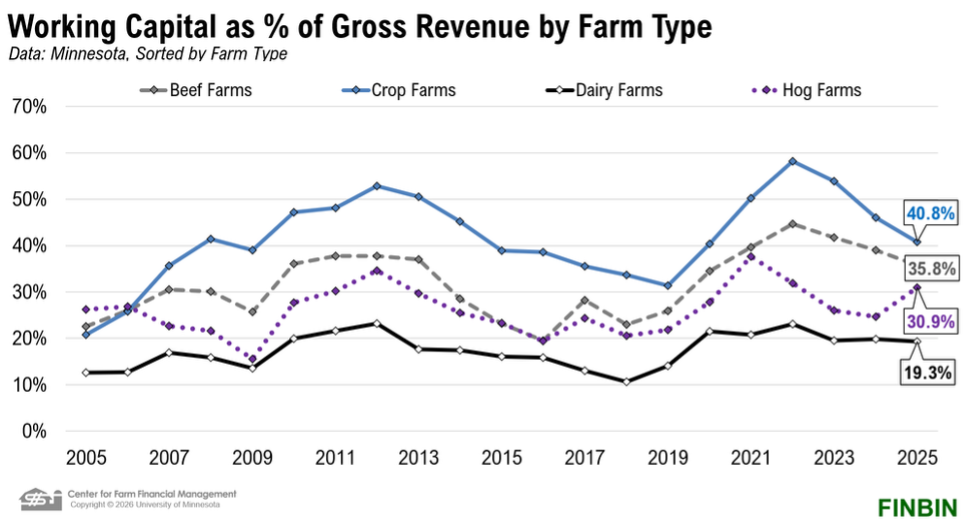
This lack of homogeneous data availability is of particular concern in southern states, which have a significant number of scale-dependent specialty crop operations as well as diverse grower demographics. Because these producers may be underrepresented in traditional credit data, important nuances could be lacking from the underwriting process, potentially reducing access to credit for producers in the region, particularly where inequalities in credit access have existed historically. For example, data from the FINBIN database shows that over the last 20 years, Minnesota dairy farms consistently held the least working capital as a percentage of gross revenue compared to other farm types. This can be expected due to dairy farms receiving monthly milk checks and the fact that most assets held by dairy farms are intermediate or long-term assets. But unless an AI underwriting model is trained using this type of historic data and provided context about the industries, it could unfairly penalize a dairy farm for having lower working capital as a percentage of gross revenue when comparing to other farm types or all farm types averaged together.
AI underwriting models can also unfairly penalize farms when they lack personal context. Consider a farm that had to temporarily scale back the operation because the main operator needed major health treatments, or crop farmers facing their third or fourth consecutive year of losses because of low commodity prices. The farms’ historic data could reflect poorer performance than usual and cutting off capital access for the farms in these temporary downturns could be disastrous. While AI can help identify patterns, it takes a relationship with a lender to understand the full story, not only of the operation but also of the local market conditions surrounding it and evaluate how these conditions realistically impact a credit decision.
Agricultural lending has always been an art as much as it is a science. Numbers gathered from tax returns and income statements only tell part of the story. The introduction of AI in underwriting can make telling that story easier and more efficient for loan underwriters. However, AI cannot replace the relational aspect of lending that can provide context and insight where numbers cannot do justice in giving the whole picture of the farm and its financial situation. It is important that policymakers take these considerations into account and recognize that AI may be most valuable as a decision support tool that assist human judgment rather than as an autonomous decision maker in credit underwriting in the agricultural sector. In conclusion, AI tools can be helpful, but the lending officer should be the one to fill in the context AI lacks to make the final decision on loan approval.
Beverly, Mariah, Kimberly L. Morgan, and Elizabeth Canales. “The Role of Artificial Intelligence (AI) in Agricultural Credit Underwriting and Scoring.” Southern Ag Today