

In OSU Crop Marketing specialist Todd Hubbs weekly newsletter he says Grain prices continued to fall last week as the bearish fundamental picture put in place by USDA’s recent series of reports settled into the market. Geopolitical events remain key market drivers as Black Sea and Iran conflicts continue to rumble on. Price weakness over the near term appears probable.
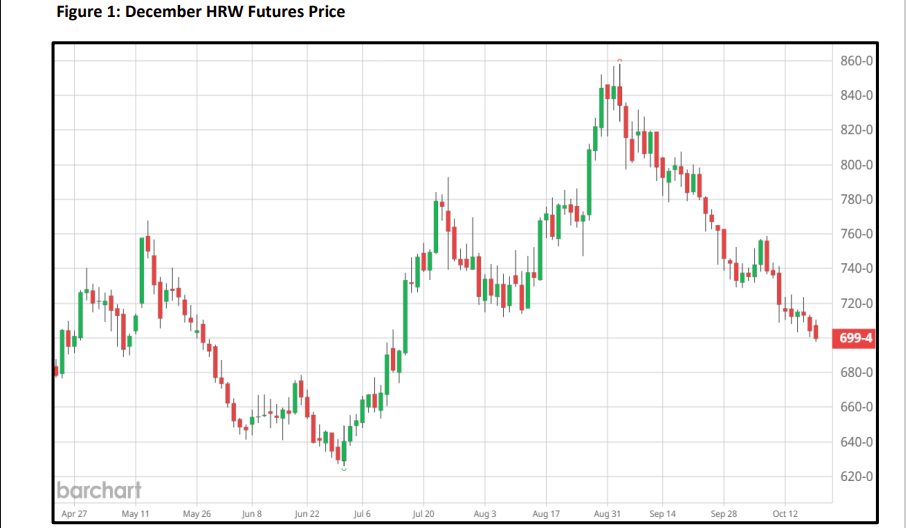
Wheat Market Outlook: December HRW future prices moved another four cents lower on Monday to close at $6.99 per bushel. As shown in Figure 1, nearby futures dropped to levels not seen since mid-July and broke through the previous range set in late July and early August. Since October 6, nearby futures have lost over 55 cents and appear to be falling into the range last seen in early summer. Through the major price drop basis in Oklahoma remained stable. At ranges between -55 to -70 across the state on cash delivery, the small crop has helped to stabilize basis. Prices stopping the fall are contingent on exports and competitor markets.
HRW exports sales picked up over the last two weeks to meet the pace necessary for USDA’s recently lowered forecast of 175 million bushels for the 2026-27 marketing year. Total commitments sit at 83 million bushels, down from 222 million bushels at this time last year. New sales need to equal 2.8 million bushels. Over the last month, HRW net sales averaged 2.5 million bushels per week. U.S. Gulf HRW export prices fell 0.63 cents per bushel over the last month to come in at $8.64 on October 16. Despite the drop in price, Gulf HRW prices remain well above competitors’ port prices. However, the difference decreased by approximately 65 cents with major Southern Hemisphere competitors over the last month, but HRW Gulf prices remain on average 50 cents above those origination points. HRW exports maintain buying from Mexico, South Korea, Taiwan, and Japan. Barring another geopolitical shock, expect exports to stay tame at these price levels.
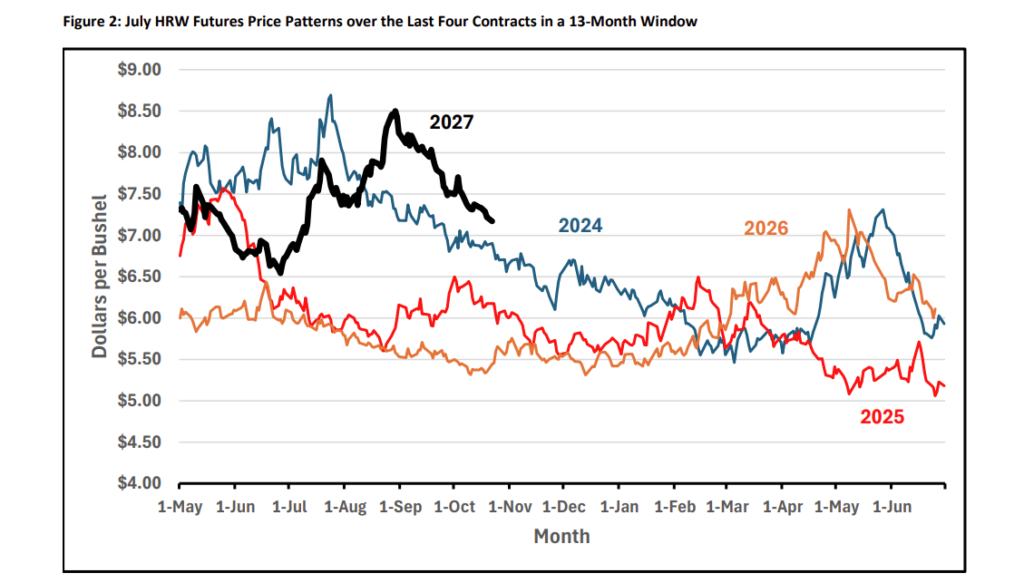
Next year’s crop remains behind planting pace for this point in the year. USDA placed winter wheat planting at 63 percent for the week ending October 18. Oklahoma and Kansas sit below the five-year average. At 37 percent planted, Oklahoma trails the average by 22 percent. Despite delayed planting, July HRW prices continue to fall. As shown in Figure 2, the peak for the harvest price contract occurred in late August and early September, which coincided with the projected crop insurance price of $8.11. Seasonal patterns for a 13-month window, which begin in the May of the year prior to contract expirations, tend to see peaks for a harvest contract early in the May-June period of the previous year. Due to the conflict in the Black Sea region and a particularly poor HRW crop, the peak occurred later in the year. The prospect of El Nino climate conditions promises plentiful rain this winter across HRW growing regions along with positive crop prospects in the Southern Hemisphere put potential rallies as limited possibilities at present. Lows could approach $6.75 per bushel as prices follow seasonal patterns without an outside shock.
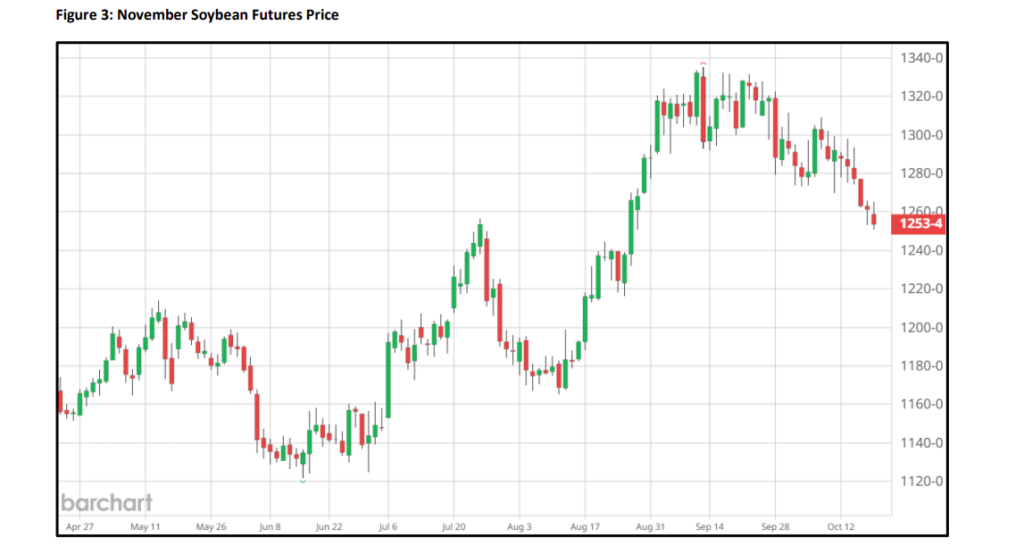
Soybean Market Outlook: The November soybean future price closed on Monday at $12.53 per bushel, dropping a little over seven cents from the open. The harvest price is approaching levels not seen since late August. USDA’s yield projection of 53.1 bushels along with consternation about crush and Chinese buying hang over the market. Cash prices in Oklahoma varied between $11.69 – $12.09.
Soybean harvest caught up on the five-year average pace over the last week. Presently, harvested acres sit at 64 percent, one percent behind the average. Kansas, Nebraska, and Iowa remain the laggards among major producing states. The excess moisture in those areas that led to delayed harvest make USDA’s next crop production report particularly interesting since reports of mold and sprout issues have been reported. Currently, any expectation of USDA lowering the yield should be treated with caution.
Soybean crush in September appears lower than expected this year. NOPA reported crush for the month at 196.1 million bushels. NOPA’s level implies a USDA crush level near 200 million bushels, down approximately 5 million bushels from last September. Lower crush looks related to slow harvest in the western Corn Belt. Despite the disappointing number, an expectation of strong crush remains in place for this marketing year to satisfy soybean oil and meal demand.
In the NOPA report, soybean oil stocks were placed at 1.506 billion pounds, the lowest level for NOPA since November of 2014. The low oil stocks imply continued strong usage for biofuels in September. Barring a change in policy, an expectation of strong fats and oils usage for biofuels stays in place for the remainder of this year and into 2027. If soybean oil prices stay in the mid-sixty cent per pound range, soybean oil usage will stay robust.
In conjunction with strong soybean oil demand, expectations of strong soybean meal demand at levels put forth by USDA in old and new crop balance sheets stay in place. Early in the soybean meal marketing year, which started on October 1, export sales data indicate total commitments at 27 percent of the projected forecast from USDA. While six percent below the five-year average, U.S. meal remains competitive on world markets and with expanded crush should witness strong exports during the 2026-27 marketing year.
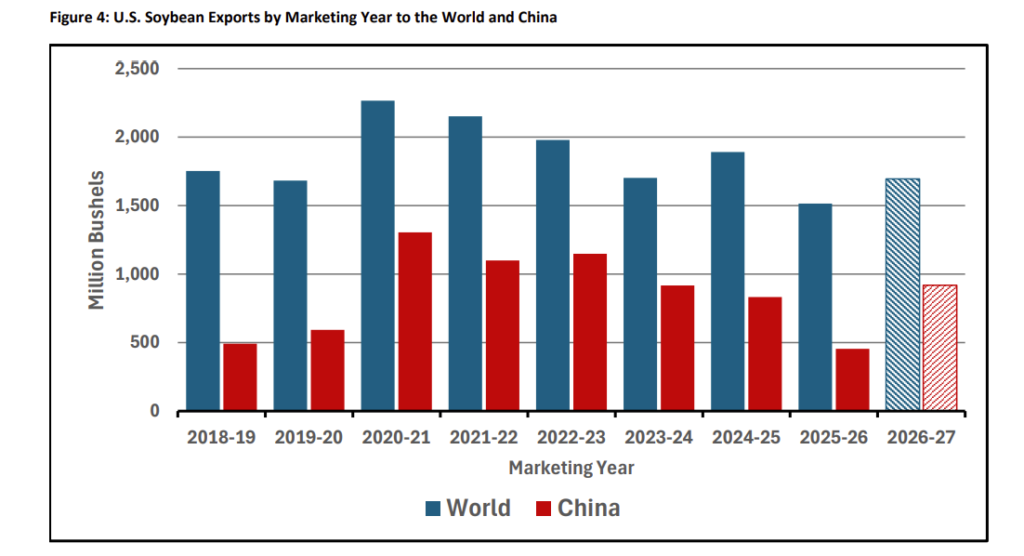
Soybean exports continue to focus on Chinese buying. As seen in Figure 4, the 2025-26 marketing year closed out with exports at 1.515 billion bushels of exports. Chinese exports encompassed 454 million bushels of the total. Export sales data places total commitments through October 8 at 855 million bushels with China on the book for 414 million bushels. Total commitments sit at 51 percent of the projected total, seven percent above the five-year average. China is halfway to the 925-million-bushel (25 million metric tons) level agreed to by Trump and Xi during previous trade discussions. As seen in Figure 4, 925 million bushels is nothing out of the ordinary for China buying. One should not expect buying from China above the agreed upon level given the geopolitical circumstances and Brazilian crop expectations.