

As we discussed last week, only about 60% of cull beef cows are marketed in the Utility grades (Boning or Breaking Utility) with 20 to 25% in the USDA Cutter and 5 to 15% in the Canner grade. Feeding thin cows to higher BCS before marketing can make a large difference in their value. Beef cutout research (Apple and others 1999 https://doi.org/10.2527/1999.77102610x) indicated that cows in BCS 3 were 33% Boning or Breaking Utility grade while cows in BCS 6 and 7 were 73 and 100% Boning or Breaking Utility. So, body condition of cows at market has a large impact on their value. I calculated the value of cull cows using current cull cow prices, expected weight changes between BCS, and expected changes in cull cow grades. Feeding to add weight and condition of a thin cow from a BCS 3 to 7 can increase her value by over $450.
Research at Texas Tech University (DeClerck et al., 2020) showed that thin cull cows (BCS of 2) can be fed mixed diets in feedlot pens to gain weight and body condition. At the end of the 45-day feeding period cows in a high roughage diet (25% cotton burrs) consumed 32 pounds (DM basis) and gained 5.8 pounds/day requiring 5.5 pounds of feed DM per pound of gain. Cows in the low roughage diet (10% cotton burrs) consumed 30 pounds per day, gained 6.4 pounds per day and required 4.5 pounds of feed per pound of gain. These thin cows gained 3 body-condition scores over the 45 days but consumed large amounts of feed to do it.
Cows do not have to be fed in dry lot to gain weight and body condition, supplementation programs can be fed to cull cows as well. Recent research shows that grazing cull cows supplemented with 0.5% of body weight (4.7 lbs of supplement/day) on pasture gained 126 pounds over 84 days (1.5 pounds/day) while feeding 1% of body weight (9.5 lbs of supplement/day) increased gains to 193 pounds (2.3 pounds per day).
Adding value to thin cull cows can be profitable, but increased sale value is not the same as increased profit. Feed expenses, available forage, cow health, labor, interest, and market risk must all be considered before retaining cows for feeding.
Here are some scenarios for adding condition and weight to cull cows over 60-days starting at a BCS 4:
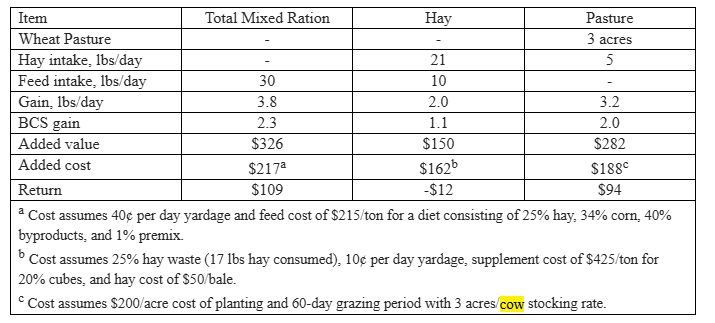
Daily feeding a total mixed diet can be very efficient and cost effective, but requires excellent management, dedicated feeding equipment and facilities that many producers do not have available. Feeding hay and a supplement is easier to manage but does not add as much gain as other feeding programs and may not be cost effective, especially when hay stocks are limited during droughts. Recent rains have boosted the growth of wheat pasture and high prices of calves has made a cow grazing program economically competitive with our normal stocker grazing programs on wheat pasture. Cows can gain rapidly on wheat pasture but require higher stocking rates that growing calves to provide adequate pasture.
Adding value to thin cull cows can be profitable, but increased sale value is not the same as increased profit. Feed expense, available forage, cow health, labor, interest, and market risk must all be considered before retaining cows for feeding.







