

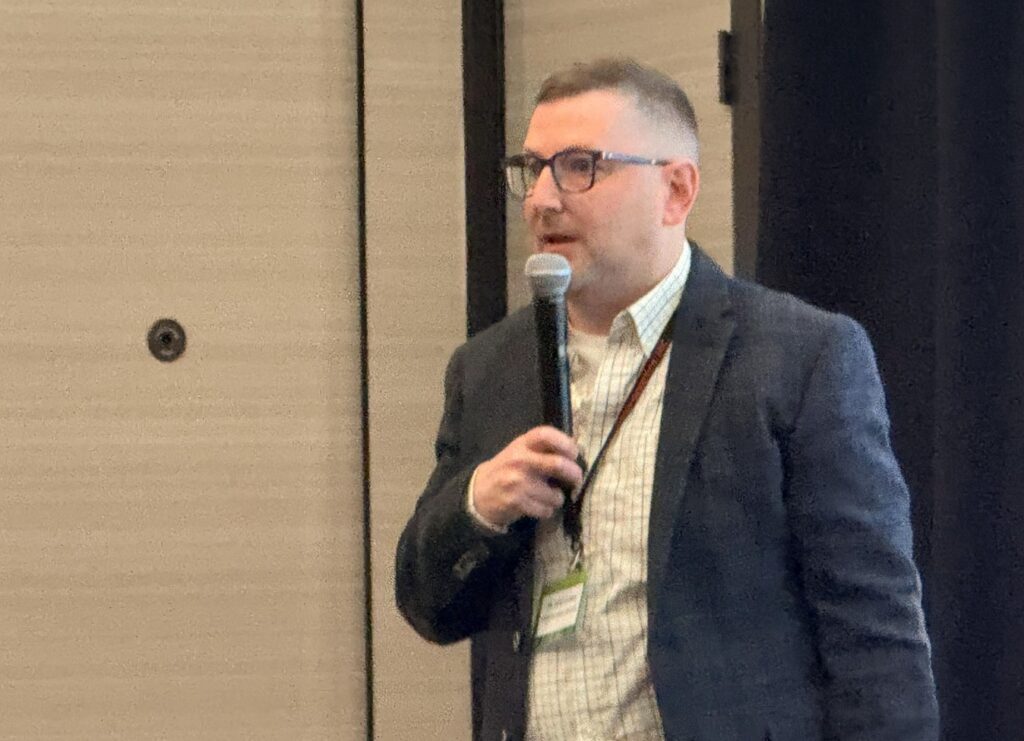
Following recent widespread rainfall across the Southern Plains, Oklahoma State University crop marketing specialist Dr. Todd Hubbs joined Farm Director KC Sheperd to deliver a detailed Todd Hubbs crop market update covering planting progress, harvest projections, and shifting commodity prices.
While the moisture brought much-needed relief to parched fields, the intensity of the deluge created uneven planting conditions across the region.
“I think there’s going to be some replant, for sure, in Oklahoma,” Hubbs said. “That was a heavy rain after nothing for what felt like forever. I think folks are going to plant what they planned on planting. We really won’t know or have a good idea until the winter wheat seedings report in January, but I think the planters are rolling. There has been some replant, which stinks—I hate that for people that have to do it—but we needed the rain. I’d like to see some more rain, not in deluge form, you know, an inch or two a week for a couple of months would be nice, but from what I’ve seen and talking to a few people around the state, I think it’s going in.”
Despite the challenging start to the season, Hubbs noted he does not anticipate major shifts in overall winter wheat acreage across the Southern Plains.
“I haven’t moved them; I think it’s going to be relatively stable,” Hubbs explained. “A lot of my thinking about it is linked to policy, and you’ve got to plant stuff to get the policy money coming through. And there’s just a tendency—farmers want to plant, they want to grow a crop, and they do it year over year. So, I’m not expecting a big loss of acreage in the Southern Plains despite the horrible conditions we’ve had. You might see a little bit more milo acres in northern Texas in places, maybe a little bit more cotton down in southwest Oklahoma and some of those areas, but I don’t expect to see huge moves in winter wheat acres.”
Turning to the price outlook, Hubbs described current grain markets as under significant pressure, driven in part by international developments.
“Awful,” Hubbs remarked when asked about the week’s market tone. “A lot of the Black Sea news has been pretty negative for hard red winter wheat prices. A lot of that premium has been coming out of the market. We’re seeing cash prices touching six, and in some places in Oklahoma below six, depending on where you’re selling.”
He added that the downtrend could carry contracts lower in the near term.
“The July contract for next year is down to $6.90. I think it could very easily get down to $6.75 the way things are trending,” Hubbs stated. “It’s touching on its seasonals. On the harvest contract for July ’27, we got our peak a little bit later in the year—thankfully it was during the crop insurance period—and we’ve been basically running down ever since, trying to get our export price a little bit closer to the world price. Our Gulf HRW price has dropped around a dollar over the last month as our prices have run down, and our exports have been somewhat weak.”
Hubbs cautioned that any breakthrough in trade corridors overseas could bring additional downside.
“If they do get some kind of resolution in the Black Sea, look out; it’s going to be ugly for a bit, and it’ll come down to what we do for the winter wheat crop in the Northern Hemisphere next year,” Hubbs said. “That weakness is here. I think a lot of speculators are coming out of our ag markets, particularly wheat.”
In managing market risk, Hubbs highlighted that current levels make traditional put options less enticing and emphasized the baseline protection provided by crop insurance.
“If you’re playing futures and options, work with a broker unless you’re just really, really confident in doing it,” Hubbs advised. “Options are particularly expensive because of the volatility. If we’re talking about wheat, new-crop hard red winter, you’ve got that crop insurance price at $8.11 already locked in. That’s well above where we’re seeing right now, given the hard rundown we’ve been in. So think about your marketing strategies in terms of that crop insurance number. If you did supplemental coverage, if you boosted it, if you’re 85 or 90% covered, even if you’re 75% covered, you should think about at what price would I want to sell what’s not really covered.”
Hubbs noted that entering fresh downside protection right now presents drawbacks.
“I don’t think there’s any reason, particularly in my opinion, to hedge with a put at this point since we’ve run down so far,” Hubbs said. “You could start looking at something like spreads, but right now I’m sort of just sitting here. We had that chance if you wanted to do it in late August and early September when we got above $8.00. I doubt we get back there unless there’s some kind of really major crop problem in the Black Sea next year.”
Looking at the row crop complex, Hubbs noted producers should monitor weather and planting progress in South America, particularly in Brazil.
“Monitoring how that crop in northern Brazil in particular looks as we move into December and January is going to be important to pay attention to,” Hubbs said. “We’ve got strong domestic demand for crush. China is a little over halfway to what they said they’d do—their 25 million metric tons. That’s traditionally what they do, and I think they’ll probably come through on that. It’s a huge crop—over 180 million metric tons. If they don’t come through, you could see our exports tick up and that balance sheet tighten, but that’s probably four or five months away before we get some kind of resolution on that.”
Hubbs also noted sluggish export activity for sorghum and corn, leaving cash markets in a waiting pattern.
“On milo, we’re still seeing a massive spread with corn on cash,” Hubbs observed. “We’re not moving it yet through export channels. Corn is going to sit there; I think we’re sort of flattening out down where we’re at right now, waiting to see what the USDA says the final crop number is. We’re sort of in a cash-holding place. If you want to play the carry, there’s ways to play the carry to get you out into the July contract or the March contract on stuff like corn—you can roll it forward—but those kinds of strategies are something you’d work with a marketing adviser on.”







