
The latest Cattle on Feed report pegged the feedlot inventory at 11.372 million head, fractionally below one year ago. September marketings were down 6.6 percent year over year. Feedlot placements in September were record low for the month and down 12.1 percent year over year. Marketing were about as expected but the placements were lower than pre-report estimates.
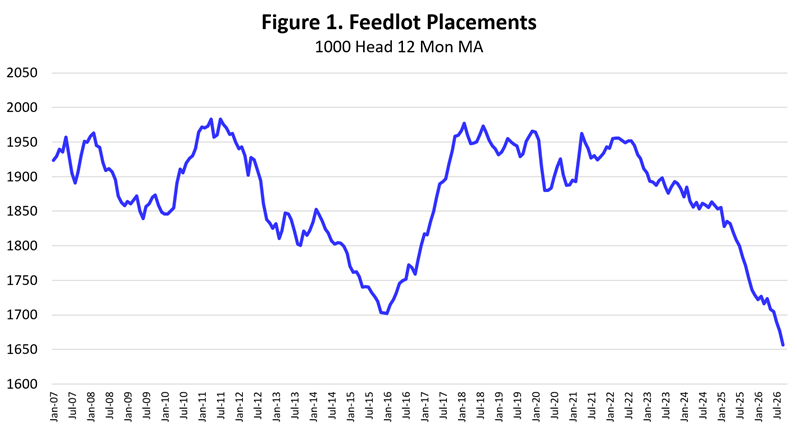
Feedlot placements have been generally decreasing since 2018 but have dropped dramatically since Jan 2025 from an annual average of 1.856 million head per month to the current average of 1.656 million head per month for the past 12 months (Figure 1). This decrease of 10.8 percent means that, on average, 200,000 head less cattle per month are being placed in feedlots. In other words, total placements were down 2.392 million head in the most recent twelve months, compared to the period from February 2024-January 2025.
Despite the sharp drop in feedlot placements, the average monthly on-feed inventory has declined just 1.26 percent between January 2025 and October 2026. This is possible because of a similar decrease in the feedlot marketings rate. From January 2025 to September 2026, the average marketings rate has decreased from 15.5 percent to a record low 14.0 percent (Figure 2). Feedlot placements are down; but once in the feedlot, cattle are staying more days and being marketed very slowly.
The slower marketings rate (monthly marketings as a percent of the monthly on-feed inventory) is the reason that carcass weights have increased so dramatically, beginning in 2024. Average steer carcass weights are up 76 pounds since 2023, with heifer carcasses up 66 pounds. Carcass weights appear to be topping out. The most recent weekly data shows an average steer carcass weight up 7 pounds compared to last year, the smallest year over year increase since February 2024.